
Giant Sunspot Growing: Now Seven Times Larger Than Earth and Threatening to Trigger Blackouts
Solar region AR 4366 is drawing significant interest and attention, as its size has grown dramatically in just three days and it has already produced 60 eruptions, including the third most powerful of the past six years.
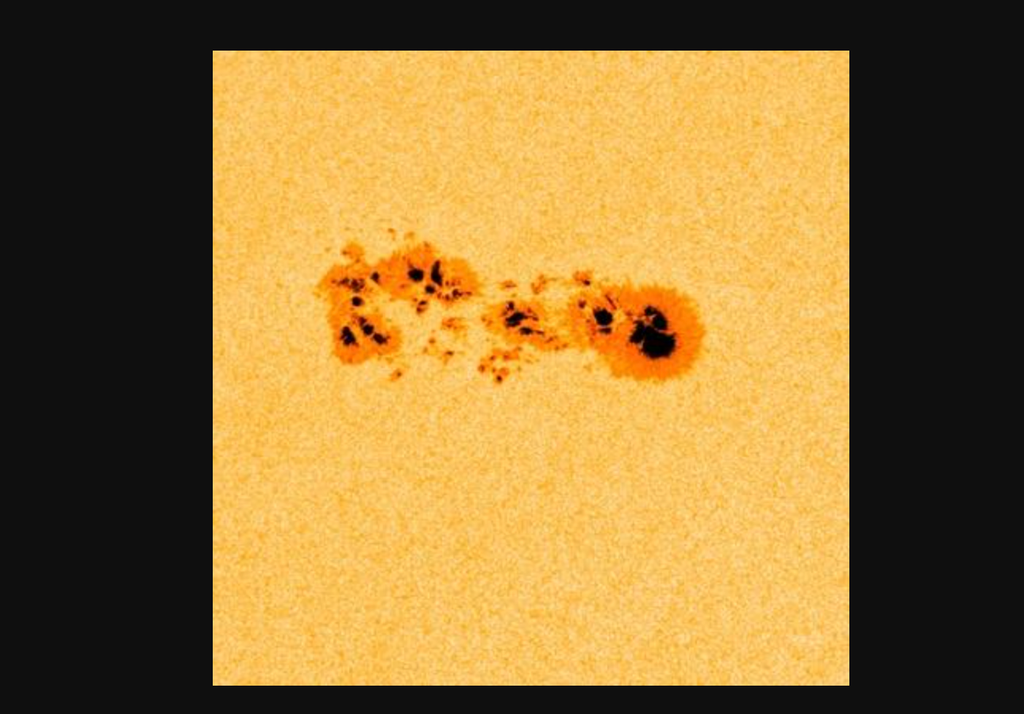
For several days now, solar astronomers have been keeping a close eye on AR 4366, an active region of the Sun that is growing at an extraordinary rate and could potentially bombard us with solar plasma. This active region is evolving very rapidly. It appeared on the surface of the Sun on January 30, made up of just four sunspots with a total area of 180 million square kilometers.
In the days that followed, the number of sunspots increased exponentially, rising to 7 on January 31, 21 on February 1, and 45 on February 2, with a total area of more than 3.5 billion square kilometers (more than seven times the total surface area of Earth).
Watching the Evolution of AR4366
The cover image, corresponding to February 2, was obtained in the visible spectrum and shows active region AR4366 as it would appear to the naked eye. Numerous sunspots (45) of different sizes can be observed, each consisting of a dark central region (the umbra) surrounded by a lighter region (the penumbra).
Five X-Flares thus far (X1.0, X8.1, X2.8, X1.6, X1.5), yet as Earth bullseye approaches in just hours AR4366 is still 100% locked and loaded with plasma and could launch a truly mind-bending solar storm straight at us. pic.twitter.com/DPthWanMEg
— Stefan Burns (@StefanBurnsGeo) February 3, 2026
The umbrae with their respective penumbrae mark the locations where intense magnetic fields generated inside the Sun have emerged at the surface. Specifically, each sunspot represents the visible footprint of a magnetic flux tube that, though invisible, rises into the atmosphere.
The same active region is shown below in an image obtained with a magnetometer, an instrument that measures magnetic field polarity. In this figure, green/blue regions represent positive magnetic fields, while yellow/red colors indicate negative polarity.
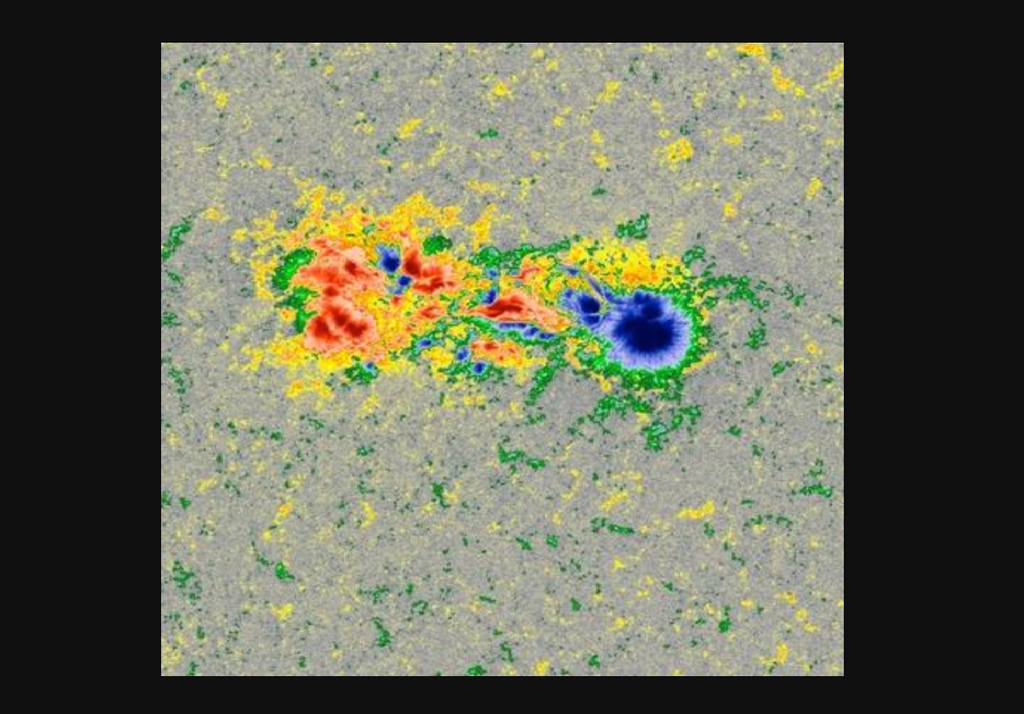
At larger scales, we observe that the two polarities are separated (+ on the right and − on the left). However, at smaller scales, we see blue spots—positive polarities—within the predominantly red (negative) region. It is precisely this configuration, in which polarities tend to mix, that generates solar flares.
It is as if an uninsulated electrical cable with positive polarity were to touch another uninsulated cable with negative polarity, creating a short circuit and, therefore, an instantaneous release of thermal energy.
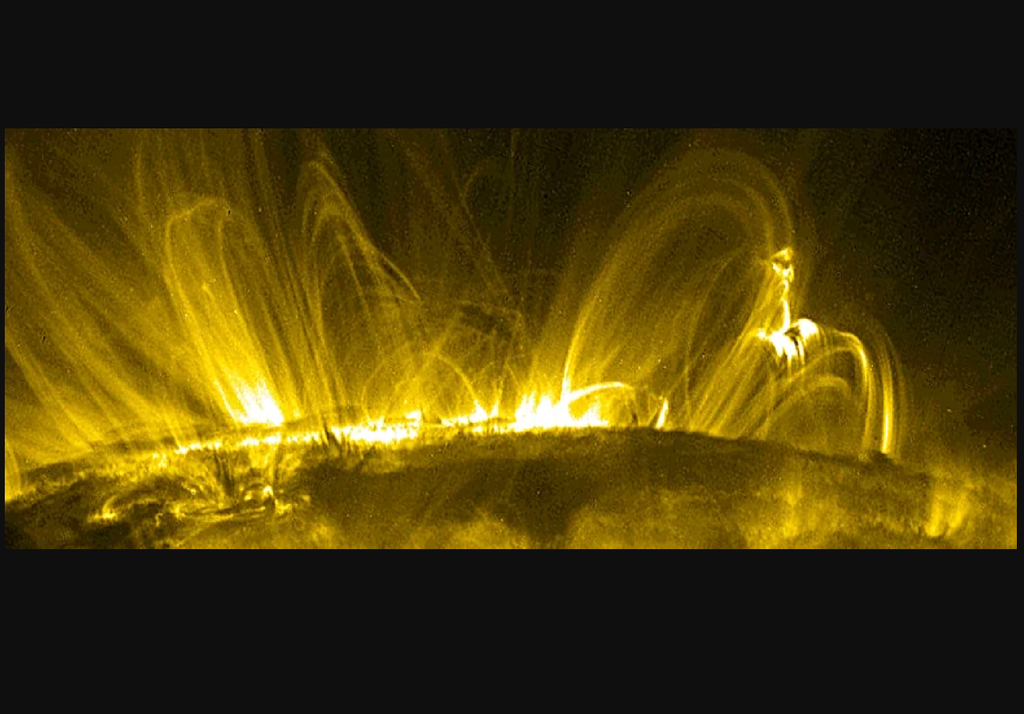
In fact, in just three days this active region produced 60 flares: 20 C-class, 36 M-class, and 4 X-class, the most energetic. On February 2, an X8.3-class flare occurred—the third most powerful of the current solar cycle.
The most energetic flares can generate coronal mass ejections, known as CMEs, consisting of extremely hot plasma that, once expelled from the solar atmosphere, travels through space at supersonic speeds.
Current Situation and Forecast
The X8.3 event generated one of these coronal mass ejections that is now reaching Earth. Today at 10 UTC, the first radio blackout was recorded, a sign that charged particles have begun interacting with Earth’s magnetic field, triggering geomagnetic storms. For now, however, both the proton flux and the Kp geomagnetic storm index remain below alert thresholds.
The active region continues to change both in total surface area and in the configuration of its magnetic fields and, importantly, it is moving toward the center of the solar disk—a position from which it is more likely to impact Earth in the event of a future coronal mass ejection.
Space-based telescopes, particularly the Solar Dynamics Orbiter, as well as ground-based observatories, continue to monitor its evolution, ready to issue alerts in the event of powerful flares in the future.