
Scientists Detect Echoes of the Big Bang From 13.8 Billion Years Ago Using Just a TV
Have you ever tuned into an empty channel on your old television and seen static? That eerie noise contains ancient photons that reveal the violent birth of our Universe.
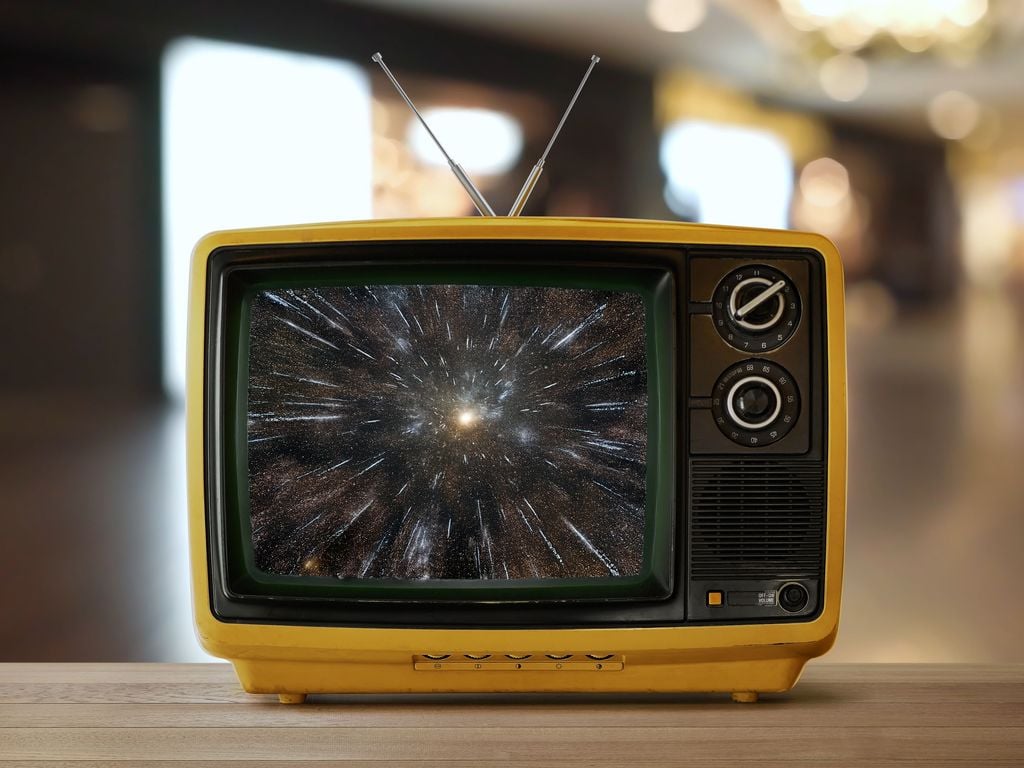
The universe was born in a very dense and hot state billions of years ago. From that “great explosion,” space began to expand and cool. Today, we can detect traces of that primordial heat in the form of invisible light that bathes the entire cosmos.
What is most fascinating is that we don’t need a giant telescope to perceive it. With a simple old television, even those with vacuum tubes, we can directly observe the energy from the beginning of all time in the static noise that appeared before tuning into our favorite program.
At the beginning, the cosmos was an opaque plasma where light was trapped. As it cooled to about three thousand degrees Kelvin, electrons formed neutral atoms. At that moment, the signals were released to travel through space and eventually reach us.
This signal is known as the Cosmic Microwave Background, or CMB, and it is essentially made up of photons that have traveled freely since the Universe was young and became transparent to radiation, making it the oldest light we can observe across the entire sky.
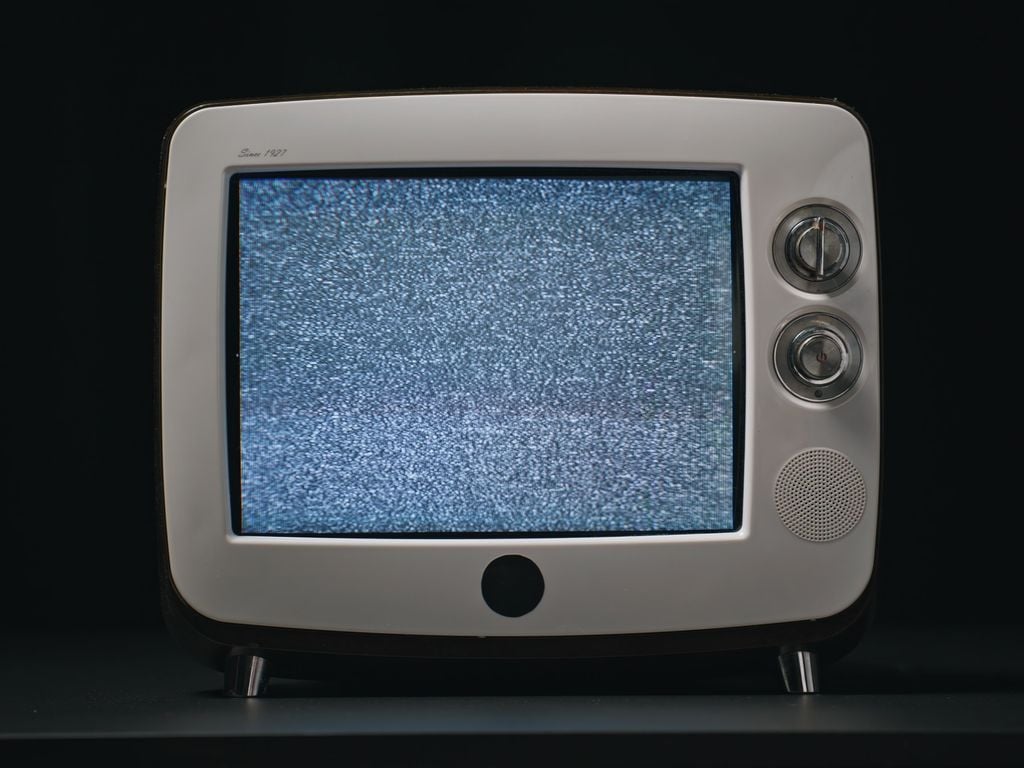
Due to cosmic expansion, that light was stretched until it became invisible, shifting from a blinding glow to very faint, cold radio waves. Today, its temperature is just about 2.7 degrees above absolute zero.
An Accidental Discovery Among Pigeons
The discovery of this cosmic noise happened entirely by accident in 1965, when Arno Penzias and Robert Wilson, two engineers at Bell Labs, were trying to eliminate noise from a radio antenna because they kept hearing a constant, persistent, and inexplicable hum.
At first, they thought the problem was pigeons nesting in the instrument. After carefully cleaning away the bird droppings, the annoying noise persisted in all directions. It did not come from the Sun or our galaxy, but from infinite space.
What they detected was the leftover heat from the primordial Big Bang, a finding that confirmed the theoretical predictions made years earlier by George Gamow. For this serendipitous discovery, Penzias and Wilson received the Nobel Prize in Physics in 1978.
Chance allowed humanity to hear the cry of universal birth. That hum, which to others was mere interference, turned out to be the definitive evidence that the Universe had a fiery and extremely violent beginning in the distant past.
The Map of Galactic Seeds
Modern missions such as COBE and WMAP have mapped this radiation with high precision, generating color maps that represent tiny temperature variations. These fluctuations are only about one part in one hundred thousand across the current and distant night sky.
On the map, blue indicates regions slightly cooler than average, while red shows warmer areas due to higher matter density. These small differences are fundamental to understanding how matter formed and how stars were born.
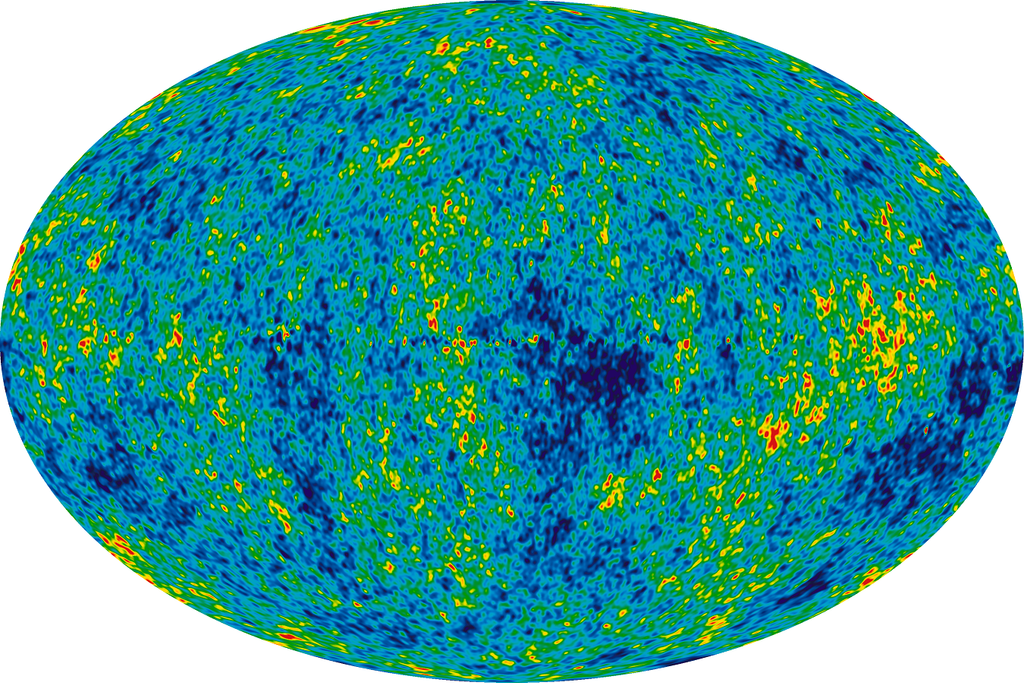
Scientists call these color patches the “seeds” of galaxies. Without these initial irregularities, gravity would not have been able to clump matter together, and the Universe today would be an empty, dull, and completely uniform place in all its vast regions.
Thanks to these tiny seeds, the first stars and large structures were born, where every point on the map tells the story of a future galaxy cluster. Putting it romantically, we could say we are looking at the architectural blueprint of the cosmos, written in ancient light.
The Invisible Hand of Darkness
However, these “seeds” alone do not explain all the growth. Baryonic matter, which makes up everything we are made of, was too scarce and dispersed, so it needed help from mysterious primordial dark matter millions of years ago.
This dark substance, which we have discussed in previous articles, does not interact with light, but it has gravity that pulled gases together, allowing galaxies to condense. Studying the cosmic microwave background map helps us understand this dominant component of our vast Universe.
Today we know that the Universe is about 13.8 billion years old, and observing the CMB is like looking directly at our own distant origin. Deciphering this ancient code written across the sky is a triumph of human intellect.
The next time you see static on a screen, remain absolutely silent. You are witnessing the final whisper of a fiery creation that occurred eons ago: the true voice of a cosmos that is still breathing and expanding, without stopping… for now.