
There is a planet that survived the death of its star, and now we know how it did it.
The giant planet WD 1856 b, which survived a dead star, offers clues about atmospheres, orbital migration, and the distant future of our Solar System and its outer planets.
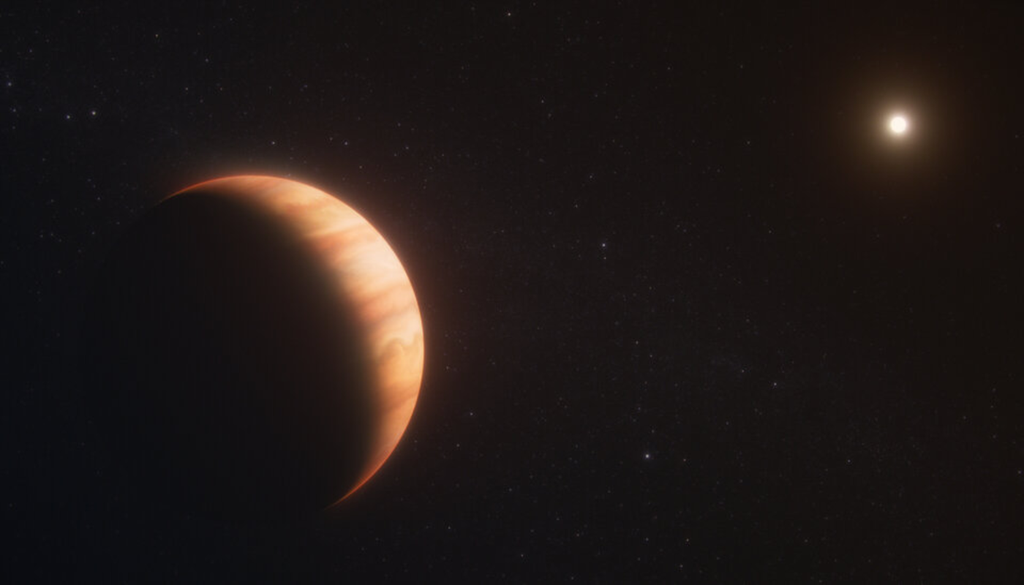
In 2020, astronomers discovered a Jupiter-sized planet orbiting a white dwarf, a stellar remnant similar to what the Sun will become in several billion years. However, WD 1856 b tells a somewhat different story from our own.
The case is unusual because around the white dwarf (WD 1856+534), located just 80 light-years from Earth, the planet is larger than the star itself, presenting a rare sight: a massive world crossing the disk of a star about the size of Earth.
Thanks to observations from the James Webb Space Telescope, scientists were able to examine the system with unprecedented precision. During its transit, when the planet passes in front of the star from our perspective, researchers measured signals related to its mass, temperature, and atmospheric composition.
The planet completes one orbit around its star every 34 hours and does so at a distance of less than 3 million kilometers from the star, less than 20 times Mercury's distance from the Sun. The remarkable part is that if it had been there during the star's red giant phase, it likely would have evaporated.
Webb steps in
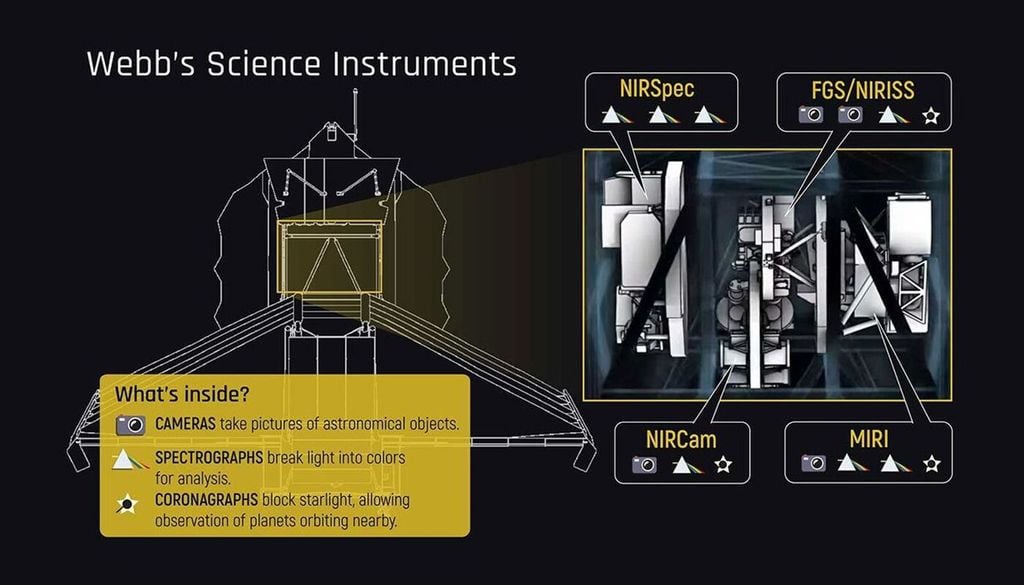
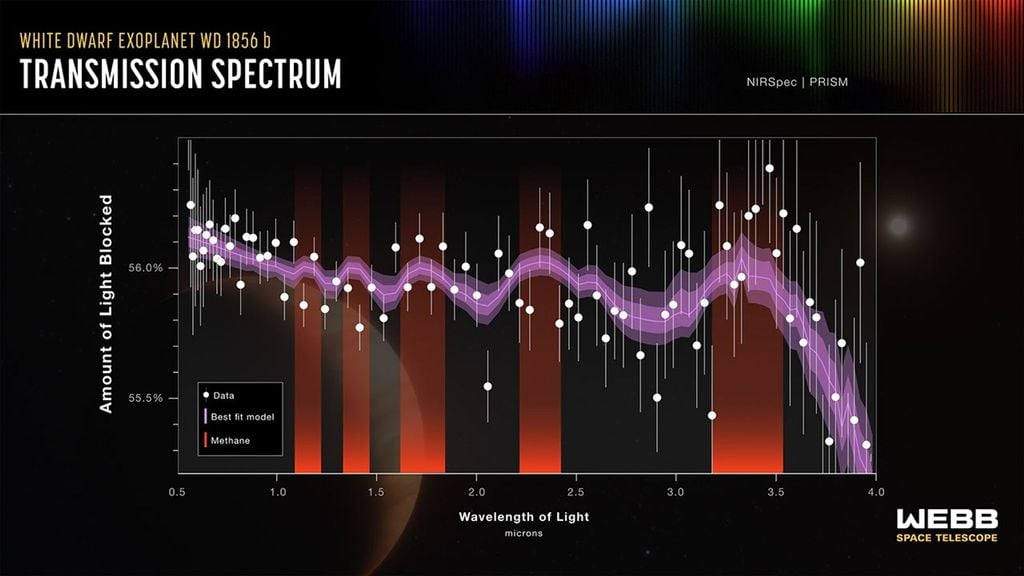
The scientific paper describes an observation using Webb's NIRSpec PRISM spectrograph, capable of separating infrared light into different wavelengths. Using this instrument, the team analyzed a spectrum between 0.5 and 5.0 micrometers during the brief transit of the planet in front of the star.
The observations indicate that the atmosphere shows signs of hydrocarbons, with methane emerging as the leading candidate, along with aerosols acting as suspended particles. Thermal emission from the planet's night side was also detected, a key signal for estimating its internal heat.
The models place the planet's mass between four and eleven times that of Jupiter and its effective temperature near 400 Kelvin, far exceeding the expected equilibrium temperature of about 160 Kelvin if it were receiving energy only from the current white dwarf.
This difference points to a complex orbital history, and the most widely accepted explanation is that the planet did not form in its current orbit. Instead, it migrated toward the white dwarf much later, heating up through gravitational interactions and tidal forces as it moved closer to the star.
Atmospheric revelations
The observations do not solve every detail, but they help clarify the picture by confirming that WD 1856 b is not merely a shadow crossing a dead star. It retains a detectable atmosphere, an unexpected temperature, and a thermal memory of its orbital migration.
The study reconstructs the likely timing of the reheating event and places it between 3.0 and 5.5 billion years after the star became a white dwarf. This timeframe favors a late migration scenario and rules out the hypothesis that the planet directly survived inside the expanding star during its red giant phase.
For exoplanet astronomy, the result opens a promising path because white dwarfs are small, and a giant planet can block a significant fraction of their light, making atmospheric measurements easier than around larger stars.
The team has already observed four additional transits, and these measurements could refine our understanding of the presence of methane, aerosols, and other still uncertain molecules, while also testing models of clouds, temperature, and deep atmospheric circulation.
Chronicle of a foretold destiny
This discovery reminds us that the death of a star does not always mark the end of its planets. Some worlds can escape the most destructive phase, change their orbits, and retain an atmosphere for billions of years afterward.
It also serves as a warning about our own Solar System. When the Sun becomes a red giant, the inner worlds will face a critical fate, while Jupiter, Saturn, and the other outer planets may follow paths that remain uncertain, but which we may already be beginning to understand.
Although we have not directly observed the Sun's future, we have observed a system that allows us to explore that question with real data. The combination of transits, infrared spectroscopy, and thermal models makes WD 1856 b a benchmark for studying planets around dead stars.
There is no doubt that with these new-generation telescopes, we have stopped looking only toward our origins and have begun to glimpse possible futures. And while we still do not have all the answers, we now know that there is always another planetary story waiting to be deciphered…