
What Is This Celestial Body With The Curious Name Makemake, And What Did The James Webb Discover About Its Surface?
The planet with the curious name Makemake could have its own atmosphere, much thinner than that of Earth. Thanks to the James Webb Telescope, we are also discovering new important information about this family of dwarf planets.
The solar system is rich in methane (CH₄), but its distribution is quite uneven. While the outer regions are rich in it, it is scarce in the inner regions, with the exception of Earth, where its presence is linked to biological activity.
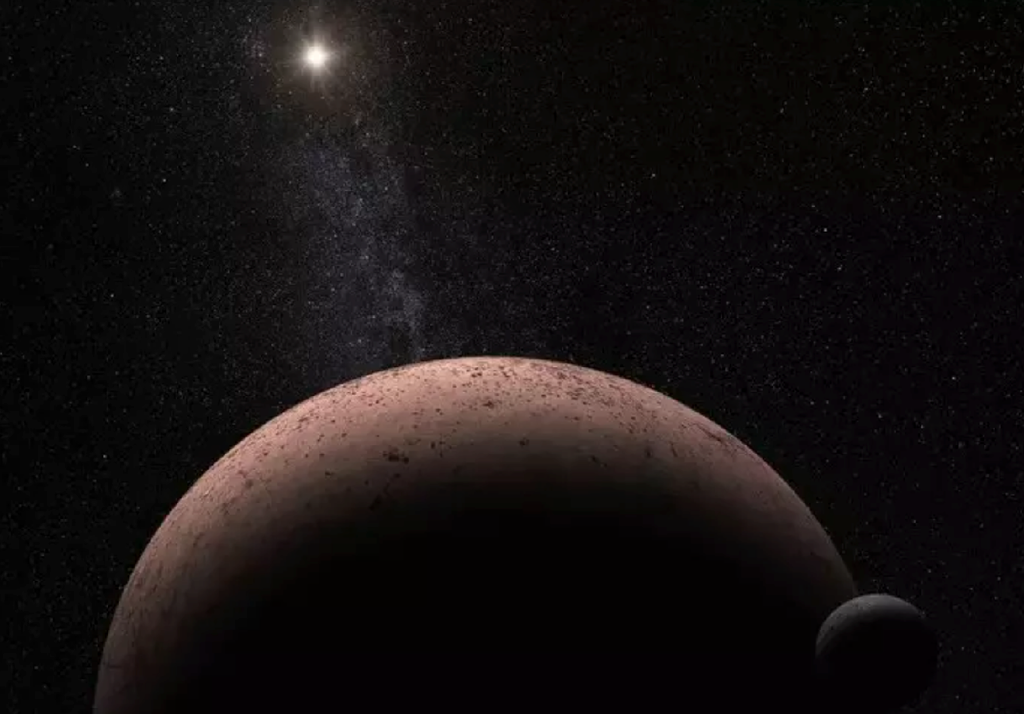
Frozen methane has been detected not only on the outer planets, but also on some dwarf planets. Among them, the dwarf planet Makemake has recently made headlines. It even seems it could have a methane atmosphere.
Makemake, a dwarf planet
The dwarf planet Makemake is the third largest dwarf planet by decreasing mass. It was discovered in 2005, a year before the other two dwarf planets, Haumea and Eris. Makemake and Eris are the only ones covered in ice. About 10 years later, a small moon was discovered.
JWST just made the exciting detection of methane gas above the surface of dwarf planet Makemake
— Black Hole (@konstructivizm) September 28, 2025
This discovery makes Makemake only the second trans-Neptunian object, after Pluto, where the presence of gas has been confirmed. The gas was identified as methane.
The Webb telescope pic.twitter.com/VsjdLR7UVA
It was already known that the planet was covered in frozen methane. However, observations from the James Webb Space Telescope have also detected the presence of methane in gaseous form.
The planet, unlike other dwarf planets, could have its own methane atmosphere. However, it would be a very thin atmosphere: its base pressure would be 100 billion times lower than Earth’s atmospheric pressure.
Another possibility is that the methane detected by James Webb was expelled from the surface in columns, similar to the water jets observed on Saturn’s moon Enceladus, and much more intense than those detected on Ceres.
The other dwarf planets in the solar system
Currently we know of five: Ceres, Pluto, Haumea, Makemake, and Eris. The International Astronomical Union defined them as dwarf planets in 2006.
They are defined as "dwarfs" if they orbit the Sun (like the other planets in the solar system), if they are massive enough to have an almost spherical shape but still have a much smaller mass than the non-dwarf planets (for example, Pluto has 25 times less mass than Mercury), if they are not satellites of other planets, and if they have not managed (due to their reduced mass) to clear their orbit of other celestial bodies, specifically asteroids.
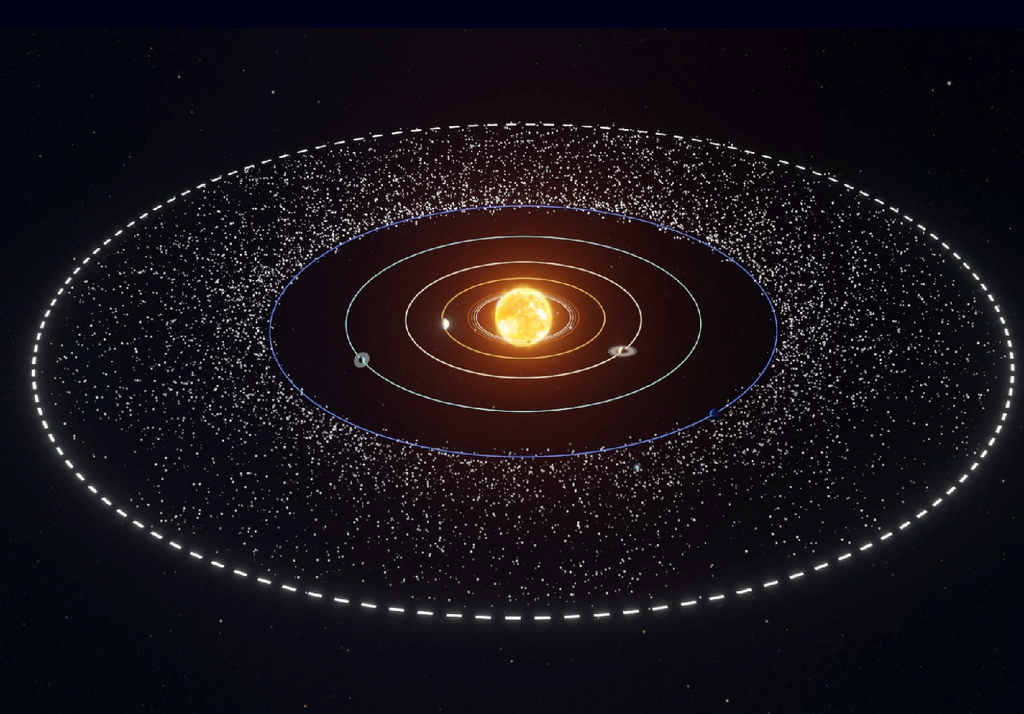
This definition led to Pluto being downgraded from planet to dwarf planet. On the other hand, while Ceres is located between the orbits of Mars and Jupiter, the other four are beyond Neptune’s orbit, inside the Kuiper Belt. Of these, Makemake and Eris are covered in ice.
The idea that Makemake might have an atmosphere is very fascinating, and would show that this dwarf planet is not a fossil remnant of the solar system, but has its own dynamics with active exchanges between its surface and its atmosphere.
To obtain more reliable data and make stronger hypotheses, it is necessary to observe Makemake again with the James Webb telescope at a higher spectral resolution.
This possibility requires the planet to be brighter and, therefore, to be observed in a position in its orbit close to the Sun (which illuminates it) and near Earth’s orbit, so that it appears more luminous.
A curiosity about its name
The dwarf planet Makemake takes its name from the divine figure Machemàche or Makemake, present in the mythology of Rapa Nui island, Easter Island. In fact, after being discovered a few days after Easter 2005, its discoverers nicknamed it "Easter Bunny."
#Makemake descubierto en marzo de 2005, es el segundo planeta enano más alejado del Sol.También es el tercer planeta enano más grande, sólo un poco más pequeño y débil que Plutón. Debe su nombre a un dios creador de la mitología de los Rapa Nui, habitantes de la Isla de Pascua. pic.twitter.com/mHt4CHWmv7
— Macarena Ilharreborde McL (@IlharrebordeM) September 26, 2025
For years, the International Astronomical Union has decided to assign names taken from myths and deities to trans-Neptunian objects, that is, objects located in the Kuiper Belt, beyond Neptune’s orbit.
News reference
"JWST Detection of Hydrocarbon Ices and Methane Gas on Makemake" Silvia Protopapa, et al. The Astrophysical Journal Letters in press https://arxiv.org/abs/2509.06772