
Spanish researchers discover a crucial link in the Atlantic for predicting El Niño events
Scientists at the Complutense University of Madrid have discovered that the Atlantic Ocean could play a decisive role in forecasting El Niño. Find out what this discovery could mean for different sectors of society around the world.
What if anticipating one of the planet’s biggest climate phenomena required looking towards another ocean? A team from the TROPA research group (Complutense University of Madrid and the Institute of Geosciences - IGEO-CSIC) has discovered that the Atlantic Ocean could play a decisive role in forecasting El Niño.
Today, forecasting systems are capable of predicting the El Niño phenomenon around one year in advance. The new study, published in the prestigious Scientific Reports and based on the ECMWF model, shows that this forecasting window could be extended thanks to the Atlantic.
El Niño’s “younger sibling”
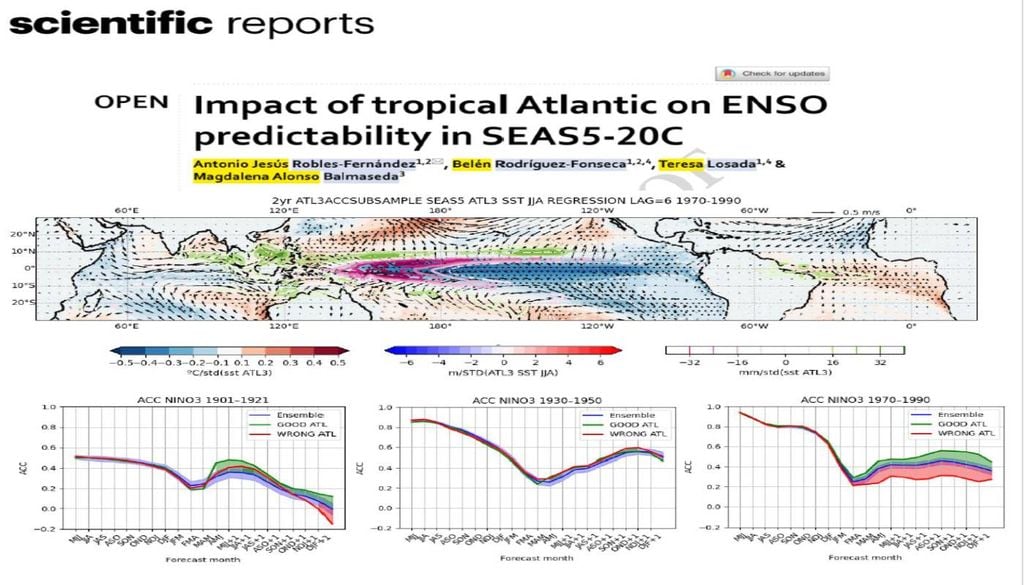
The key piece of the study is what researchers call “Atlantic El Niño”, a phenomenon similar to its Pacific counterpart, although more modest, which occurs in the equatorial Atlantic during the Northern Hemisphere summer, around six months before Pacific El Niño. The changes in winds associated with this phenomenon can alter atmospheric conditions that later influence the Pacific.From the Atlantic to the Pacific, a new forecasting window “opens”, with an eye on the future
To reach this conclusion, the team analysed data from across the 20th century and demonstrated that the coupling between the two oceans varies over time, alternating between periods of stronger and weaker interaction. This interaction was particularly more cohesive at the beginning and end of the last century, and researchers estimate that it could intensify again in the near future.
When the interaction connecting the two oceans is active, incorporating information about the Atlantic into forecasting models significantly improves the ability to anticipate Pacific El Niño. If Atlantic models become sufficiently accurate, it may be possible to overcome the current forecasting barrier of around one and a half years.
"To improve global forecasting, it is not enough to look at the Pacific; we need to make consistent progress in monitoring and researching the tropical Atlantic,” stress the members of the TROPA group, whose future aim is to continue exploring these dynamics in greater depth in order to improve seasonal forecasting on a global scale.
The study forms part of the doctoral thesis of Antonio Robles, supervised by Belén Rodríguez-Fonseca and Teresa Losada, with the participation of Magdalena Balmaseda from the European Centre for Medium-Range Weather Forecasts (ECMWF).
News reference
Robles-Fernández, A.J., Rodríguez-Fonseca, B., Losada, T. et al.. (2026). Impact of tropical Atlantic on ENSO predictability in SEAS5-20C.
UCM | IGEO-CSIC. (2026). Impacto del Atlántico tropical en la previsibilidad del ENOS en el modelo SEAS5-20C.