
Two Thousand Years Ago, a Geomagnetic Anomaly Similar to the Current South Atlantic Anomaly Had Already Occurred
An international study shows that two thousand years ago there was already a geomagnetic anomaly with a pattern similar to the current South Atlantic Anomaly.
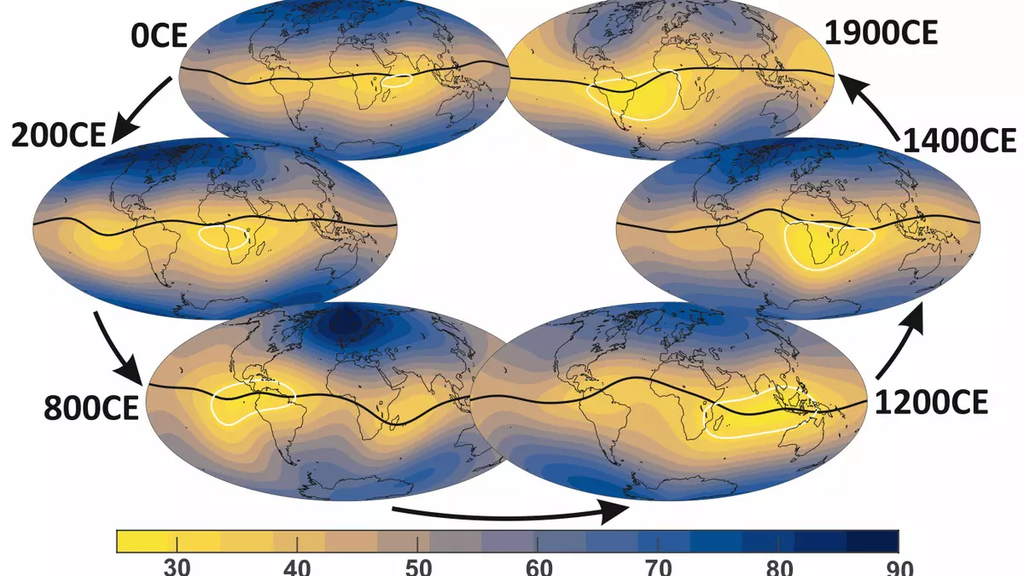
An international team led by the Institute of Geosciences (IGEO, CSIC-UCM) has demonstrated that the South Atlantic Anomaly (SAA), a vast region of weakened geomagnetic field that currently affects South America and the South Atlantic, is not an exclusively modern phenomenon.
During the first millennium CE, low-intensity anomalies already occurred following evolution patterns similar to those observed today. The study, published in the journal PNAS, reconstructs the evolution of the Earth’s magnetic field in the Southern Hemisphere over the last 2,000 years.
What is the South Atlantic Anomaly (SAA)?
The SAA is an area where the geomagnetic field is particularly weak, allowing greater penetration of cosmic radiation and posing an increasing risk to satellites, space missions and technological systems.
Although its rapid intensification in recent centuries has attracted significant scientific interest, until now it was unclear whether it was an exceptional process or a recurring manifestation of the Earth’s deep internal dynamics.
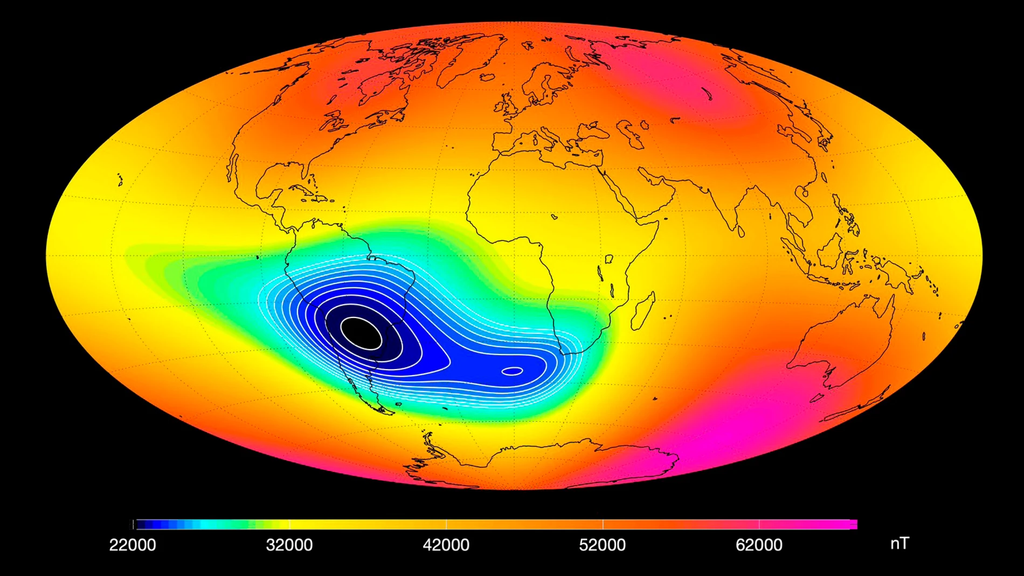
To address this question, the team obtained 41 new determinations of the absolute intensity of the geomagnetic field from archaeological materials from north-western Argentina, a region close to the current centre of the South Atlantic Anomaly.
These materials, having been heated to high temperatures in the past (for example during firing processes), recorded a magnetic signal associated with the Earth’s magnetic field existing at that time, which can be measured with great precision in archaeomagnetism laboratories.
A new global geomagnetic model
The new data were integrated with previous high-quality records and enabled the development of a new global geomagnetic model that reconstructs the evolution of the Earth’s magnetic field over the last two millennia, as well as investigating its origin by analysing the dynamics of the Earth’s outer core, where the geomagnetic field is generated.
“Our results show that weak geomagnetic field regions similar to the current South Atlantic Anomaly already existed in the past and also followed a comparable evolution,” explains Miriam Gómez-Paccard, CSIC researcher at IGEO and lead author of the study. “This indicates that the SAA is probably the most recent expression of a recurring geomagnetic process operating on millennial timescales.”
The new model developed by the team confirms that the anomaly associated with the SAA originated beneath the Indian Ocean around the year 1000, gradually moving westwards, crossing Africa and reaching the Americas before acquiring the configuration observed today. In addition, the model reveals the existence of a similar episode during the first millennium, also beginning in the Indian Ocean and following a migration path comparable to that of the modern anomaly.
“The key was substantially improving the model constraints in the Southern Hemisphere,” says F. J. Pavón-Carrasco, researcher at the Complutense University of Madrid and co-author of the work. “Until now, the scarcity of data in the Southern Hemisphere introduced major uncertainties there. By incorporating new high-quality absolute intensity records and correcting spatial biases in the dataset, the model reveals coherent and recurring patterns that could not previously be resolved.”
“These results point to a multiscale geodynamic control, in which the dynamics of the outer core are conditioned by boundary conditions imposed either from the mantle (top-down) or from the inner core (bottom-up),” explains Gómez-Paccard. In particular, the study highlights the possible influence of major deep mantle anomalies beneath Africa in the genesis and migration of these low-intensity anomalies.
This study shows that the Earth’s internal “engine”, which generates the magnetic field, is far more complex than it appears, and that its future behaviour — including the evolution of the South Atlantic Anomaly — is not easy to predict. Although the results indicate that this type of anomaly may weaken and even disappear, the mechanisms involved and the timescales on which they operate remain largely unpredictable.
The authors stress the importance of continuing to expand high-quality archaeomagnetic records, especially in the Southern Hemisphere, in order to improve future models and projections of the Earth’s magnetic field.
Source: IGEO-UCM-CSIC
Reference
Gómez-Paccard, M., et al. Tracing the origins and recurrence of the South Atlantic Anomaly: A 2000-year absolute paleointensity record from central South America. PNAS. DOI: 10.1073/pnas.2536503123