
Washing dishes with kitchen sponges has surprising side effects, releasing microplastics
Kitchen sponges are among the most commonly used household items and may represent an underestimated source of microplastics.
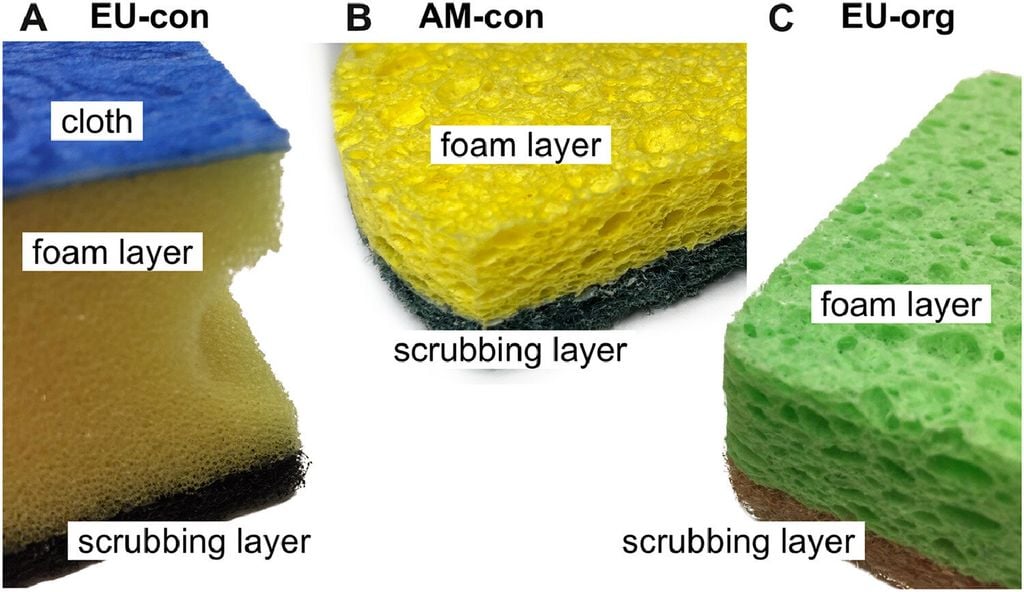
Researchers from the University of Bonn studied how many plastic particles are released from sponges during dishwashing and their environmental impact. The results show that while measurable amounts of microplastics enter the environment each year, most of the environmental impact comes from water consumption.
Kitchen sponges are considered a potential but under studied source of microplastics. The study aimed to quantify real world microplastic release and assess environmental impacts using life cycle analysis.
The research combined citizen science and laboratory testing. Volunteers in Germany and North America used different sponge types in daily routines, while laboratory tests used an automated device to simulate mechanical stress.
Results and impacts
All the analysed sponges lose material during use, thereby releasing microplastics. The annual release ranges from approximately 0.68 to 4.21 grams of microplastics per person per year, depending on the type of sponge. Sponges with a lower plastic content release significantly fewer microplastics. However, overall, the analysis showed that it is not the release of microplastics itself, but primarily water consumption during manual dishwashing that contributes most to environmental impact.
Citizen science played a fundamental role, as volunteer participants used the sponges under real life conditions. This made it possible to record realistic usage patterns and typical dishwashing habits. These data enabled a much more accurate estimation of microplastic release compared with studies conducted exclusively in laboratory settings.
Although the amount per person may seem low, when extrapolated to Germany, the figures become significant. For example, up to 355 tonnes of microplastics per year could be generated if a specific type of sponge is used in every household. While a large proportion of these particles is retained in wastewater treatment plants, several tonnes still reach aquatic ecosystems or soils each year. Furthermore, the environmental assessment shows that between 85 and 97 per cent of the total environmental impact of dishwashing is due to water consumption, while microplastic emissions contribute to a much lesser extent to overall ecosystem damage.
What can be done to reduce the impact
The study identifies several ways to reduce environmental impact:
- Use less water when washing dishes, as this has the greatest effect.
- Choose sponges with lower plastic content to reduce microplastic release.
- Use sponges for longer, as a longer lifespan reduces overall resource consumption.
Source: Universidad de Bonn
Reference of the news
Leandra Hamann, Christina Galafton, Peter T. Rühr, Alexander Blanke, Nils Thonemann: From sink to sea: Microplastic release from kitchen sponges and potential environmental effects, Environmental Advances, Volume 23, 2026, 100693, ISSN 2666-7657, https://doi.org/10.1016/j.envadv.2026.100693