
An event that occurred 11 billion years ago may have changed the structure of the Milky Way
Researchers investigated how interactions between galaxies shaped the structure of the galactic disc over billions of years.
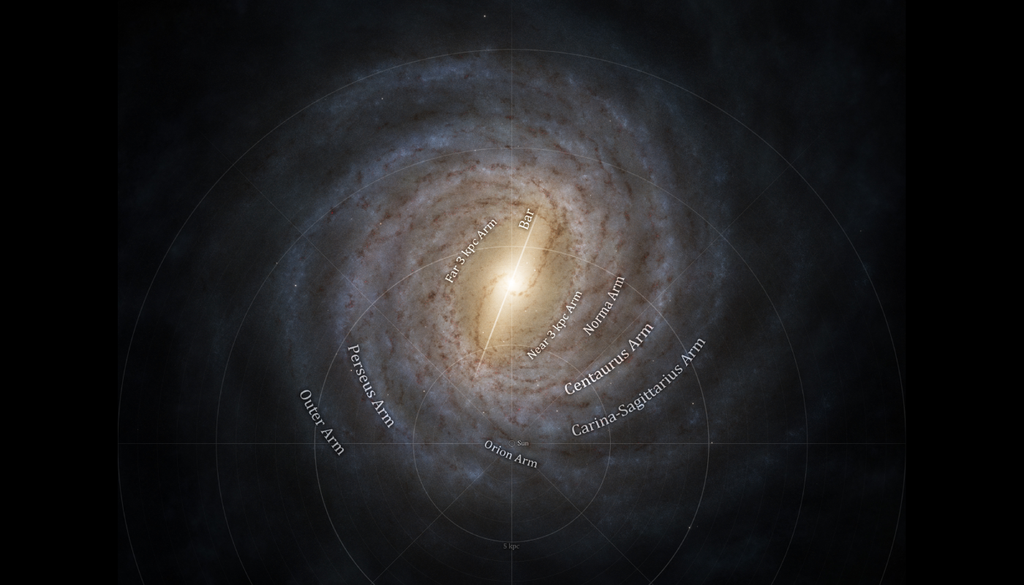
The Milky Way has a complex structure composed of different components. Its galactic disc contains much of the young stars, gas and star-forming regions organised into spiral arms. At the centre of the galaxy lies a stellar bulge surrounding the supermassive black hole Sgr A*. Around the disc and the bulge is the galactic halo, made up of ancient stars, globular clusters and dark matter. The Solar System is located within the disc, orbiting the galactic centre at a distance of approximately 27,000 light-years.
To understand how the Milky Way acquired its current structure, it is necessary to reconstruct its evolutionary history and past gravitational interactions. During galactic formation, collisions and mergers with smaller galaxies played a role in redistributing stars, gas and angular momentum. These interactions can heat the stellar disc, alter its rotation and even destroy structures. One of the main goals of galactic models is to understand how the Milky Way’s thin disc managed to acquire the flattened shape and rotation observed today.
Recently, astronomers carried out numerical simulations and compared them with observational data to investigate how the structure of the Milky Way was shaped over time. The models analysed the impact of ancient galactic collisions on stellar discs similar to that of our galaxy. The results show that the Milky Way may have undergone a significant collision around 11 billion years ago. According to the study, this event could have destroyed a previous galactic disc, leading later to the formation of the current disc.
Structure of the Milky Way
The Milky Way is a barred spiral galaxy composed of different stellar and gravitational structures organised across multiple scales. In its central region lies the galactic bulge, which has a high concentration of older stars surrounding the supermassive black hole Sgr A*. Around this structure is the galactic disc, where spiral arms rich in interstellar gas, dust and active star-forming regions are located.
All of this structure is immersed in a halo gravitationally dominated by dark matter. The galactic halo of the Milky Way is an approximately spherical region surrounding the entire galaxy and containing ancient stars and globular clusters. Unlike the disc, the stars in the halo have inclined orbits and are distributed in a less organised way. The Milky Way is also surrounded by a much larger halo of dark matter, responsible for much of its gravitational mass.
Galactic disc
However, the best-known and most remembered structure is the Milky Way’s disc, which is a flattened structure made up of stars, gas and dust. It formed from the gravitational collapse of primordial gas at the beginning of the Galaxy’s evolution, preserving part of the angular momentum of the original system. Within the disc, spiral arms emerged, along with regions of intense star formation and dynamic structures associated with the Galaxy’s gravitational evolution.
One of the biggest questions involving the galactic disc is explaining the observed velocities of stars. According to visible matter alone, more distant stars should orbit more slowly, but observations show much higher velocities than expected. This behaviour is one of the main pieces of evidence for the presence of dark matter surrounding the galaxy in an invisible gravitational halo. In addition, there are still questions about how the disc managed to maintain its relatively stable structure.
Collision in the past
The Milky Way probably did not evolve in isolation, but underwent gravitational interactions throughout its lifetime. For decades, astronomers have suspected that collisions with smaller galaxies shaped the structure observed today. This hypothesis gained strength in 2018 with data from the Gaia mission, which found stars with unusual movements in the galactic halo. The orbits of these stars indicate that they originated in a smaller galaxy absorbed by the Milky Way around 10 billion years ago.
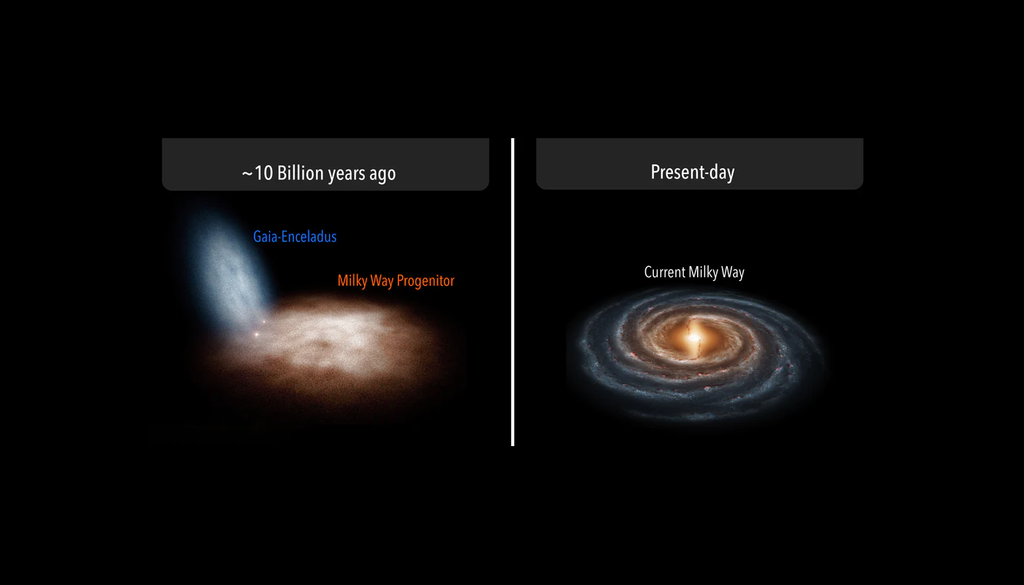
This event became known as the Gaia-Sausage-Enceladus merger. The collision probably redistributed stars, gas and angular momentum across much of the galaxy. New studies using simulations investigated how galactic discs form and evolve after collisions of this type. The results show that the disc observed today may have formed after the galaxy dynamically recovered from a collision that occurred around 11 billion years ago.
Starburst
The simulations also indicate that this collision coincided with a sudden increase in the formation of stellar clusters and new stars within the galaxy. During galactic collisions, large quantities of interstellar gas undergo gravitational compression and increase the density of gas in certain regions, favouring the collapse of molecular clouds. As a consequence, the rate of star formation rises rapidly over a relatively short period of time.
The models of the Gaia-Sausage-Enceladus event suggest that the collision produced a burst of star formation in the primitive Milky Way. The temporal coincidence between the galactic merger and the increase in clusters provides new evidence of the influence of these collisions on the galaxy’s evolution. According to the researchers, this is the first time that this connection between the Gaia-Sausage-Enceladus event and the burst of star formation has been established.
Reference
Orkney and Laporte 2026 Build-up and survival of the disc: from numerical models of galaxy formation to the Milky Way Monthly Notices of the Royal Astronomical Society