
Astronomers discover the first pair of stars to survive a double supernova explosion
A team of scientists has identified the first known candidate binary star system in which both stars have undergone supernova explosions—a discovery that could expand our understanding of how binary star systems form and evolve.
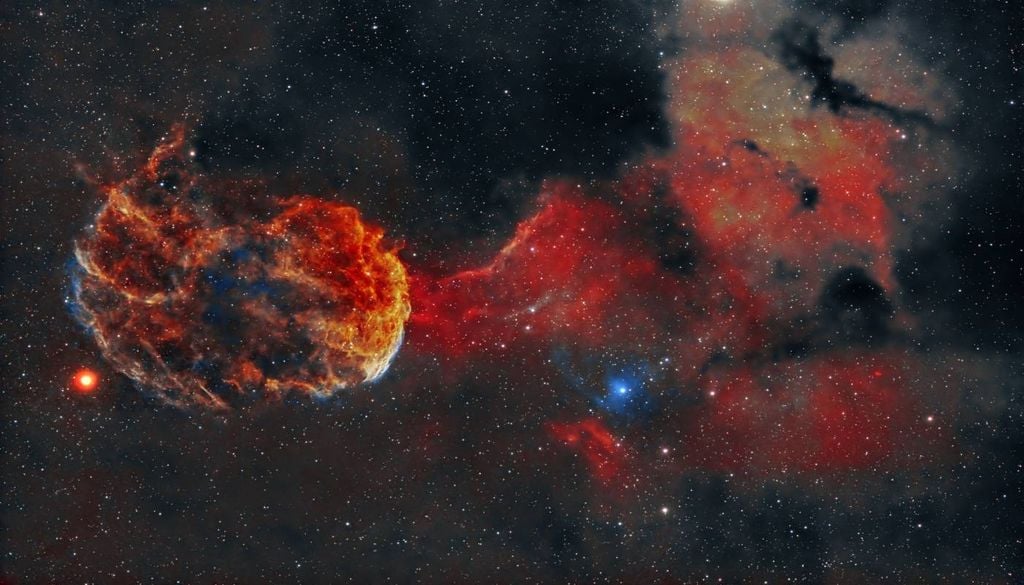
An international team of astronomers has found compelling evidence that the two supernova remnants IC 443 (also known as the Jellyfish Nebula) and G189.6+3.3 may be the products of the evolution of the same binary star system.
If confirmed, this would be the first time astronomers have identified a candidate system in which both stars ended their lives in supernova explosions—a scenario long predicted by theoretical models but never before convincingly observed.
The results reveal that IC 443 and G189.6+3.3 occupy the same physical environment and are located at nearly the same distance from Earth, indicating that they lie very close to one another in space. Their proximity makes it unlikely that this is merely a coincidence and strengthens the hypothesis that they originated from two stars born together that evolved as a binary system.
If this hypothesis is confirmed, the two remnants would serve as a natural laboratory for better understanding the evolution of massive stars and the mutual influence they exert on each other throughout their lifetimes.
IC 443, or the Jellyfish Nebula, is one of the best-studied supernova remnants
Supernova remnants are clouds of gas, dust and other debris left behind after a star explodes. As they expand, they interact with the interstellar medium, shaping the surrounding environment and enriching it with chemical elements forged inside stars.
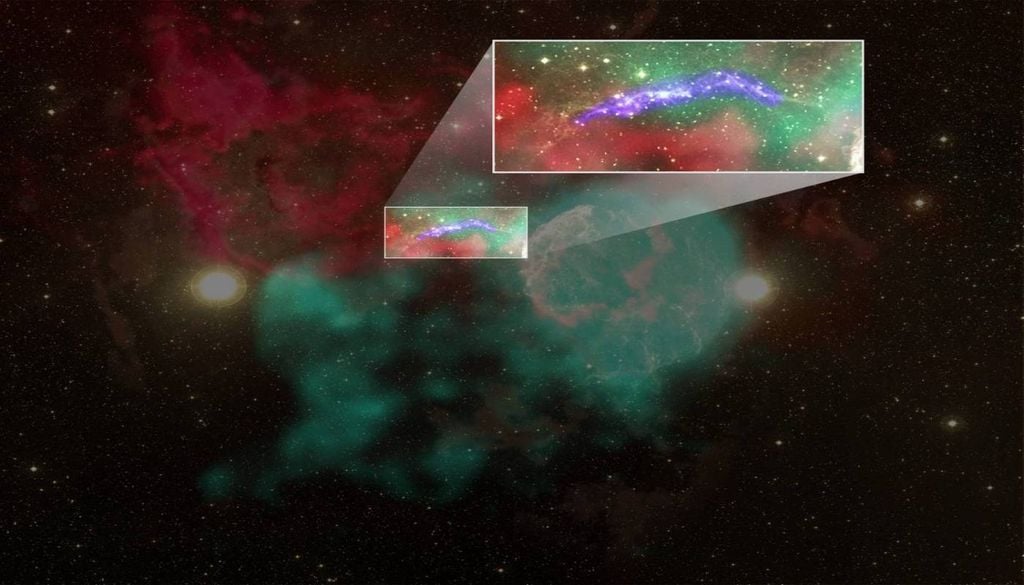
Although hundreds of these remnants are known to exist in the Milky Way, establishing connections between them remains a challenge, especially in densely populated regions rich in gas and dust, where multiple structures can overlap along the same line of sight.
Located in the constellation Gemini, about 6,000 light-years from Earth, IC 443 is one of the most extensively studied supernova remnants, largely because it lies in a particularly complex region. According to the researchers' estimates, the star that produced G189.6+3.3 exploded between 20,000 and 100,000 years before the star that created IC 443.
Simulations suggest this configuration is unlikely to be a chance alignment
Statistical analyses indicate that this configuration is highly unlikely to be the result of chance, strengthening the hypothesis that both objects are the remnants of the two stars from an ancient binary system.
This discovery provides new insight into the evolution of massive stars and could help scientists better understand how these systems evolve until both stars end their lives in supernova explosions.
References
Michailidis, M., Lemoine-Goumard, M., Willcox, R. et al. (2026). Shared cloud interactions unveil a candidate binary-system supernova pair with no known analogue.
SINC. (2026). Discovery of a possible binary supernova system.