
Astronomers present a new hypothesis about the origin of Saturn's rings.
The origin of Saturn's rings remains a subject of controversy in the scientific community. However, some researchers have put forward a theory that seems to explain why and how they formed.
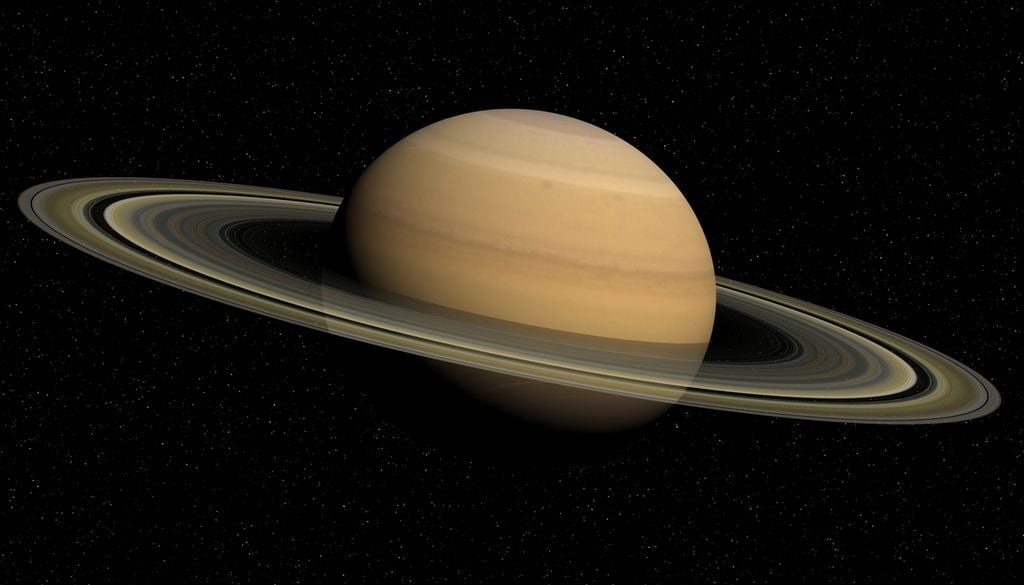
Although Saturn's rings are often considered the most beautiful celestial objects in our Solar System, they are also the subject of much debate, particularly regarding their origin . However, a team of researchers recently presented an interesting hypothesis in this regard.
A missing moon?
The planet Saturn has not always been adorned with these magnificent rings, easily identifiable with a small telescope. According to estimates made following the passage of the Voyager and Cassini probes nearby, these rings are only 100 million years old , which is particularly "young" compared to the planet's approximately 4.5 billion years.
However, some parameters are not truly explained by this hypothesis, namely the fact that Saturn's rings are particularly pure , when such a collision should have "dirtied" them. Therefore, many studies on this subject are still underway, and a team of researchers may well have found a convincing scenario.
During the 57th Lunar and Planetary Science Conference, held in Texas, scientists presented their hypothesis based on an ancient, now-vanished moon . Named Chrysalis, it is believed to have met a tragic end, but this would explain the formation of the gas giant's rings.
A cosmic "striptease"?
According to the authors of this hypothesis, Chrysalis was a unique moon, composed of a rocky core surrounded by a thick icy mantle, with a diameter similar to that of Iapetus (a satellite of Saturn), that is, about 1500 kilometers . This moon would have approached Saturn too closely, which would have caused its destruction.
However, instead of crashing into the planet or colliding with another natural satellite, researchers estimate that Chrysalis entered a region of gravitational "striptease ," located between 60,000 and 90,000 km from Saturn's surface. In this zone, the tidal forces of the gas giant would have gradually "peeled" Chrysalis, starting with its thick layer of ice .
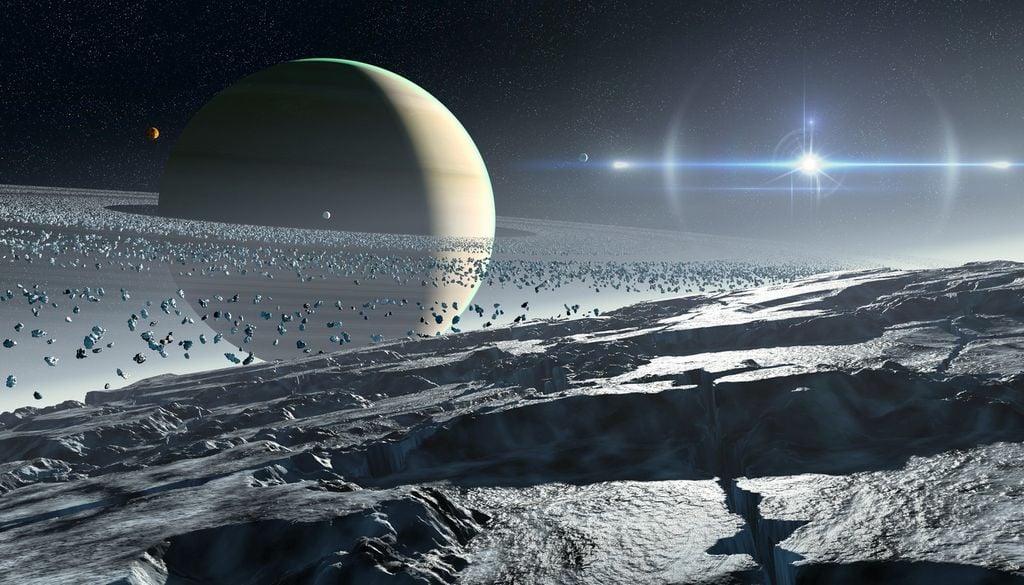
This layer of ice ejected from the moon would then have extended, forming a long stream of very pure ice debris, which would eventually form a thick ring that would have gradually flattened and widened under the effect of rotation. This scenario therefore explains the purity of the ice debris that currently makes up Saturn's rings, but not only that.
The hypothesis also explains Saturn's unusual tilt of about 27° . Upon losing this large satellite, the gas giant would have tilted, finally finding its current angle which, just as on Earth, gives rise to the seasons. In comparison, the angle of its neighboring gas giant, Jupiter, is only 3°.
It remains to be seen what happened to Chrysalis . Indeed, the ice stripped away by Saturn's influence would have left the rocky core wandering in the orbit of the gas giant. According to the researchers' simulations, it would have been ejected into an eccentric orbit because it was too dense, but the unfolding of its story is still uncertain.
News reference:
Saturn: the original explanation for the “strip-tease gravitation” of the moon Chrysalis , Les Numériques (11/05/20026), Brice Haziza
Tidal stripping of Chrysalis as the origin of Saturn's young icy rings , 57th LPSC (2026), Yifei Jiao, Francis Nimmo, et al.