
Comet 3I/ATLAS Says Goodbye to the Solar System, but Continues to Provide Scientific Discoveries
In the final moments of comet 3I/ATLAS in the solar system, observations revealed the presence of methane in its composition.
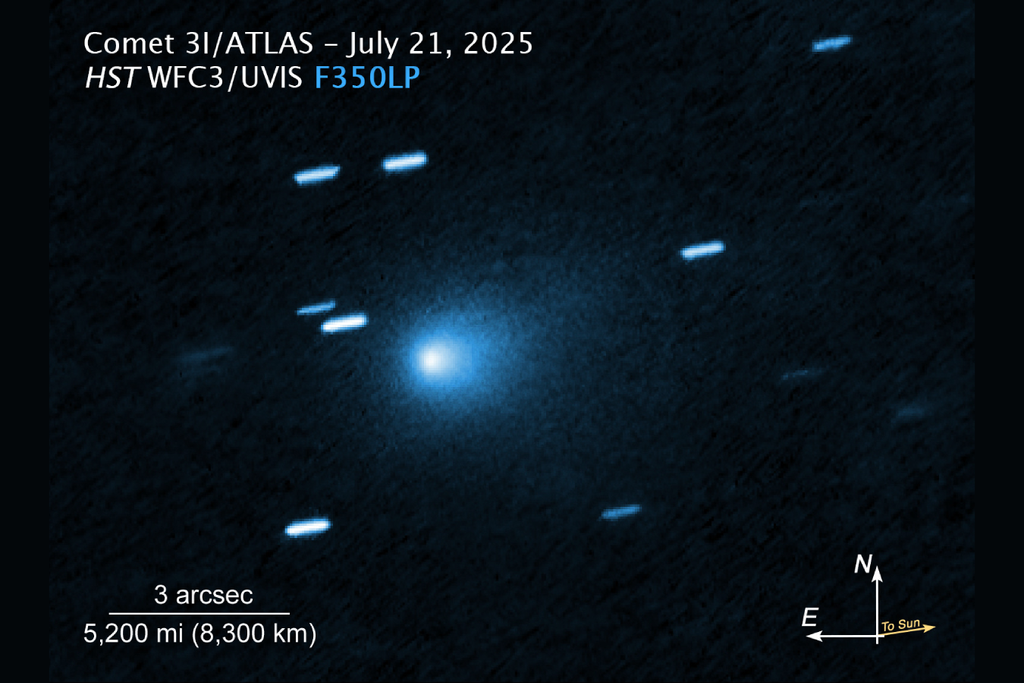
3I/ATLAS is an object of interstellar origin identified in July 2025, becoming the third interstellar visitor ever recorded. Its detection was made through observational studies and was quickly confirmed as an interstellar object with a hyperbolic trajectory. Both astronomers and the general public showed great interest due to the rarity of visits from objects of this type. 3I/ATLAS made 2025 one of the main scientific highlights of the year.
After its closest approach to the Sun, comet 3I/ATLAS began its path out of the solar system, following an orbit that prevents any possible return. Despite the short duration of its passage, the object was continuously monitored by ground-based and space telescopes. Various spectroscopic and photometric observations were carried out to characterize its composition and activity. These observations were important for understanding how objects form outside the solar system.
Since April 2026, 3I/ATLAS has been beyond Jupiter’s orbit, in the process of moving away from the solar system. Even at this stage, new analyses continue to reveal relevant information about its chemical composition. Recent observations have indicated the presence of methane in the comet. The detection of this material provides even more clues about the environment in which this object formed and the formation environments in other stellar systems.
Comet 3I/ATLAS
In July 2025, the ATLAS observatory identified an object entering the solar system and, a few days later, other observatories confirmed its interstellar origin. In this way, the object became the third interstellar object detected crossing the solar system. Because it was the third interstellar object and was first observed by ATLAS, the comet was named 3I/ATLAS.
Comet 3I/ATLAS reached its perihelion, the point of closest approach to the Sun, at the end of 2025 and, from then on, began its path moving away from the Sun. Its closest approach to Earth occurred shortly afterward, with no risk of impact. Since its discovery, orbital calculations have indicated a minimal probability of collision with our planet. Even at its closest point, the object remained at a safe distance, consistent with the expected parameters for interstellar visitors.
Discoveries
During its brief passage through the solar system, 3I/ATLAS was the subject of observation campaigns that made it possible to characterize its activity and physical properties. Photometric data indicated variations in brightness associated with rotation and the release of volatile material. Spectroscopic observations revealed the presence of gases typical of cometary activity beyond the coma. Analysis of the tail morphology provided information about interaction with the solar wind and the distribution of ejected particles.
Observing comets is important because it provides information about the early stages of planetary system formation. In 3I/ATLAS, observations showed that formation processes involving ice and dust are common in protoplanetary disks outside the solar system. Comparison with local comets indicated structural similarities, but also differences in composition and thermal evolution.
In Its Farewell, 3I/ATLAS Continues to Bring New Discoveries
Currently, 3I/ATLAS is moving away from the solar system and has already passed Jupiter’s orbit. Even so, 3I/ATLAS continued to be observed with the James Webb Space Telescope. Researchers analyzed infrared emissions and studied the object’s thermal and chemical composition. During its approach to the Sun, the data indicated limited volatile release. This behavior is consistent with exposure
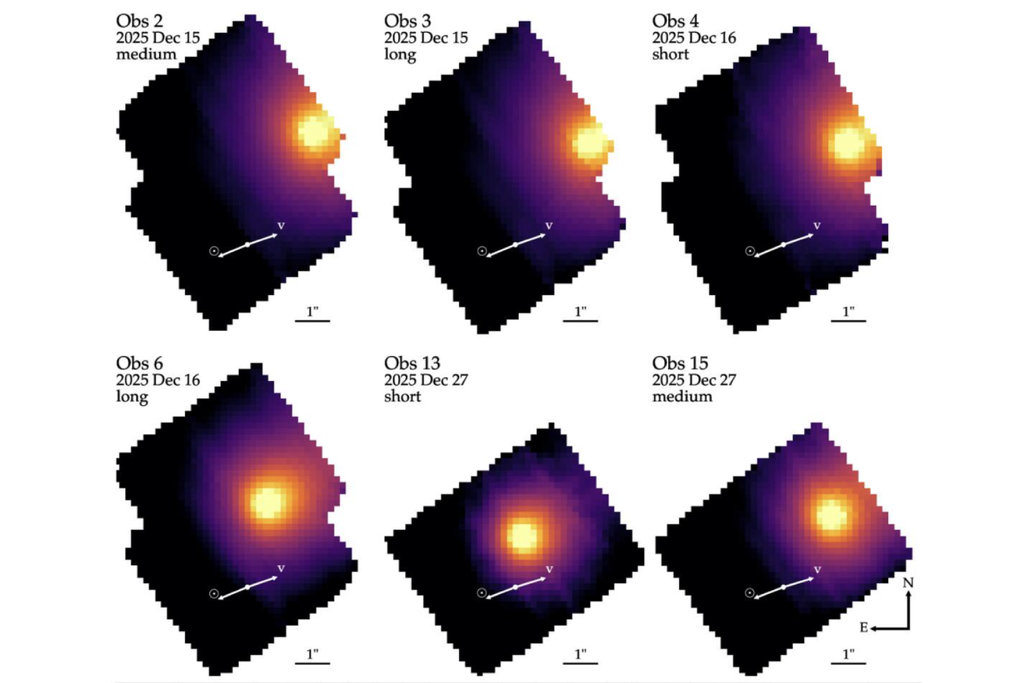
Initial observations mainly reflected the chemistry of a processed and aged surface. As 3I/ATLAS moves away from the solar system, new analyses have revealed changes in its activity. The new data showed an increase in the release of volatiles, indicating the warming of deeper layers. This behavior suggests that the object has lost its surface crust, exposing better-preserved internal regions. One of the main discoveries was the presence of methane in its interior.
When Will We Have Another Visit?
With this, 3I/ATLAS has provided us with a great deal of information about the chemical composition of planetary systems beyond the solar system. Even so, 3I/ATLAS is saying goodbye forever; that is, its passage is unique, with no possibility of return. Before it, only two interstellar visitors had been confirmed: ʻOumuamua and 2I/Borisov. The detection of these few cases highlights the rarity or possible underdetection of this type of object.
As a result, it is still not possible to predict when the next interstellar visit will occur. Despite the uncertainty about the frequency of these encounters, technological advances are expanding detection capabilities. This suggests that new visitors may be detected more regularly in the future. However, it is still unclear whether the low number observed so far reflects past instrumental limitations or a genuinely low passage rate.
News Reference
- Belyakov et al. 2026 The Volatile Inventory of 3I/ATLAS as Seen with JWST/MIRI The Astrophysical Journal Letters.