
James Webb detects signs of what could be the first black hole stars in the universe
The result obtained reinforces the idea that massive black holes emerged very early in the history of the universe.
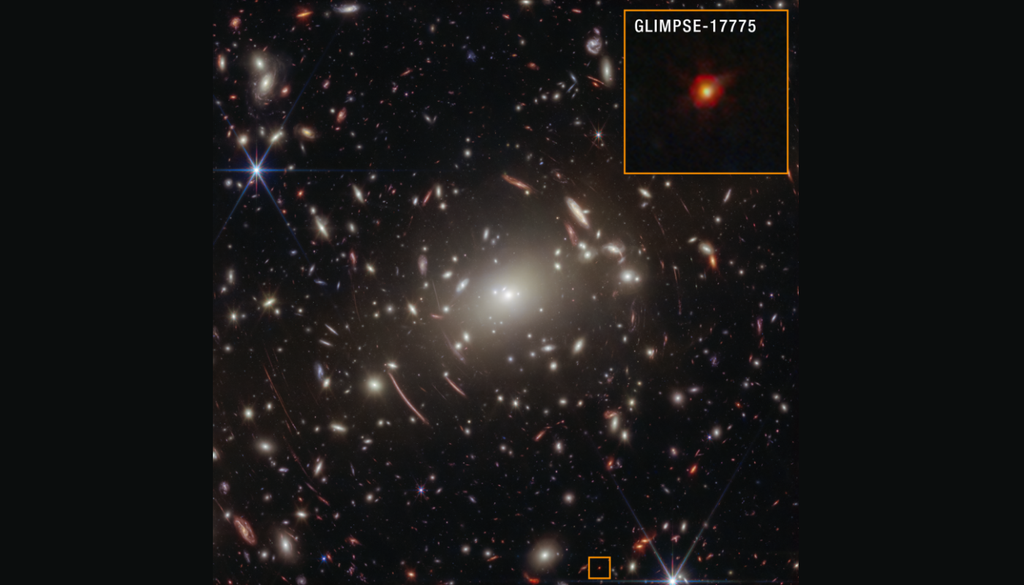
One of the greatest mysteries in astronomy is understanding the relationship between the appearance of the first galaxies and the first supermassive black holes. Observations show that very massive black holes already existed when the universe was less than a billion years old. Explaining how these objects grew so rapidly is an open problem in astronomy. One of the central questions is determining whether galaxies or black holes formed first.
With the launch of the James Webb Space Telescope, several pieces of evidence have emerged that help solve this mystery. Among these discoveries are the so-called "little red dots ," reddish objects found by James Webb in the early universe. One hypothesis suggests that these are stars surrounding black holes. In this scenario, a growing black hole is surrounded by a dense layer of partially ionized gas. The radiation produced by accretion is responsible for the observed brightness.
This week, NASA released new results from the James Webb Space Telescope that provide the strongest evidence to date for this scenario. Analysis of the object GLIMPSE-17775 revealed spectral signatures consistent with a supermassive black hole as described by the star-black-hole model. If future observations confirm these results, the discovery could indicate that some supermassive black holes emerged before galaxies.
Small red dots
The small red dots are a population of compact, reddish objects discovered by the James Webb Telescope during its observations of the early universe. They were observed when the universe was only a few hundred million years old, a period related to the formation of the first galaxies and black holes . Despite appearing as tiny points of light, they possess a very high brightness relative to their size.
The main difficulty lies in simultaneously explaining their intense brightness, size, and abundance in the early universe. Some models suggest that these small red dots could harbor rapidly growing supermassive black holes. Other scenarios propose that they are young galaxies in the star-forming phase. However, several recent observations have supported the hypothesis that at least some of these objects are associated with black holes in the early stages of their evolution.
What came first?
One of the most important problems in astrophysics is determining the order of formation between galaxies and supermassive black holes. For decades, the most widely accepted scenario was that the first galaxies formed from the collapse of clouds of gas and dark matter, while black holes emerged later and grew gradually. However, the discovery of extremely massive black holes very close to the Big Bang has called this explanation into question.
Answering this question was one of the main scientific motivations for building the James Webb Space Telescope. The telescope was designed to observe the early universe in infrared wavelengths, detecting objects formed only a few hundred million years after the Big Bang. Some of these observations suggest that supermassive black holes already existed before many galaxies reached advanced stages of evolution.
Stars of black holes
Black hole stars are hypothetical objects in which a rapidly growing black hole remains enveloped by a dense layer of gas. Unlike an active galactic nucleus, much of the radiation produced near the black hole is absorbed and reprocessed by this gas before escaping into space. This scenario has been proposed to explain some of the small red spots discovered by the James Webb Space Telescope.
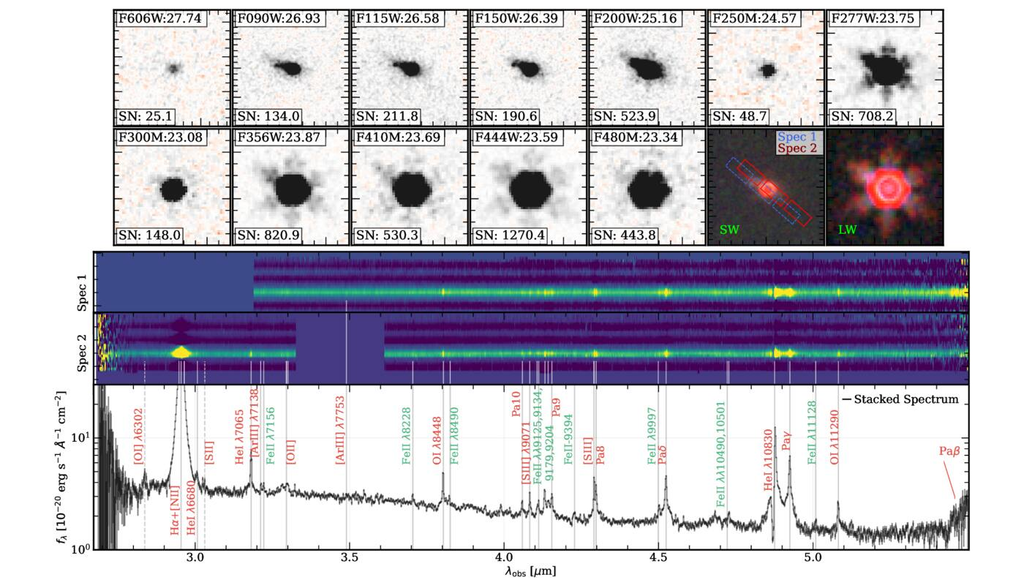
One of the most compelling pieces of evidence for this scenario came from the object GLIMPSE-17775, a small red dot observed by the James Webb Space Telescope. This object dates back to when the universe was approximately 1.8 billion years old. Analysis revealed more than 40 spectral lines, making it the most detailed spectrum ever obtained for a small red dot . The observed features are consistent with a black hole enveloped by a dense layer of gas that modifies the radiation emitted by accretion. The results represent the strongest evidence found to date for the star-black-hole model.
Finally, an answer
If objects like GLIMPSE-17775 truly represent black holes enveloped in cocoons of gas, they could reveal an extremely efficient early growth phase. In this scenario, some black holes could have emerged before galaxy formation and acted as gravitational nuclei capable of attracting matter around them. The first galaxies would then have formed around these massive objects, and not the other way around.
This possibility modifies the idea that black holes only formed after the creation of the first galaxies. This interpretation helps explain both the brightness of the small red dots and their spectral characteristics. If confirmed, these red dots could represent the formation of the first supermassive black holes. Therefore, these objects have become one of the most important discoveries of the James Webb Space Telescope.
News reference
Kokorev et al. 2026 The Deepest GLIMPSE of a Dense Gas Cocoon Enshrouding a Little Red Dot The Astrophysical Journal