
Mirrors in space to generate energy 24 hours a day: the project that could blind you
The future project by Reflect Orbital could pose a risk to our health, while also having potentially significant consequences for our night sky.
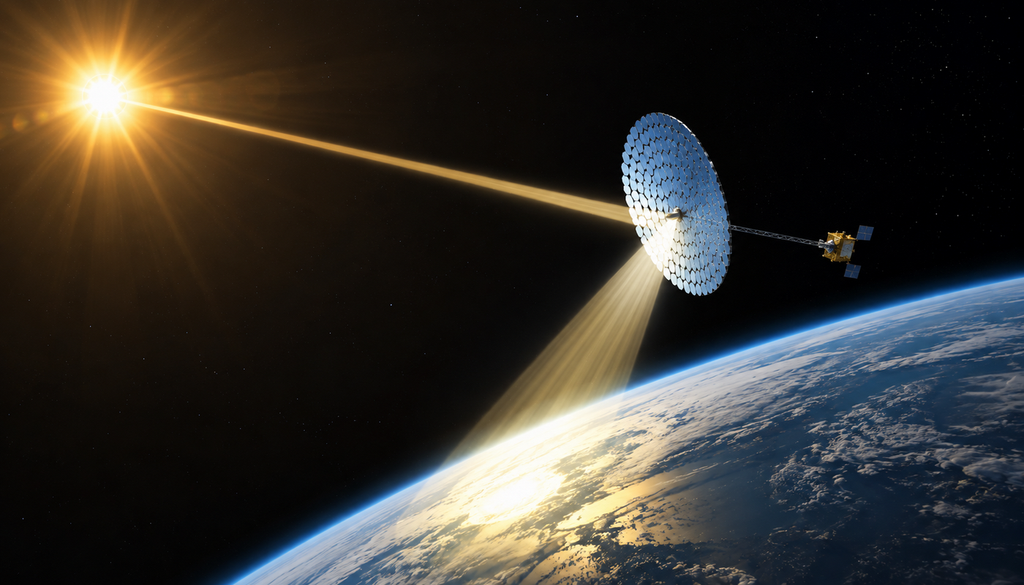
A U.S. startup plans to deploy "mirror" satellites capable of reflecting sunlight and concentrating it on a specific point on Earth's surface, an ambitious project that is not without potential risks to human health.
Tens of thousands of reflectors!
Solar energy is expanding rapidly around the world, and its efficiency continues to improve. However, the sun does not shine 24 hours a day across most of the planet, even though its rays could potentially be harnessed not only for energy but for other purposes as well.
With this in mind, a U.S. startup came up with an unusual but innovative idea: deploy satellites that act as mirrors to reflect sunlight and direct it toward a specific area on Earth's surface. Reflect Orbital recently received approval from the FCC, the U.S. telecommunications regulator, to deploy its first test satellite equipped with an 18-square-meter mirror.
[ UNITED STATES | SPACE ]
— Little Think Tank (@L_ThinkTank) July 17, 2026
U.S. startup Reflect Orbital plans to launch Eärendil-1, an experimental satellite equipped with an 18-meter mirror capable of reflecting sunlight toward Earth at night. The stated goal is to provide illumination
The California-based startup's ultimate goal is to deploy a constellation of 50,000 satellites to create a beam of light five kilometers in diameter that could power solar farms 24 hours a day, seven days a week, or illuminate construction sites at night. Private applications are also being considered.
While this technology appears promising, it is not without risks. Within the illuminated area, the brightness could reach up to four times that of a full moon, and these satellites could even increase the overall brightness of the night sky on a global scale through atmospheric scattering. Other, more direct consequences could also pose risks to human health.
A risk to our eyesight?
The issue was recently in the news with the August 12 solar eclipse in Europe: looking directly at the Sun can cause irreversible eye damage of varying severity. However, even sunlight reflected from a mirrored satellite could potentially be dangerous.
In February 1993, the Russian Znamya 2 experiment placed a massive mirror into orbit designed to reflect sunlight back toward Earth. At the time, the potentially dangerous effects of exposing the retina to intense light were already widely documented in scientific literature.
It is therefore easy to draw parallels between that experiment, conducted more than 30 years ago, and the Reflect Orbital project. With a much larger number of mirrors, the risk of sudden glare for people on the ground or in the air could become significant. What would happen, for example, if an airplane pilot were temporarily blinded by the glare?
The U.S. startup itself acknowledged that simply looking through a 30-centimeter amateur telescope could cause irreversible retinal damage, an admission that was understandably met with concern from both the public and the scientific community. According to some researchers, the risk could even exist with smaller instruments.
Another issue is that there is currently no public warning system to provide advance notice when the beam will pass overhead. At this stage, the FCC determined that issues related to eye safety and protection of the night sky fell outside its jurisdiction when granting the authorization.
News reference
Alexandre Scotti. (2026). Mirrors on satellites to power solar panels 24/7: they could damage your retina, yet the project has already been approved.