
Recent Study Reveals Surprising Insights Into Jupiter's Moons and Their Influence on Northern Lights
Through scans by the James Webb Space Telescope and its near-infrared spectrograph, a team of scientists collected data around Jupiter that yielded several surprising results, including several cold spots and regions of highly variable densities.
Recently-published results in Geophysical Research Letters highlight the work of researchers from Northumbria University. Led by Katie Knowles, Ph.D., this international team gained valuable insights into the physical characteristics of Jupiter’s northern lights through critical spectral analyses.
Influence of Jupiter’s Moons
Jupiter’s northern lights are unique and distinct from Earth’s, in that several of Jupiter’s moons play a key role in their evolution and characteristics. Jupiter’s four largest moons--Io, Europa, Ganymede, and Callisto--each leave their own footprint on the northern lights of their parent planet.
Jupiters northern lights reveal layers of complexity.
— Wiley in research (@wileyinresearch) March 6, 2026
The James Webb Space Telescope reveals extreme temperature and density changes in auroral footprints from moons like Io and Europashowing how moons shape planetary atmospheres.
More in @physorg_com: https://t.co/uYFbJHzq4B pic.twitter.com/MAg7xbtMvI
As Jupiter and its powerful magnetic field rotate at a frequency of once per ten hours, the charged particles that comprise the field rotate with it. This robust, evolving magnetic field interacts with Jupiter’s moons as they orbit, with the moons moving in and out of the field and its highly energetic particles.
“The moons constantly interact with the magnetic field and plasma surrounding the planet, and that interaction leads to highly energetic particles traveling down magnetic field lines and then crashing into the planet’s atmosphere, creating the auroral footprints that map to where the moons orbit around Jupiter,” explains Knowles.
Io’s Footprint
The moon Io is the most volcanically active world in our solar system. as it contains hundreds of active volcanoes, associated lava lakes, and a surface suffocated by sulfur. According to NASA, volcanic activity on Io is so frequent that the face of the moon resurfaces with new deposits faster than impacting comets and asteroids can form permanent craters.
All of this volcanic activity spews hundreds of kilograms of material into space every second. These particles become ionized as they form a layer of plasma around Jupiter.
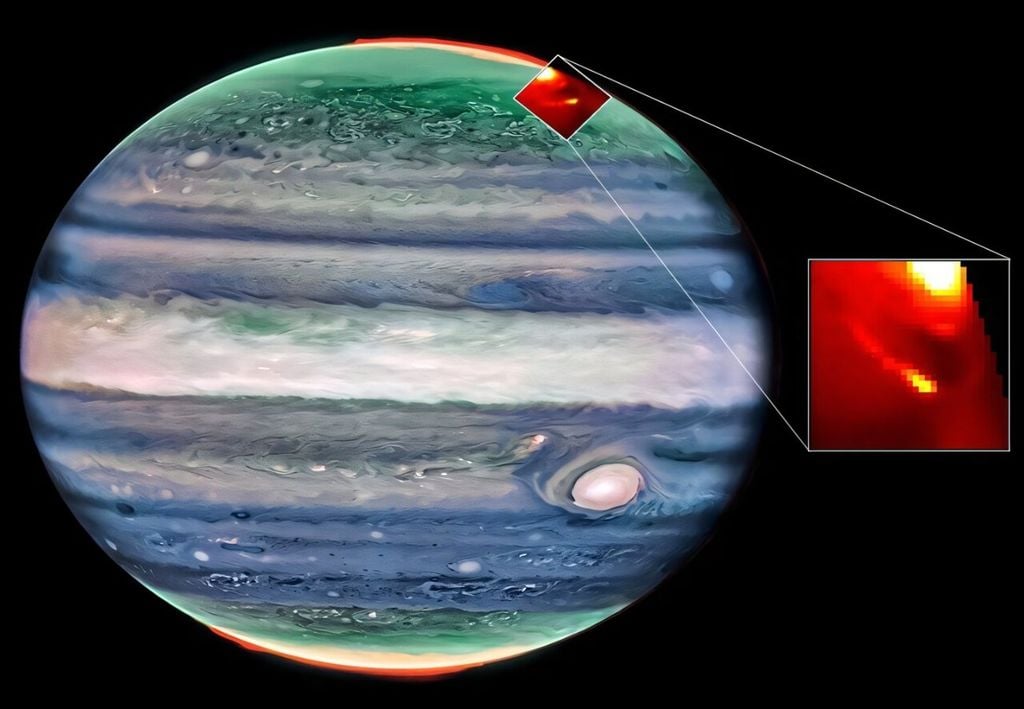
As Io moves through this doughnut-shaped cloud, or plasma torus, generated electrical currents create notable bright spots in Jupiter’s northern lights. Within these bright spots, researchers discovered densities of a hydrogen ion (H3+) three times higher than in the main aurora. In general, the densities were more highly variable throughout Io's auroral footprint than previously thought.
Temperatures were also found to be highly variable in these auroral footprints--around 265ºC as opposed to a much toastier 493ºC in the rest of Jupiter’s aurora. Knowles notes that these observations open up questions about the remainder of our solar system and the universe.
“We’re seeing Jupiter’s atmosphere respond to its moons in real-time, which gives us insights into processes that occur throughout our solar system and perhaps further afar,” she noted. In Janaury 2026, Knowles and her team were awarded additional time on NASA’s Infrared Telescope Facility in Hawaii for further data collection and analysis.