
The New “El Dorado” Is in Space: Trojan Asteroids and the Race for Resources
Trojan asteroids are emerging as new frontiers in space mining: rich in water and precious materials, they combine orbital stability with strategic value, opening real possibilities for a future sustainable extraterrestrial economy.
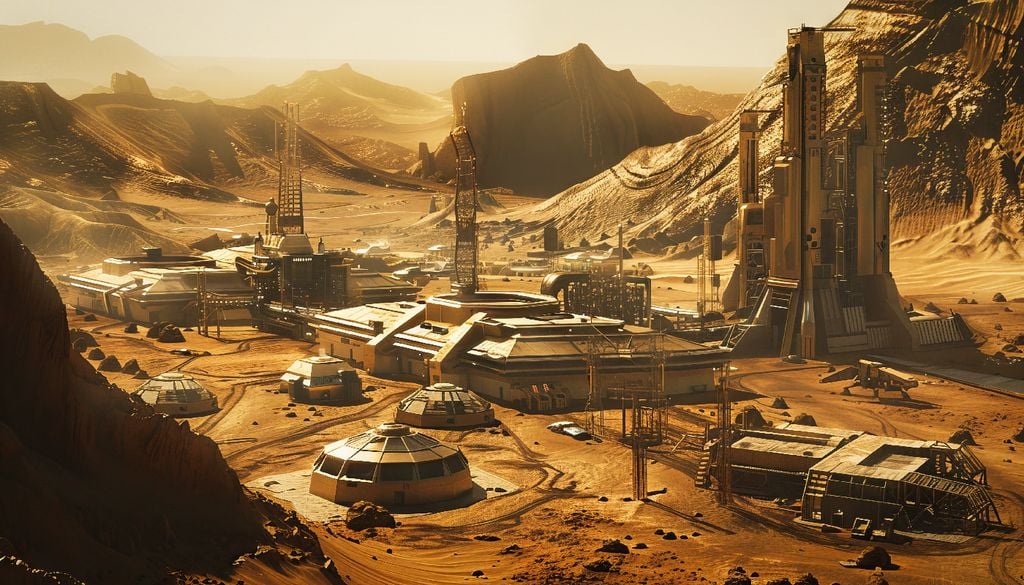
The constantly growing demand for raw materials is shifting attention toward the possibility of exploiting resources that exist in space. Space agencies and, above all, private companies are seriously evaluating the extraction of materials from asteroids.
This is no longer science fiction, but a real possibility. Among the candidate extraction sites, the most promising are the Trojan asteroids, currently considered the potential “New El Dorado” of space.
Trojan Asteroids: Primitive Mines Suspended in Space
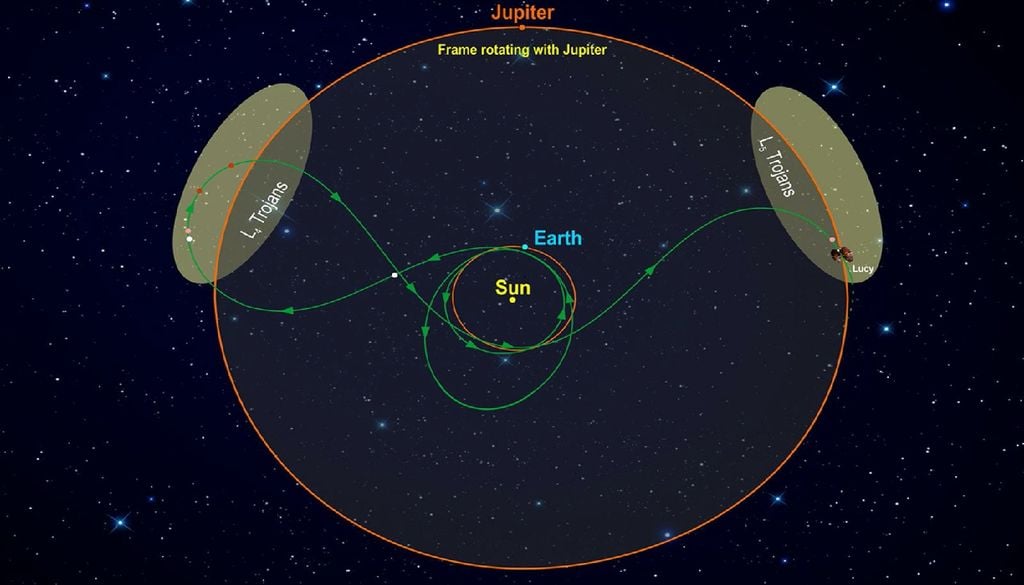
Trojan asteroids are celestial bodies that follow or precede a planet along its orbit by approximately 60 degrees. They occupy gravitational equilibrium positions known as Lagrange points. The most numerous are those accompanying Jupiter, although Trojan asteroids associated with Mars and Earth also exist.
These bodies are true fossils of the Solar System: rocks that formed during its infancy and have remained practically unchanged ever since. As a result, they have undergone minimal alteration and preserve extremely ancient materials, making them invaluable not only for science but also for the space resources industry.
Spectroscopic studies indicate that the Trojans have a very low albedo, meaning they are dark, carbon-rich bodies. However, beyond their mineral resource content, the Trojans are also highly accessible thanks to their particularly stable orbits.
In particular, the Mars Trojans can be reached through space missions requiring relatively low energy costs compared to other asteroid destinations.
Water and Metals: Resources Worth More Than Gold
If the most important resources found inside Trojan asteroids had to be ranked, water would undoubtedly take first place. It is not only essential for sustaining life, but can also be transformed into rocket fuel through the separation of hydrogen and oxygen. It is therefore a strategic resource, not so much for use on Earth, but rather to support any future space infrastructure.
For example, it is possible that the Trojans associated with Jupiter formed beyond the so-called “snow line”; consequently, they could contain significant quantities of ice, perhaps hidden beneath their surfaces.
The most promising candidate in terms of abundant ice content is the Patroclus-Menoetius binary system: a pair of asteroids orbiting each other with very low densities, reinforcing the hypothesis of an ice-rich composition.
However, it is not only water that attracts attention and commercial interest; precious metals do as well. Various studies indicate that asteroids, in general, contain platinum-group metals: elements whose rarity on Earth makes them highly valuable and essential for the technology industry.
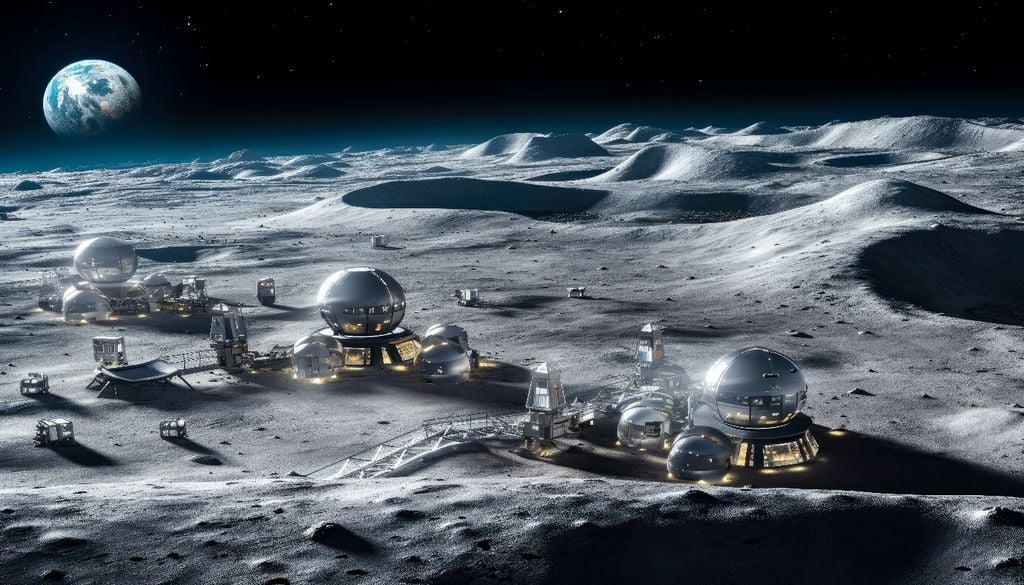
However, to be precise, there are no meteorite samples that can be clearly associated with these bodies — meteorites that have fallen to Earth and originated from the Trojan population — allowing scientists to study their chemical composition. Their abundance of precious metals remains, for now, merely an inference; the only certainty, and therefore the true “wealth” of the Trojans, remains water.
The Challenges of Space Mining
The technological, economic, and logistical challenges involved in establishing realistic in-situ mining operations are truly formidable.
From a scientific point of view, direct knowledge remains limited. However, there is already a space mission — NASA’s Lucy mission, launched in 2021 — whose goal is the systematic close-range exploration of several Trojans, studying their composition, structure, and surface properties. The data expected in the coming years will be crucial in determining how exploitable these bodies really are.
Under microgravity conditions, radically different from those commonly found on Earth’s surface, mining technology requires completely different solutions: the use of autonomous machinery and anchoring systems, as well as refining processes adapted to extreme environments.
The costs associated with transporting minerals back to Earth would also be considerable. The most realistic solution points toward in-situ utilization; that is, using resources directly in space to refuel orbital stations, missions bound for Mars, or future infrastructure.
The new space El Dorado is not, and never will be, made of gold bars to be brought back home. Rather, it is a network of resources in space, where water, ice, and primordial materials form the foundation of an extraterrestrial economy.