
The Rubin Observatory Issued Nearly One Million Alerts on Its First Night of Operations
The Rubin Observatory has just taken a giant step in astronomy: in a single night, it issued 800,000 alerts about changes in the sky. The system, which promises to revolutionize how we observe the universe, is expected to be fully operational before the end of the year.
The first time someone looks at the night sky from a dark place, far from city lights, there is a feeling of peace and stillness. As if the stars were fixed in place, just as they were a thousand years ago. But that calm is an illusion. Up there everything moves, explodes, flickers, and changes. The problem is that our eyes are not powerful enough to keep up.
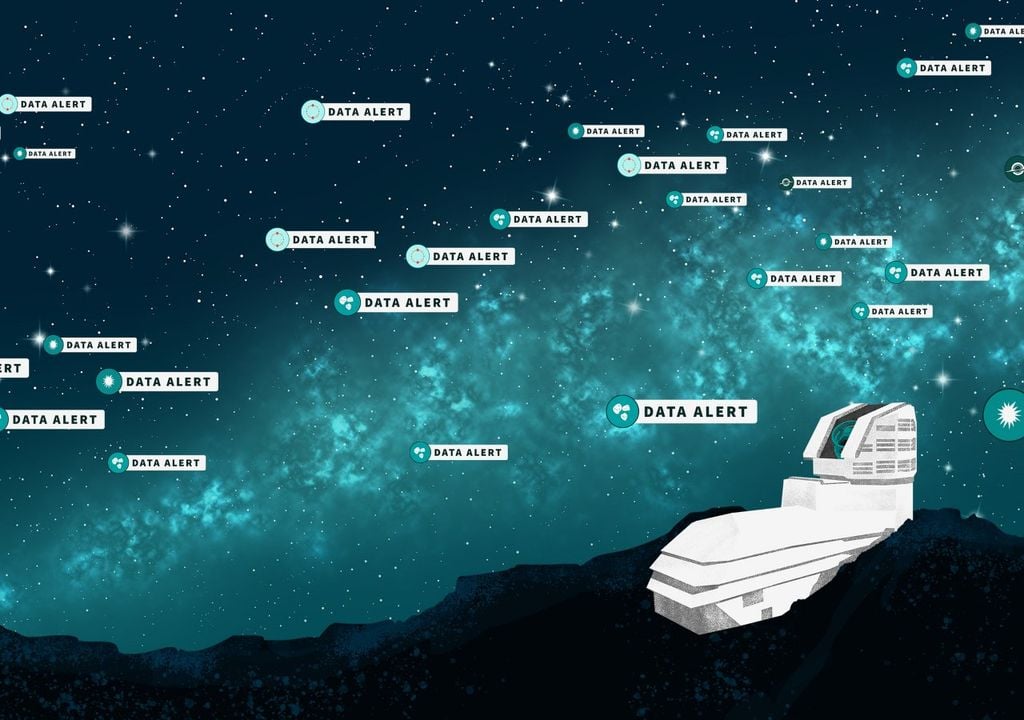
Now we are about to have a remarkable assistant to spy on what is happening. The Vera C. Rubin Observatory, the project astronomers have been talking about for years, has officially released its first real-time alerts. On the night of February 24, while most of us were sleeping, the telescope located in Chile sent 800,000 notifications to scientists around the world. The message, in simple terms, was something like: “hey, look what I found.”
Nunca antes habíamos visto el cielo así. Este es el firmamento en la dirección de la constelación de Sagitario. Es una de las primeras imágenes tomadas por el observatorio Vera Rubin y tiene dos grandes protagonistas: Messier 8 (la nebulosa de la Laguna), en el centro de la pic.twitter.com/RnjVmKW1EA
— Álex Riveiro (@alex_riveiro) December 10, 2025
The observatory sits on top of Cerro Pachón in Chile, but its data travels fast. Very fast. Every 40 seconds, the telescope points to a new region of the sky and captures an image using the largest digital camera ever built: 3,200 megapixels, powerful enough to detect objects millions of times fainter than what our eyes can see.
The image shoots from the Andes to California, where a data center processes it in seconds. There, a system compares that image with previous pictures of the same region. If something has changed—a star that increased its brightness, a point that wasn’t there before, something that moved—an alert is triggered. The entire process, from the moment the telescope captures the image until astronomers receive the notification, takes about two minutes.
What We Are Actually Seeing
Among those first 800,000 alerts were things that sound like science fiction but are very real: newborn supernovae (exploding stars), variable stars that change brightness as if someone were turning them on and off, galactic nuclei where active black holes are devouring matter, and asteroids wandering through our cosmic neighborhood.
When the observatory begins full operations before the end of the year, it will generate between 5 and 7 million alerts every night. For an entire decade, it will record the southern sky like a giant time-lapse movie. Scientists estimate that in its first year alone, this telescope will photograph more objects than all optical observatories combined throughout the entire history of humanity.
Think about that for a second: all of astronomy from Galileo to today surpassed in just twelve months.
Catching Events and Alerting in Time
The system is designed so that any researcher, anywhere in the world, can quickly learn about something interesting and ask other telescopes to point in the same direction before the phenomenon disappears. Because sometimes cosmic changes last only a very short time.
Young stars, for example, are quite unstable objects. “They can have sudden bursts of brightness when material falls onto them, but those events are short and scientists easily miss them without continuous monitoring,” explains Rosaria Bonito, a researcher at the Italian National Institute for Astrophysics. With Rubin, she says, “we will be able to catch them at the exact moment.”
The system will also allow scientists to monitor asteroids that could pose a threat to Earth with greater precision. Detecting these objects early, tracking their trajectories, and assessing risks is one of the few strategies available when thinking about planetary defense. With its continuous monitoring capability, Rubin will become a central tool for that mission.
The Problem of Too Much Information
Here comes the other challenge: with millions of alerts per night, astronomers cannot simply sit down and review them one by one. They need help. That is why there is an army of intermediaries—intelligent programs that filter, classify, and organize this flood of data before it reaches scientists.
Some of these intermediaries specialize: one searches for supernovae in their earliest hours, another tracks objects within the solar system, another cross-matches information with catalogs from other wavelengths such as X-rays or infrared. They use machine-learning algorithms to recognize patterns and find exactly what each research team needs.
“What is revolutionary about Rubin is that anyone will be able to access these alerts,” says Tom Matheson from the Data and Community Science Center. That includes not only professional researchers but also students and citizen scientists. There are platforms like Zooniverse where anyone interested can help classify cosmic events—something like participatory science on a planetary scale.