
What can solar storms tell us about the Martian atmosphere?
What effect do solar storms have on the atmosphere of our sister planet, Mars? Imperial researchers investigate.
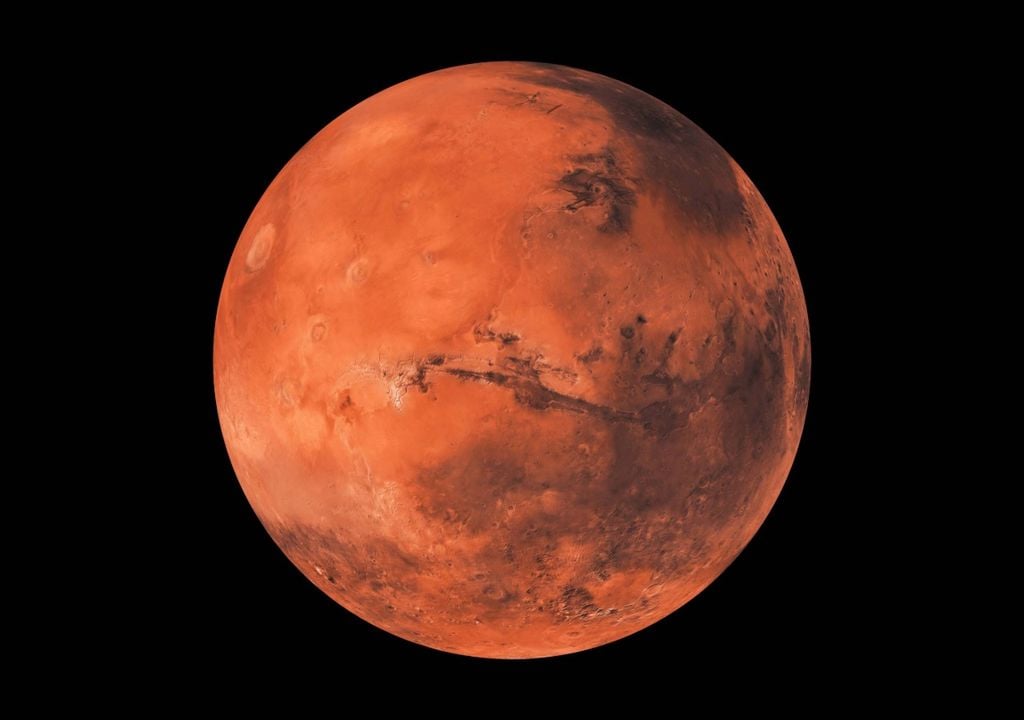
When the Sun reached the peak of its 11-year activity cycle in May 2024, a powerful solar storm on Mars gave scientists their most detailed view of how our sister planet responds to extreme space weather; what did they find and what’s next?
Knockout radiation
When the intense pulse of radiation and solar material hit the Red Planet, ESA orbiters Mars Express and ExoMars Trace Gas Orbiter (TGO) were in prime position to observe the planet’s response.
“The impact was remarkable: Mars’s upper atmosphere was flooded by electrons. It was the biggest response to a solar storm we’ve ever seen at Mars,” explained lead author Jacob Parrott, who conducted this research as a PhD student at Imperial.
There was an extraordinary increase in electron density in two atmospheric layers causing the largest lower ionospheric layer ever recorded at 278% of its typical size. TGO’s radiation monitor also measured a dose equivalent to 200 normal days of radiation exposure in just 64 hours. The radiation was so intense it caused temporary computer errors on both orbiters, but both spacecraft recovered quickly due to their radiation-hardened designs.
Reconstructing the Martian atmosphere
Researchers reconstructed the structure of Mars’s atmosphere immediately after the storm thanks to a signal sent from Mars Express to TGO as it passed behind the planet’s horizon, just as the solar flare stuck. This signal bent as it passed through the layers of the upper atmosphere in response to the charged environment.
The measurement relied on mutual radio occultation, a technique developed at ESA but enabled by Imperial in this instance. Previous work from Parrott and his supervisor optimised the sampling strategy used during the measurements.
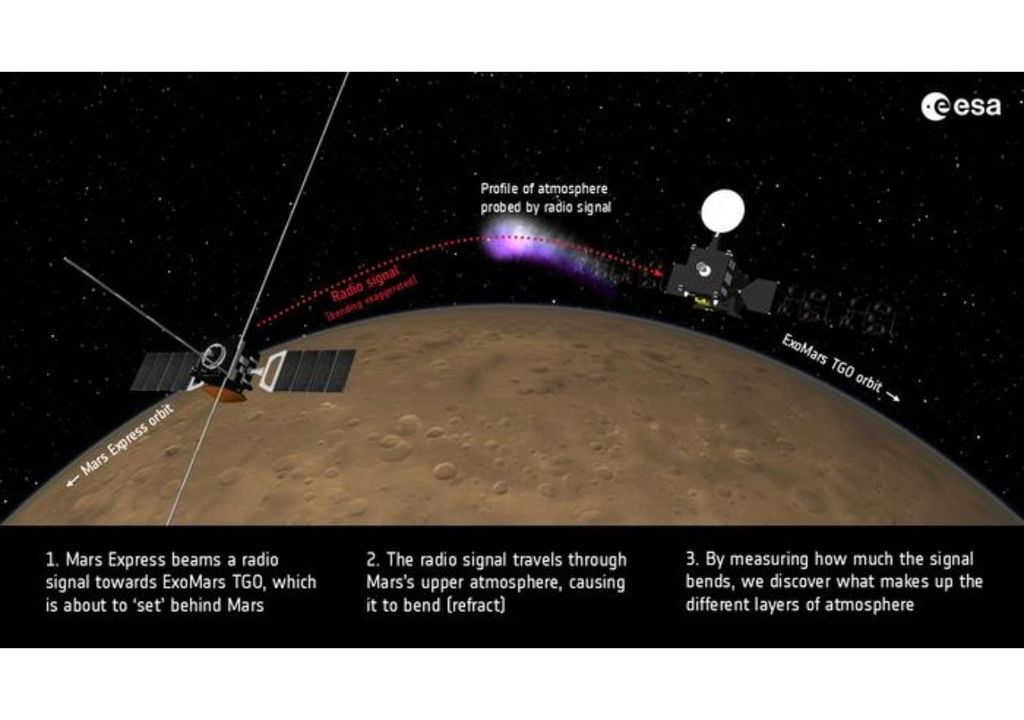
“At Imperial, the sampling frequency requirements were optimised so that each measurement didn’t take up as much hard‑drive space on the spacecraft. This led to an increase in the number of measurements we could take per week,” said Parrott. “Because of this increased cadence, we were able to get this ‘super‑lucky’ measurement just 10 minutes after a massive solar flare hit Mars.”
Increased understanding
Understanding solar activity is crucial as intense events pose a risk to astronauts, satellites and communication systems, but activity can be unpredictable, making direct measurements difficult.
That’s what makes this study is remarkable; the team captured the aftermath of three solar events – a flare, a burst of high-energy particles and a coronal mass ejection – within the same storm. By analysing how each interacted with Mars’s atmosphere, they discovered clear differences in the way energy and particles were deposited.
The study revealed that Earth and Mars respond quite differently to solar activity. On Earth, incoming particles are deflected by its magnetic field and channelled towards the poles; Mars, however, is directly exposed to the solar wind, so when a storm hits, the upper atmosphere becomes filled with charged particles.
Colin Wilson, ESA project scientist for Mars Express and TGO, said the results improve our understanding of Mars, but “there’s another side to it: the structure and contents of a planet’s atmosphere influence how radio signals travel through space. If Mars’s upper atmosphere is packed full of electrons, this could block the signals we use to explore the planet’s surface via radar, making it a key consideration in our mission planning – and impacting our ability to investigate other worlds.”
The team will use the same approach to investigate the nightside of Mars, where the lower ionosphere is traditionally more difficult to observe. They will also assess whether reflectometry, where radio signals are bounced off the planet’s surface, will help in studying surface roughness or probe for subsurface ice. Although it’s at an experimental stage, this could offer additional ways using existing instruments for new science.
News reference
Martian ionospheric response during the May 2024 solar superstorm, Nature Communications, March 2026. Parrott, J., et al.