
This California Desert Is the Hottest Place in the World: Tips for Visiting Death Valley
Death Valley in California is known for its extreme temperatures, exceeding 45°C in summer, in contrast to winter, when it can snow. Here are some tips for visiting it.
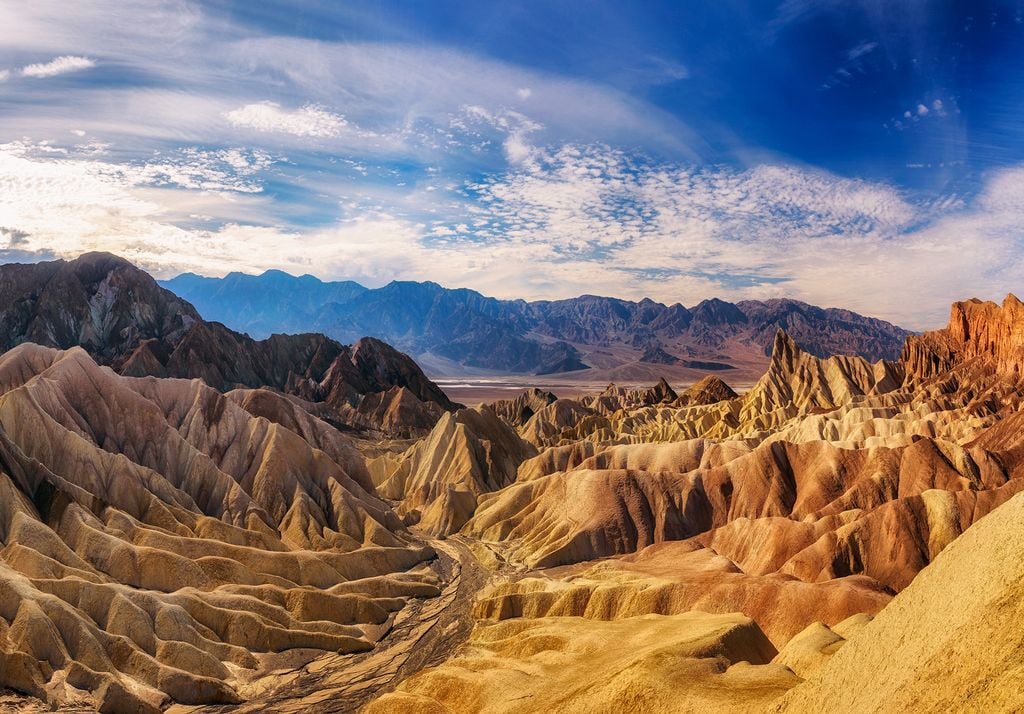
There are places on Earth that challenge our limits of perception. One of them is undoubtedly Death Valley, a desert region located in eastern California, which has become world-famous not only for its fascinating landscapes but also for its extreme weather conditions.
There, summer temperatures can exceed 49 °C (120 °F). In fact, it holds some of the highest temperatures ever recorded on the planet, with values that have at times reached 50 °C (122 °F). This changes with the arrival of winter, as in some higher areas of the park it is even possible to see snow.
These contrasts—scorching heat and winter cold—make this region of the planet a place of extremes that few destinations on Earth can match.
Why Is Death Valley So Hot?
Several geographic and climatic factors combine to make this territory one of the hottest places in the world.
Depth and Topography
Death Valley lies 86 meters (282 feet) below sea level, in what is known as Badwater Basin, the lowest point in North America. This depression acts like a “bowl” that traps hot air, preventing it from dispersing easily.
This is the official weather station in Furnace Creek, Death Valley. This is the only station in the world that has reported 130°! pic.twitter.com/z1OnV3IJZJ
— chrishenry (@chrishe10347730) January 26, 2026
Intense Solar Radiation
The lack of vegetation and the desert’s light-colored ground reflect and absorb large amounts of solar radiation. This heat builds up during the day and lingers well into the night, preventing rapid cooling as seen in other regions.
Extreme Aridity
The lack of moisture in the air reduces the surface’s ability to cool through evaporation, allowing temperatures to climb even higher.
The combination of these factors made it possible that, on July 10, 1913, the highest temperature ever documented on Earth was recorded, reaching 56.7 °C (134 °F) at Furnace Creek. This record is still frequently cited in climate studies, although its reliability has been questioned in recent years due to instrumentation concerns.
Places You Should Visit
Despite its extreme conditions, Death Valley is one of the most visited national parks in the United States, with landscapes that seem out of this world.
Badwater Basin
A vast, snow-white salt flat at ground level, formed by the evaporation of salty water.
Cindy and I ventured into Death Valley National Park today. After watching the sunrise from Zabriskie Point, we set out to explore Badwater Basin the lowest spot in North America. We started at Dantes View, 5,500 feet up with a crisp 56°, then descended to the basin floor pic.twitter.com/0dHVhXxTji
— Ed Piotrowski (@EdPiotrowski) November 6, 2025
It is the lowest point in North America and an iconic spot for photography.
Zabriskie Point
A panoramic viewpoint famous for its eroded formations and warm colors at sunrise and sunset.
Cindy and I watched the sun rise from Zabriskie Point in Death Valley National Park in California this morning, and the view was absolutely breathtaking. The colors and textures that emerged as the sunlight swept across the landscape were simply incredible. pic.twitter.com/zQottTmu7M
— Ed Piotrowski (@EdPiotrowski) November 6, 2025
Dante’s View
Located in the upper part of the park, it offers a stunning view of the heart of Death Valley.
5 Essential Tips for Visiting Death Valley
Visiting this desert is not impossible, but it does require preparation and respect for its extreme conditions. Here are the best tips to do it safely.
- Hydration above all: bring plenty of water—around 4 liters (1 gallon) per person per day, and more if you plan to hike or walk.
- Avoid peak heat hours: between 11:00 a.m. and 5:00 p.m., temperatures can become dangerously high during warmer months, so plan outdoor activities early in the morning or at sunset.
The hottest place on Earth, the Death Valley, is experiencing a superbloom, with wildflowers covering its usually barren landscapeone of the best displays since 2016.
World Meteorological Organization (@WMO) March 12, 2026
Explore more record-breaking phenomena in WMO's Weather & Climate Extremes Archive: https://t.co/x9IpirNfKp pic.twitter.com/Sj3Qae5YwP
- Clothing and sun protection: wear light-colored clothing, a hat, sunglasses, and high-SPF sunscreen, as both skin and eyes are highly exposed to the desert sun.
- Vehicle in good condition: distances are long and extreme conditions can affect vehicles, so check fuel levels, tire pressure, and carry basic supplies.
- Navigation and communication: many areas lack mobile coverage, so knowing the area and carrying offline maps or a preloaded GPS can be essential for orientation.