
Three Plants That Bloom at Night and Bring Charm to Your Garden When the Sun Goes Down
Species that awaken at dusk, fill the air with soft fragrances, and turn any garden into a scene full of color and charm.
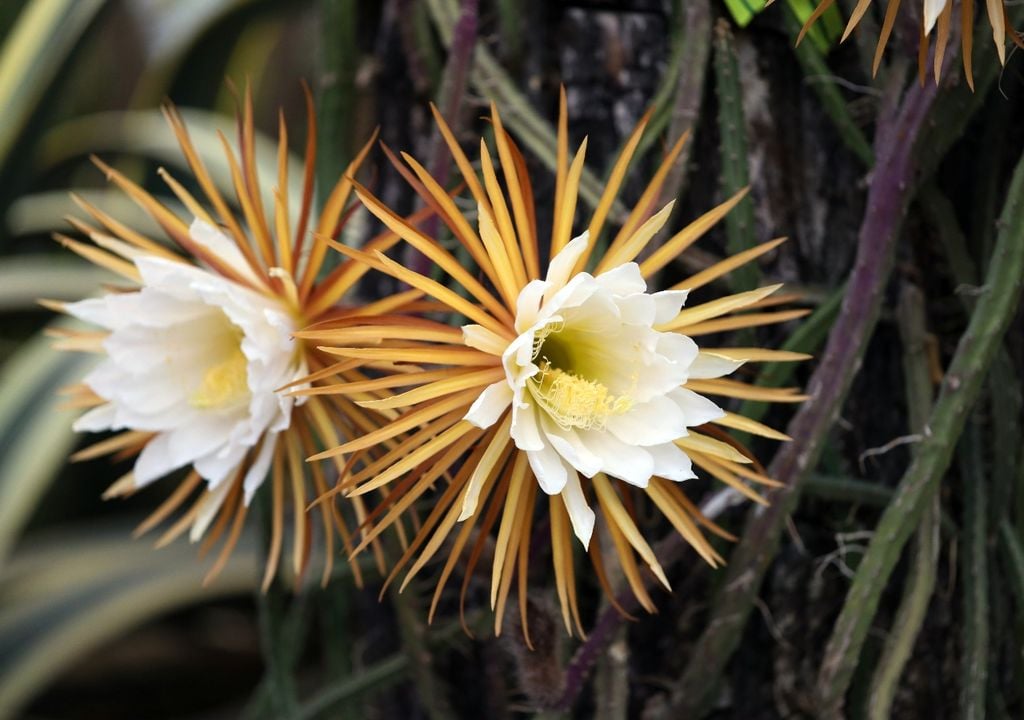
The sun goes down, and for most species it’s time to retreat and rest. But for some plants, night is the moment to open up to the world and bring color and mystery to the garden.
Here are three species that bloom under the Moon and justify staying awake a little longer.
Four O’Clock Flower That Paints the Garden at Dusk: Mirabilis Jalapa
Among the country’s most common night-blooming flowers, few compete with the Four O’Clock Flower—also known as Marvel of Peru or Mirabilis jalapa—an herbaceous plant native to Mexico that adapts to almost any yard.
It thrives on sidewalks, in large pots, and in corners where other plants give up quickly, thanks to a thickening underground tuber that allows it to return every spring, even after a cold winter.
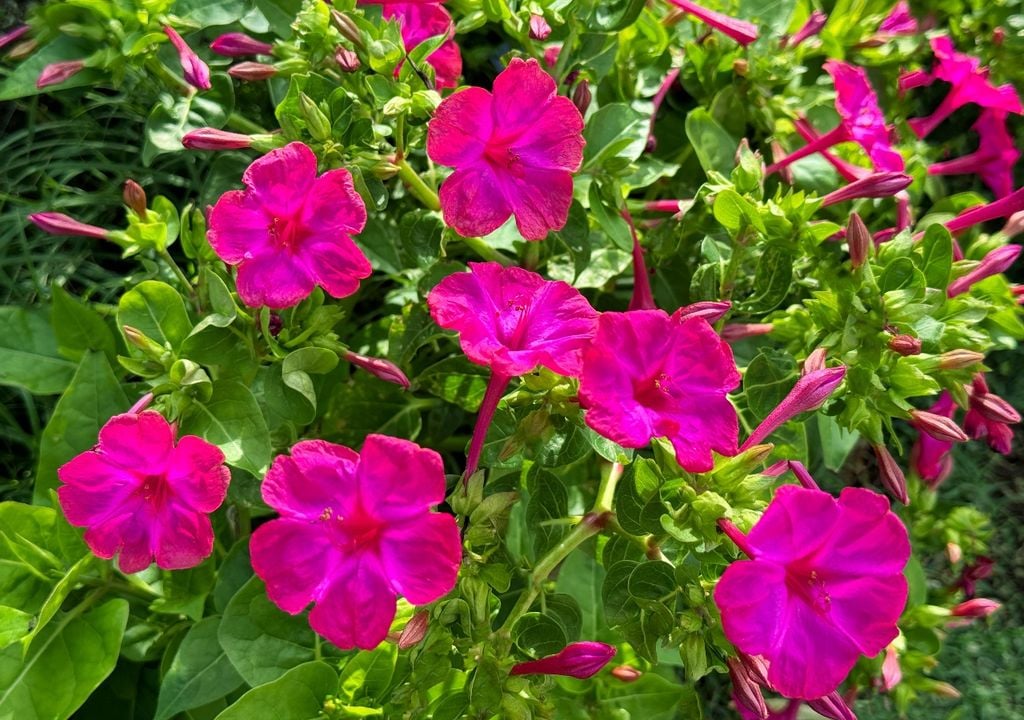
Its charm appears in the timing: the flowers open in the late afternoon and remain open until dawn, closing as soon as the first rays of sunlight return.
The colors are irresistible: white, yellow, pink, fuchsia, and sometimes several tones on a single flower. That effect isn’t a random mutation but a characteristic of the species, capable of producing bicolored, mottled flowers or blooms that shift color throughout the hours.
The corollas measure between 3 and 5 centimeters and make up for size with abundance and a soft fragrance that fills the air without overwhelming. In temperate regions it can behave as a perennial; in places with strong frosts, the aerial part disappears in winter, although the tuber usually survives and sprouts again when temperatures rise.
It doesn’t ask for much: full sun or partial shade, moderate watering, and well-drained soil. In return, it blooms nonstop from late spring to the first days of autumn. Do keep an eye on it: it produces many seeds and may pop up in places where no one invited it. For those seeking a rustic, abundant, easy-care night flower, it is the perfect ally to light up the garden just as the day begins to fade.
Epiphyllum oxypetalum, the Queen of the Night That Opens Only Once
In the world of cacti, few generate as much anticipation as the queen of the night. Epiphyllum oxypetalum is a species native to the warm forests of Central America and parts of northern South America, where it grows as an epiphyte: it clings to trunks and branches with aerial roots, without taking nutrients from them, using the humidity and organic matter that collects on the bark.
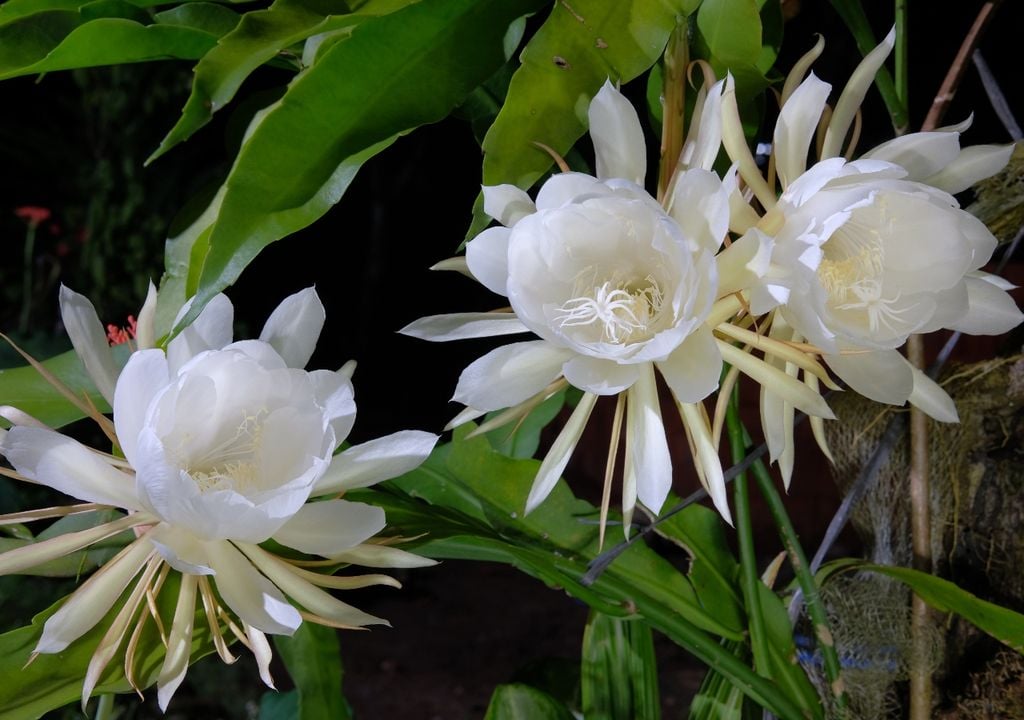
Its flat, fleshy stems—which function as leaves—already show it is not a typical desert cactus. The enormous white flowers reach between 20 and 30 centimeters, have a sweet fragrance, and open when the sun goes down.
It can thrive on bright balconies, patios with gentle shade, and windows with good light but no direct sun. It prefers an airy substrate—cactus mix with perlite or bark—and spaced-out watering, soaking thoroughly and allowing it to dry completely before watering again.
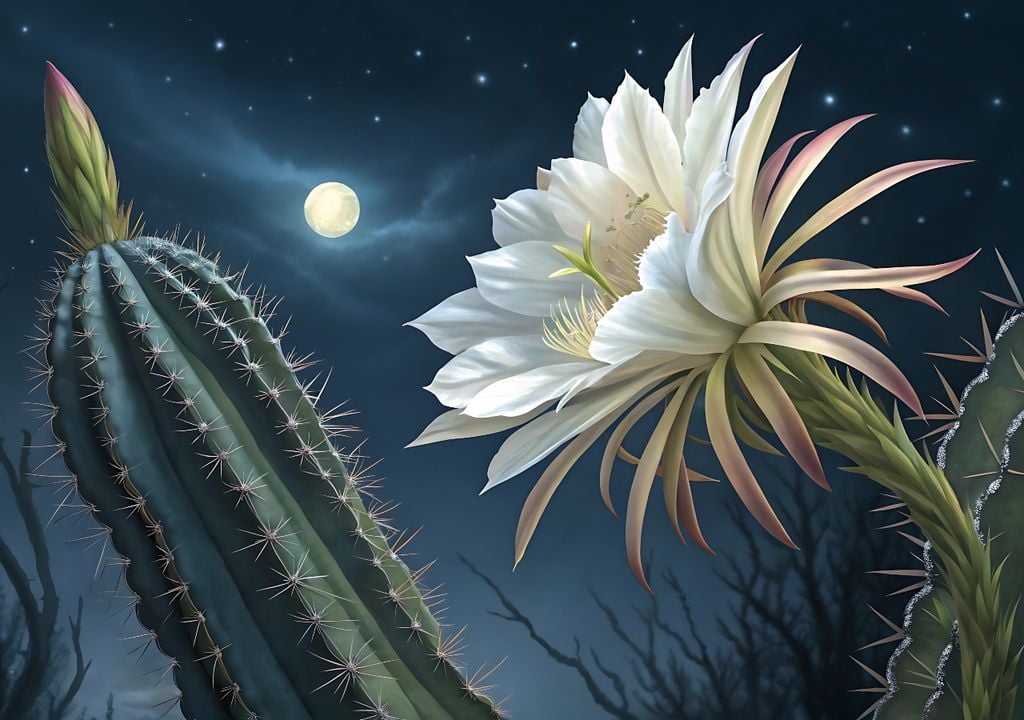
It appreciates ventilation, humidity, and a pot that is wider than it is deep, because its roots extend outward. Well established, it lives many years and occasionally offers that fleeting spectacle that turns an ordinary night into a small event.
Cestrum nocturnum, the Fragrant Shrub That Perfumes the Entire Patio
If what you’re looking for is a plant known for its fragrance, this one is unbeatable. Cestrum nocturnum—known as night-blooming jasmine or lady of the night—is a shrub native to the Caribbean and parts of Central America.
It doesn’t stand out for its flowers, which are small, white or greenish, and somewhat discreet. Its charm appears at dusk, when it releases an intense, sweet, enveloping fragrance that fills the air and transforms any corner into a classic night garden.
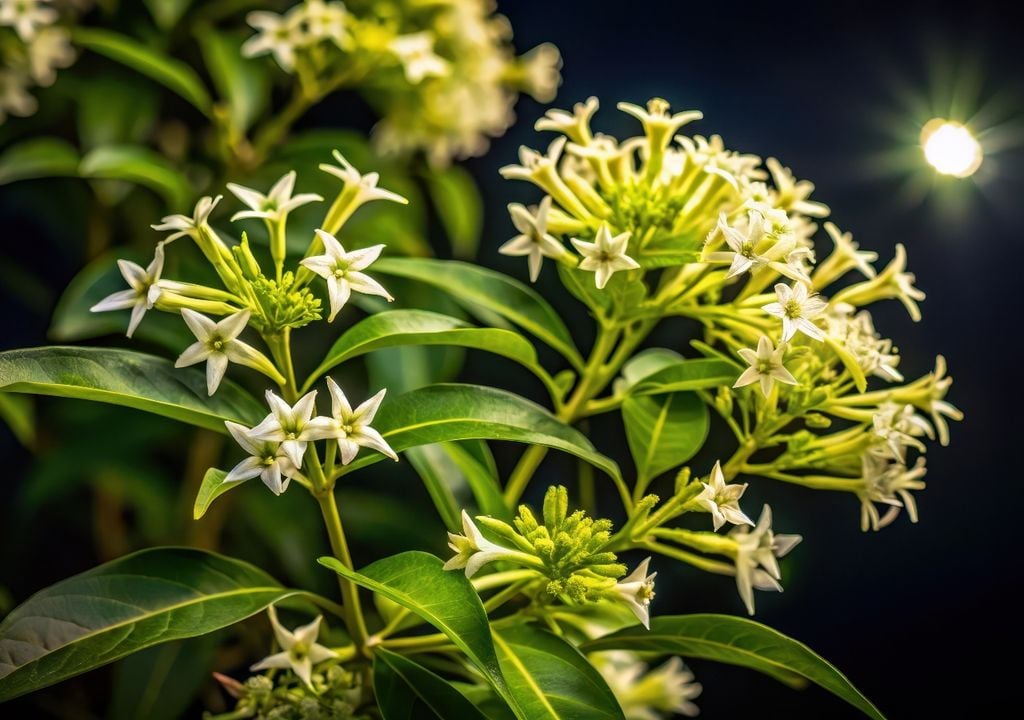
Depending on space and pruning, it can reach 2 to 4 meters, and typically blooms in waves throughout spring and summer and, in mild climates, well into autumn. It appreciates partial shade or soft sun, fertile soil, and regular watering in warm months.
It does not tolerate hard frosts, so in cold areas it’s best to protect it or grow it directly in a large pot so it can be moved. With the right spot, it lives many years and turns the patio into an aromatic delight that switches on when night falls.
Plants that open giant flowers, cacti that climb until they find the perfect light, shrubs that perfume the night like a ritual. Each has its own timing, quirks, and charm. All they need is a bright corner, the right substrate, and the gentle patience we offer to plants that bloom at their own pace. When night comes, they take care of the rest.