
AMOC collapse: the major climate threat missing from almost every country's adaptation plans
Only two of the 91 national adaptation plans examined mention the risk of an AMOC collapse. Yet this vast system of Atlantic currents could dramatically alter temperatures and rainfall in several regions around the world.
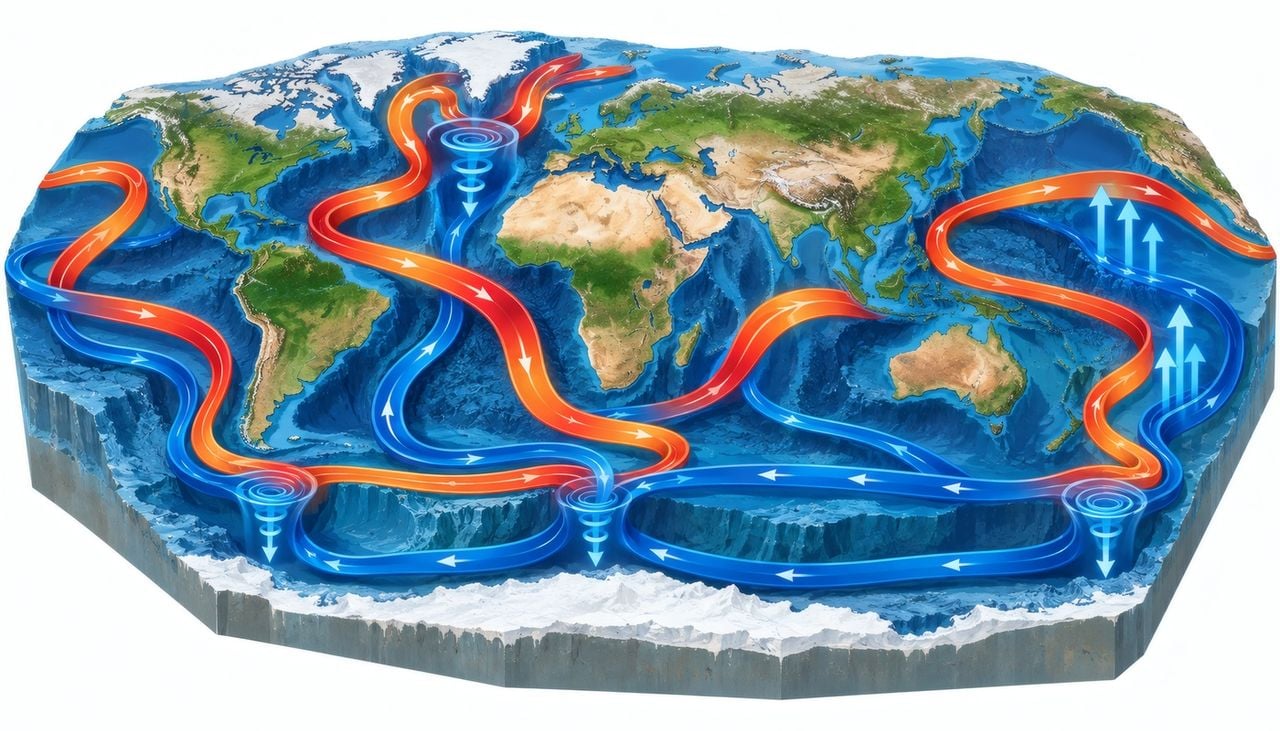
In Iceland, government officials have recently discussed a worrying scenario: what would happen if the major Atlantic current system slowed significantly or even collapsed?
A study published in Nature Sustainability reveals that only two of the 91 national adaptation plans submitted to the United Nations Framework Convention on Climate Change (UNFCCC) mention this risk. Neither of the two includes concrete measures to deal with a potential collapse.
A current system that redistributes heat around the world
At the heart of this concern is the AMOC, which stands for Atlantic Meridional Overturning Circulation. This system transports warm surface waters northwards into the North Atlantic, before bringing colder waters back southwards at depth.
By redistributing heat, it helps regulate the global climate and influences temperatures and rainfall far beyond the Atlantic basin.
A recent study projects a 50% weakening by the end of the century under an intermediate greenhouse gas (GHG) emissions scenario. This figure describes a projected reduction in the strength of the circulation, not the probability of a collapse. A complete collapse before 2100 is still considered unlikely.
The AMOC has already experienced significant variations in the past. Around 17,500 years ago, it underwent an almost complete shutdown, following the coldest period of the last ice age.
Possible consequences extending far beyond the Atlantic
A significant slowdown, and even more so a collapse, would alter the distribution of heat and rainfall across several regions. In north-western Europe, the reduction in heat transported from tropical regions could contribute to much colder winters.
In a scenario involving major disruption to the AMOC, a modelling study considers temperatures potentially falling to -20°C in London. This result illustrates a possible scenario rather than a forecast for any particular year.
Regions dependent on monsoon rainfall would also be exposed. Modelling experiments in which the AMOC is switched off show an average 29% weakening of the West African monsoon and a 19% weakening of the Indian summer monsoon. A reduction in rainfall could put water resources and food security at risk for populations that depend on these rains.
Why is this risk so rarely included in national strategies?
Because it is difficult to determine its probability and timing. Yet its potential impact is considerable: some consequences could run counter to the trends currently prioritised in adaptation policies.
A country that builds a reservoir to cope with more irregular rainfall could find itself poorly prepared if precipitation decreases further and the rainy season becomes shorter. Similarly, investments in coastal protection or agricultural systems could become less suitable if climatic conditions evolve differently from expected.
Brazil and Ireland are among the few countries to mention this scenario. Brazil's plan highlights the risk of the Atlantic rainfall belt shifting southwards, potentially threatening the Amazon. Ireland points out the limitations of adaptation in the event of a possible collapse, given its dependence on the AMOC to maintain its temperate climate.
Preparing investments for several possible futures
The researchers propose five approaches: i) identify the countries and investments most exposed to risk; ii) test infrastructure using simulations that incorporate a significant weakening of the AMOC; iii) prioritise flexible and scalable solutions; iv) strengthen the monitoring of ocean currents; and v) reassess global climate projections. The AMOC also influences the amount of carbon absorbed by the oceans, which could alter projections of future warming.
Anticipating this risk does not mean predicting the date of a collapse or diverting resources away from crises that are already being observed. Rapidly reducing greenhouse gas emissions remains essential. Decisions made today, particularly those concerning water, infrastructure and coastal protection, must be able to withstand several possible climate futures.
News reference
Brenden Jongman, Jim Hall. (2026). Key Atlantic currents could collapse this century, but the risk is missing from almost all national climate plans – new study.