
Scientists use rapid attribution science to find the footprint of climate change in heat waves
An exceptional heat wave occurs, lasting only a few days. Climatologists estimate that such a phenomenon would have been virtually impossible without global warming. What mechanisms do they use to reach this conclusion so quickly?

Today, whenever a heat wave occurs, the question inevitably arises: Is this a normal weather phenomenon or a consequence of climate change?
A new field capable of providing quick answers
Until about a decade ago, it often took months or even years before the scientific community could offer a definitive answer. Today, thanks to advances in climate modeling, researchers can publish an initial analysis in a matter of days.
This field, known as the science of attributing extreme events , does not seek to determine whether climate change "caused" a heat wave, but rather to what extent it increased the probability or intensity of such an event.
This is precisely the work carried out by the international network World Weather Attribution (WWA), which brings together researchers from various countries and employs a methodology widely recognized by the scientific community.
Comparison between the current climate and the past
To understand the implications, climatologists compare two worlds. The first is the world we live in today, characterized by global warming of approximately 1.4°C above pre-industrial levels. The second is a reconstructed climate scenario in which human-caused greenhouse gas emissions have not altered the climate system.
Scientists combine meteorological observations, current forecasts, and climate models to compare the frequency and intensity of a specific phenomenon in both contexts. For this study, they specifically focused on the historical heat waves of 1976 and 2003, two major benchmarks for heat waves in Europe.
Their conclusion is unequivocal: the heat wave of June 2026 would have been virtually impossible at that time of year without human-caused climate change.
Figures that speak for themselves
The study reveals the extent to which the baseline climate has changed over the course of just a few decades. Had comparable atmospheric circulation occurred in 1976, daytime temperatures would have been approximately 3.5°C lower, and nighttime temperatures 2.4°C lower.
The probability of experiencing such intense daytime heat is now about ten times greater than in 2003 , while the probability of recording such hot nights is more than one hundred times higher.
These results illustrate a fundamental climatological phenomenon: the same weather patterns now generate considerably higher temperatures due to the warming of the climate baseline.
A familiar time in an unfamiliar climate
Contrary to popular belief, this heat wave was not caused by an unprecedented meteorological phenomenon. As in other historical episodes, a powerful high-pressure system settled over Western Europe, drawing very hot air from Africa under clear, sunny skies. The difference lies in the climate itself.
According to researchers, this atmospheric configuration already existed in the mid-20th century. However, it is now causing much higher temperatures because the climatic baseline has risen. Furthermore, the analyses rule out any significant influence from the El Niño phenomenon ; it played no role in this heat wave.
Heat involves more than what the thermometer says.
To assess health risks, researchers go beyond simple air temperature. They also use the WBGT (wet-bulb globe temperature) index, a heat stress indicator that combines temperature, humidity, solar radiation, and air movement.
This indicator provides a much more accurate estimate of the difficulty the human body has in cooling down through sweating and serves as a reference in the fields of sports and occupational health.
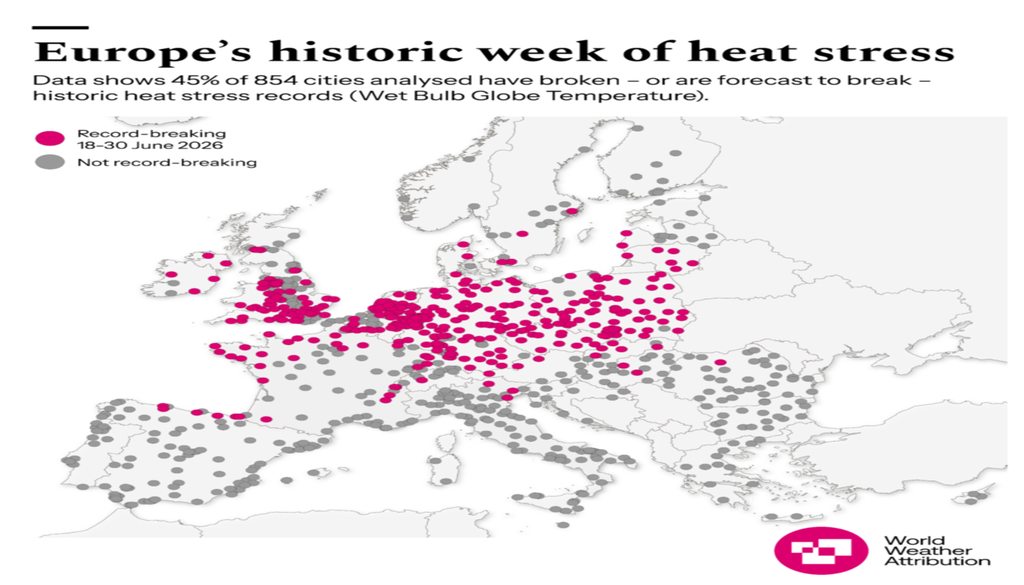
The results are worrying. Between June 18 and 29, almost 45% of the 854 cities studied in 30 European countries exceeded or were close to exceeding historical thresholds for heat stress.
A society facing its own limits
The consequences extend far beyond simple weather records. Currently, heat waves cause more deaths in Europe than all other natural disasters combined . In the summer of 2022, they were linked to more than 60,000 deaths.
Even in 2023, a cooler year, they caused more than 47,000 deaths . It is estimated that the first heat wave of 2025 alone caused around 2,300 deaths in 12 European cities.
The impacts also affect infrastructure : record demand for air conditioning (the highest in at least 45 years), increased risk of fires, disruptions to rail transport due to track expansion, overloading of electricity networks and possible reductions in nuclear power production as the bodies of water used for cooling heat up.
Cities bear the brunt of this vulnerability. The urban heat island effect , the aging housing stock, and social inequalities increase the exposure of residents, especially the elderly, those with chronic illnesses, the homeless, and the most economically vulnerable groups.
Deciphering the present to anticipate future risks
Attributing a heat wave to climate change doesn't mean pointing the finger at a single culprit. Rather, it involves using sound scientific tools to measure how human activities are gradually altering the likelihood of extreme weather events.
A study by World Weather Attribution (WWA) shows that, in just a few decades, temperatures that were once almost unimaginable have become much more likely. This ability to generate analyses in a matter of days has become an invaluable tool for decision-makers.
It allows cities, healthcare systems, and infrastructure to adapt to a climate that is changing faster than our societies. Understanding these mechanisms is essential to better protect the population from extreme events.
Referencia de la noticia
France 24. Le changement climatique, coupable "sans équivoque" de la canicule exceptionnelle en Europe.
Keeping, T. et al.. Fossil fuel emissions have rapidly worsened European heatwaves in just a few decades.