
How airplanes could fly without warming the planet: MIT explains the science behind contrails
An MIT study reveals that geostationary satellites miss most aircraft contrails. Combining different observation technologies could be key to reducing aviation's climate impact.
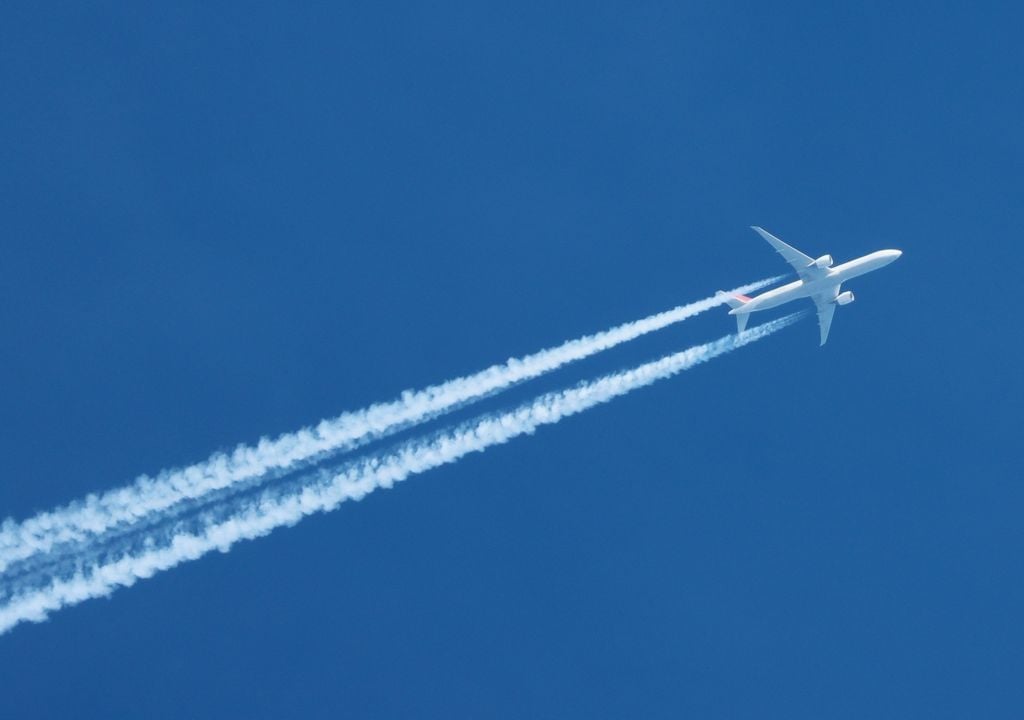
Contrails — those white lines that sometimes streak across the sky behind airplanes—are much more than a visual curiosity. According to various studies, they could be responsible for up to half of aviation's climate impact .
However, detecting them and understanding their evolution remains a scientific challenge . A new study from the Massachusetts Institute of Technology (MIT) warns that one of the main observational tools currently available is insufficient to see the full picture.
A trail that traps heat
Contrails, also known as trails , form when an aircraft's exhaust gases come into contact with layers of cold, moist air . The particles emitted by the engines act as "seeds" upon which water vapor condenses and freezes, forming ice crystals . Initially thin, they can expand and persist for hours, spreading across large areas of the atmosphere.
When they last long enough, these contrails behave like high clouds. During the day, they can reflect some solar radiation, but they also trap heat radiated by the Earth's surface. At night, their effect is exclusively warming. Overall, studies agree that they contribute to the increase in global temperature .
Avoid contrails to reduce emissions
One of the strategies being explored to reduce aviation's climate impact is to slightly modify flight routes or altitudes to avoid areas where persistent contrails are more likely to form, similar to how turbulence is avoided today . The challenge lies in knowing precisely where and when these contrails will form.
To do this, scientists analyze satellite images of past contrails and develop identification and forecasting systems. Geostationary satellites, located at an altitude of about 36,000 kilometers, are the backbone of these observations : they cover enormous areas and take images of the same location every few minutes, day and night.
What satellites can't see
The new MIT study compared images of contrails taken by geostationary satellites with those obtained by low Earth orbit (LEO) satellites, which fly much closer to Earth and capture a greater level of detail, albeit less frequently.
The result was conclusive: geostationary satellites fail to detect approximately 80% of the contrails that appear in LEO satellite images . The reason is that the former only manage to identify the largest and most developed contrails, while the smaller, shorter, and thinner ones—newly formed—go unnoticed.
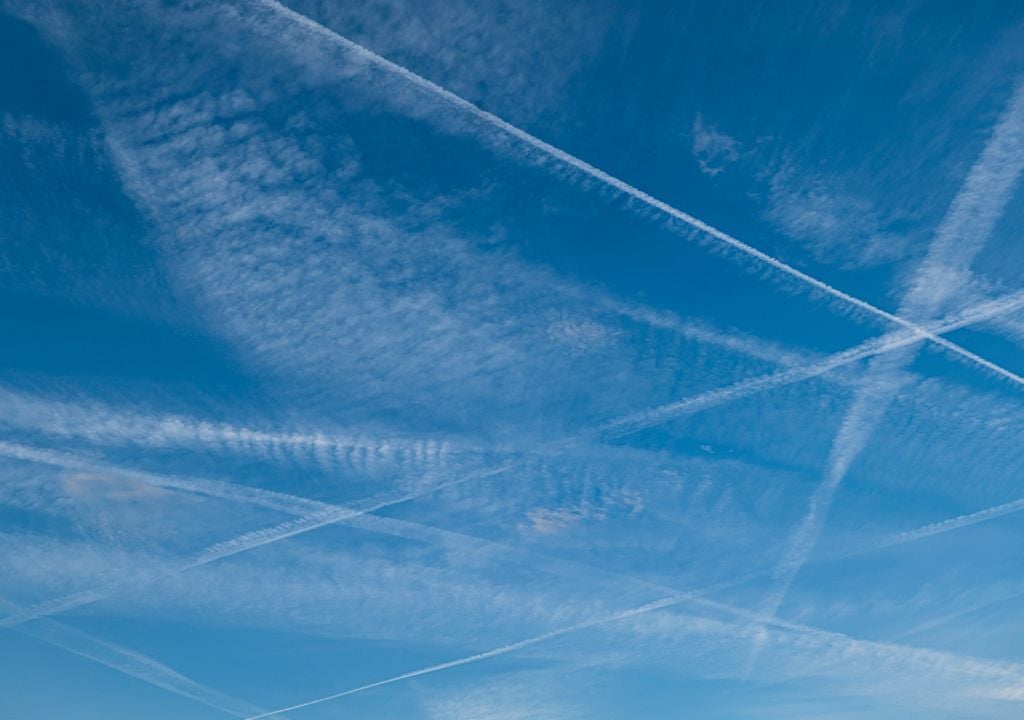
This doesn't necessarily mean that 80% of the climate impact is being ignored, since larger contrails tend to have a greater effect. But it does reveal that the current picture is incomplete .
Towards a more comprehensive view of the sky
The researchers emphasize that no single observation system is sufficient on its own . Geostationary satellites provide continuous and wide coverage; low-Earth orbit satellites offer higher resolution; and ground-based cameras could capture contrails in real time as they form.
Combining these perspectives would allow scientists to reconstruct the complete life cycle of a contrail : from its initial appearance to its dissipation. With sufficient data, it would be possible to develop real-time predictive models that indicate whether an aircraft is about to fly through a contrail-prone region and how to adjust its altitude to avoid them.
An opportunity, but with caution.
For scientists, contrail avoidance is seen as one of the few relatively quick and low-cost options for reducing the climate impact of a sector that is difficult to decarbonize. However, they warn that implementing these measures without solid information would be premature.
“The challenge is to do it rigorously ,” say the authors of the study, which was published in the journal Geophysical Research Letters . Improving observational tools is not only a scientific matter, but also a necessary step before airlines and regulators make decisions with global impact.
In the sky, many of the traces left by airplanes remain invisible . Seeing them better could make all the difference.
News reference
Euchenhofer M., et.al., Contrail Observation Limitations Using Geostationary Satellites . Geophysical Research Letters. https://doi.org/10.1029/2025GL118386