
Why the higher you climb a mountain, the colder it gets – science explains
The mechanisms that cause air to warm or cool are not driven by the Sun, but by atmospheric pressure. Here we explain how the laws of physics and chemistry directly influence our everyday life.
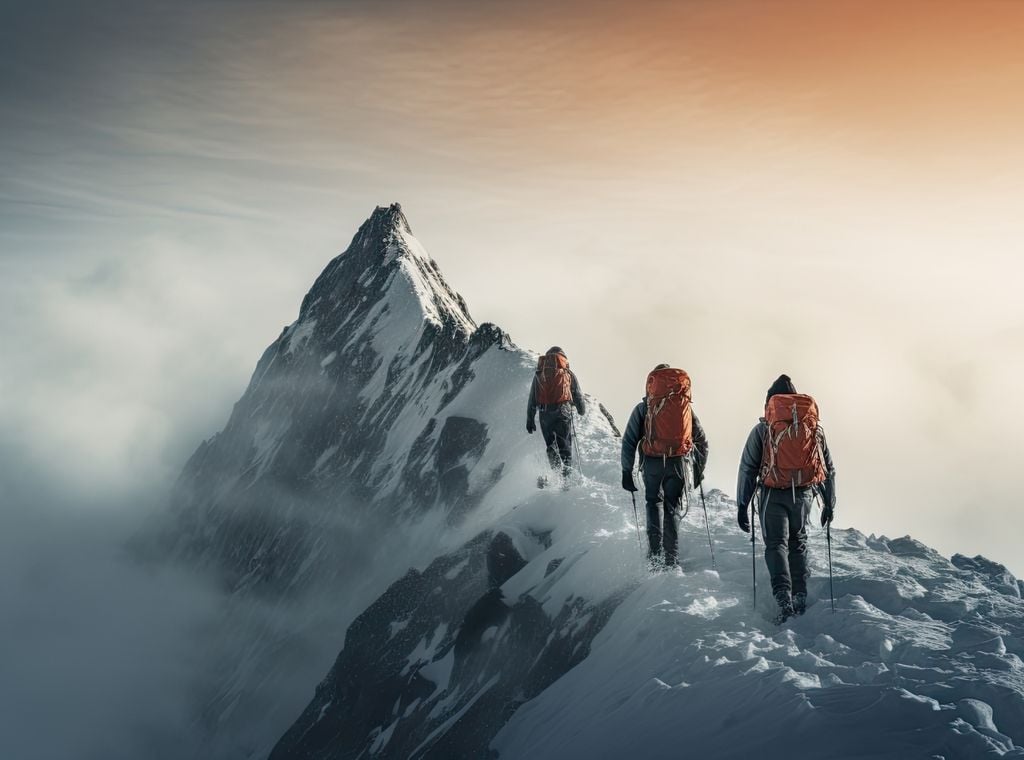
The Earth is around 150 million kilometres from the Sun. Even if we climb a mountain several kilometres high, we are still extremely far from it. Therefore, the Sun does not play a significant role in the air temperature as we ascend a mountain, and the drop in temperature is not caused by being slightly farther from the Sun.
When sunlight hits the ground, the surface absorbs that energy and then emits it as heat through infrared radiation, warming the air in direct contact with the surface. This is why the warmest air is near the ground and not in higher layers of the atmosphere.
How does atmospheric pressure affect temperature?
The atmosphere is composed of a mixture of gases, each with different masses and therefore different weights. At sea level, the air must support the weight of the entire column of air above it, producing high atmospheric pressure.
However, as we gain altitude, there is less air above us, so atmospheric pressure decreases. This allows the air to be less dense, with molecules spaced further apart.
Additionally, when gas molecules are closer, they collide more and transfer thermal energy more efficiently. Conversely, when molecules are further apart, they store less thermal energy. Therefore, air density is key to air temperature: higher density, lower temperature; cold air is denser than warm air.
What is adiabatic cooling?
When a mass of air is warmer, it is less dense and rises. As it rises, the external air pressure decreases. As a result, the air expands, pushing against the surrounding air and using part of its internal energy to do work.
This process is called adiabatic cooling, in which temperature decreases even though no heat is lost to the environment. It is one of the most important mechanisms in meteorology.
In the real atmosphere, some water vapour usually condenses as the air rises, and the average temperature decrease is about 6.5°C per 1000 m, which is the vertical thermal gradient.
Air also acts as a thermal insulator. The denser the air, the better it retains heat. This is why at low altitudes, the atmosphere functions like a blanket, preventing heat from escaping into space. In mountains, there is less air, so the blanket effect is weaker, allowing heat to escape more easily, especially at night, resulting in very low temperatures at high altitudes.
Other influencing factors
The type of surface, snow cover, and wind also affect temperatures. Mountain surfaces often have bare rock, poor soil, or snow.
Snow reflects much of the incoming solar energy, absorbing less, so the ground warms little and transmits less heat to the air above.
Wind at high altitudes, caused by pressure differences and the absence of obstacles, also plays a role. It does not reduce the actual air temperature, but it increases heat loss from the human body, removing the layer of warm air around the skin and creating a sensation of colder temperatures.
There are exceptions, such as temperature inversions, where cold air is trapped in valleys under a layer of warmer air, sometimes forming a sea of low clouds. Although in these situations it may be colder in the valley than higher up, they are temporary and do not change the general rule that it gets colder as we climb a mountain.