
A "Cold Blob" in the North Atlantic May Reveal Weakening Ocean Currents
Researchers have linked the unusual Atlantic “cold blob” to reduced ocean heat transport, providing further evidence of changes in a major ocean circulation system.

While the global ocean has generally gained heat over recent decades, one region of the subpolar North Atlantic has moved in the opposite direction. The cooling patch south of Greenland and Iceland appears to be driven mainly by weakening ocean heat transport, according to a study published in Geophysical Research Letters.
What cooled the “cold blob”?
The research examines a long-running question about the “cold blob,” also known as the Atlantic “warming hole.” Scientists have debated whether currents are bringing less heat into the region or whether the ocean is releasing more warmth to the atmosphere.
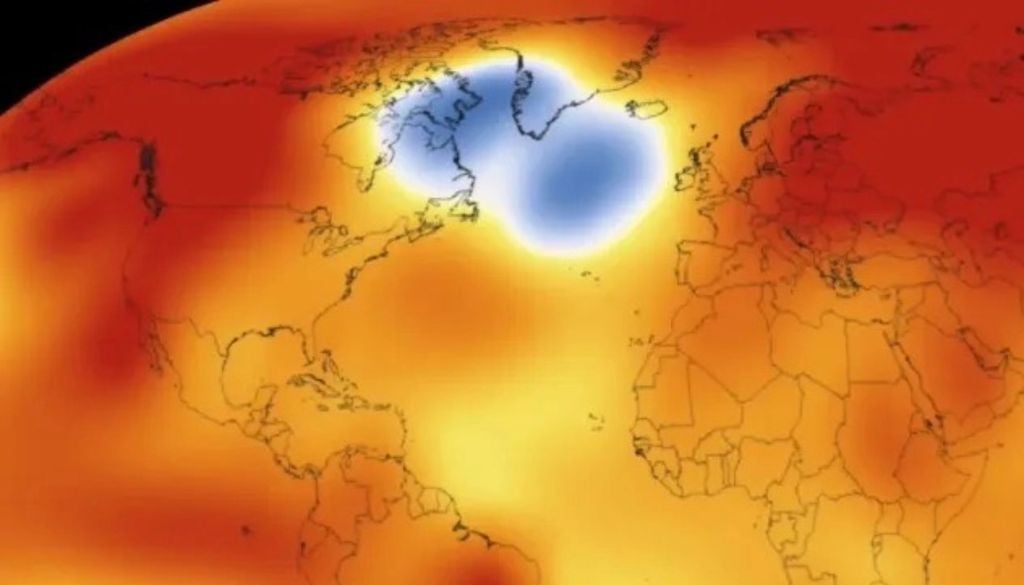
The results favor the first explanation. After analyzing observation-based ocean heat content and surface flux data, the team found that the cooling cannot be explained by increased heat loss at the sea surface.
Surface heat loss falls short
If surface heat loss were responsible for the cold patch, the region would show an increasing amount of heat escaping from the ocean into the atmosphere over time. Instead, the analysis found that this transfer has decreased, especially since 1993.
That pattern fits with reduced heat delivery by ocean circulation. If currents bring less warmth to the subpolar North Atlantic, there is less energy available to release into the air above it.
The cooling also extends below the surface. The study found a decline in ocean heat content through much of the water column, with the strongest multidecadal changes in roughly the upper 1,000 meters. That layer is associated with northward heat transport by the Atlantic Meridional Overturning Circulation, or AMOC.

The AMOC carries warm water northward through the Atlantic and helps shape climate across parts of Europe, North Africa, and the broader North Atlantic region. A weaker AMOC would reduce the amount of heat delivered to the subpolar Atlantic, while also affecting rainfall patterns, regional temperatures, and sea levels along parts of the Atlantic coast.
A warning signal in Atlantic circulation
The researchers also examined a warm strip along the North American coast north of Cape Hatteras. That pattern has been described as part of an AMOC “fingerprint,” because weakening circulation can be linked to a northward shift of the Gulf Stream.
Here, too, surface fluxes did not support a simple atmosphere-driven explanation.
The study does not rule out a role for surface conditions—winds, weather patterns, and the North Atlantic Oscillation may still affect shorter-term changes. In summer, shallow layers can warm rapidly under sunlight and temporarily mask the "cold blob," while deeper winter mixing can bring the longer-term signal back into view.
Uncertainty remains
The findings support the interpretation that the cold patch is a sign of a weakening AMOC, but they do not determine how close the system may be to a tipping point. Direct AMOC measurements cover only recent decades, while longer reconstructions rely on indirect evidence.
Other research has pointed to weakening over longer time scales, including paleoclimate records, salinity changes, Gulf Stream observations, and density shifts in the subpolar Atlantic. Climate models also project future weakening under continued warming, though they differ in timing and sensitivity.
The cold patch is therefore more than a local temperature anomaly, offering a visible clue to changes in Atlantic heat transport, while underscoring how much scientists still need to learn about the pace and limits of AMOC weakening.
News reference
Gramling, C.. (2026). The North Atlantic’s ‘cold blob’ may signal a major current’s decline.
Rahmstorf, S., Jendrkowiak, J., Gou, R., Cheng, L., Ruiz‐Angulo, A., & Björnsson, H.. (2026). Multidecadal Atlantic “Warming Hole” Heat Content Variations Are Caused by Ocean Heat Transport, Not by Surface Fluxes.