
A study on microbes supports the idea that life could have travelled between planets under extreme conditions
Tiny forms of life embedded in debris blasted from a planet by an asteroid impact could travel through space and arrive on another world still alive, according to new experiments by researchers at Johns Hopkins University.
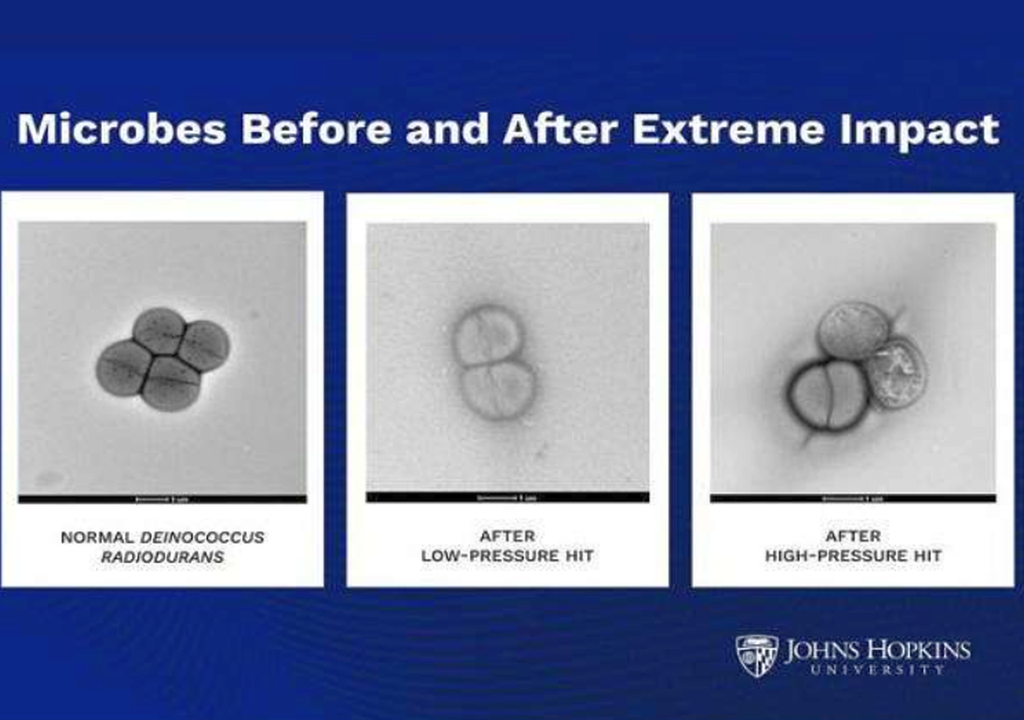
The work strengthens the hypothesis of lithopanspermia, which proposes that impacts can eject rock fragments carrying microorganisms that may later seed life on other planetary bodies.
The study, published in PNAS Nexus, focused on Deinococcus radiodurans, a bacterium from the Chilean desert known for its resistance to extreme cold, dryness and intense radiation. With its thick outer layer and remarkable ability to repair DNA, this microbe serves as a realistic stand in for life that might exist in hostile environments such as Mars or other planets.
Life can travel through space after asteroid impacts
To simulate the conditions of an asteroid impact and the violent ejection of material from Mars, the team placed bacteria between metal plates and fired a projectile at the setup using a gas gun. The impact generated pressures of one to three gigapascals, while the projectile reached speeds of up to around 480 kilometres per hour, recreating the intense mechanical shock experienced by rocks expelled from a planetary surface.
For comparison, the pressure at the bottom of the Mariana Trench, the deepest point in Earth’s oceans, is about one tenth of a gigapascal. Even the lowest pressures in the Johns Hopkins experiments exceeded this by more than ten times, surpassing levels many scientists believed living cells could not endure.
After each test, researchers measured how many microbes survived and examined their genetic material for signs of damage and repair.
At lower pressures, the cells showed no visible structural damage, while at higher pressures some displayed membrane rupture and internal damage, yet survivors were still present.
Lead author Lily Zhao explained that the team continued increasing the impact speed in an attempt to completely destroy the cells, but found them far more resistant than expected. Instead, the experimental hardware failed first, as the steel structure holding the plates broke apart before the entire microbial population could be eliminated.
On Mars, fragments ejected by asteroid impacts are thought to experience a wide range of pressures, typically around five gigapascals, with some subjected to even higher stress. The new results show that the test microbe can tolerate nearly three gigapascals, well within the range associated with material launched from the Martian surface.
Senior author KT Ramesh stated that the findings suggest that life can survive large scale impacts and ejection, opening the possibility that microorganisms could travel between planets. The work also raises the idea that life on Earth may have originated elsewhere in the solar system before arriving via impact debris.
The possibility that living material can move between planetary bodies has direct implications for planetary protection policies governing space missions. Current protocols impose strict limits on missions to potentially habitable worlds such as Mars to avoid contamination by Earth life, as well as on sample return missions to prevent uncontrolled introduction of extraterrestrial organisms to Earth.
Given that the study indicates microbes could survive the conditions associated with material escaping Mars, the authors argue that debris reaching nearby bodies, including its two moons, could also carry viable life. Phobos, which orbits close to Mars, may receive ejecta exposed to lower pressures than material reaching Earth, making it a particularly important target when assessing contamination risks.
The team notes that this broader understanding of survival under impact conditions may require a reassessment of planetary protection rules, especially for destinations currently considered lower risk but still capable of accumulating biologically significant material from Mars. Ramesh emphasised the need for caution when selecting mission targets and designing spacecraft systems to minimise unintended biological transfer.
Looking ahead, the researchers plan to test whether repeated shock events similar to impacts could select for even more resilient bacterial populations or drive adaptive changes that enhance survival under extreme mechanical stress. They also aim to extend their experiments to other organisms, including fungi, to determine whether such resilience is widespread across life or limited to a few extreme microbes.
Source: Universidad Johns Hopkins
Referencia
Lily Zhao, Cesar A Perez-Fernandez, Jocelyne DiRuggiero, K T Ramesh, Extremophile survives the transient pressures associated with impact-induced ejection from Mars, PNAS Nexus, Volume 5, Issue 3, March 2026, pgag018, https://doi.org/10.1093/pnasnexus/pgag018