
Astronomers discover a new type of astrophysical object: a black hole star the size of the Solar System
The combination of a black hole and an enormous star is a phenomenon never seen before, and could explain the mysterious little red dots that often appear in deep-space images, according to a paper in Nature.
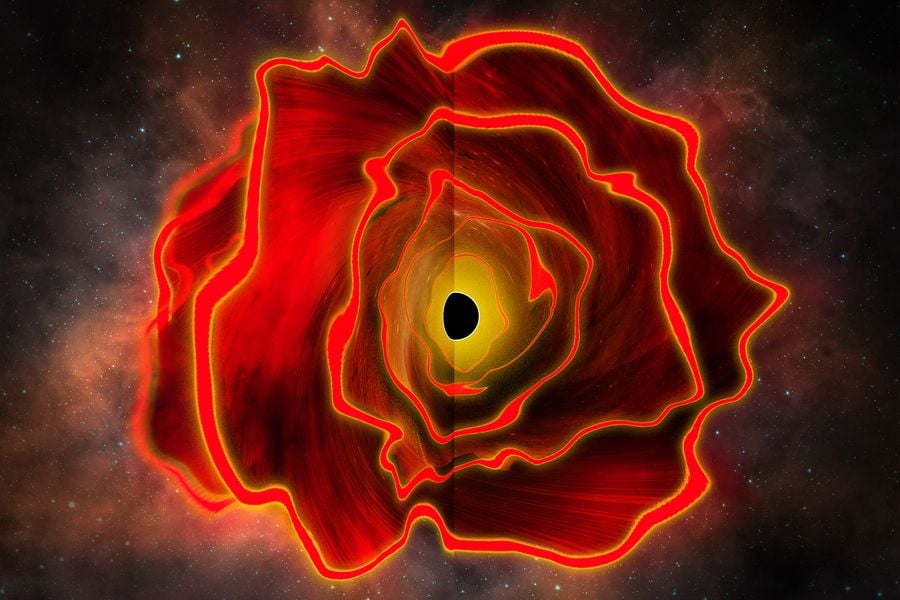
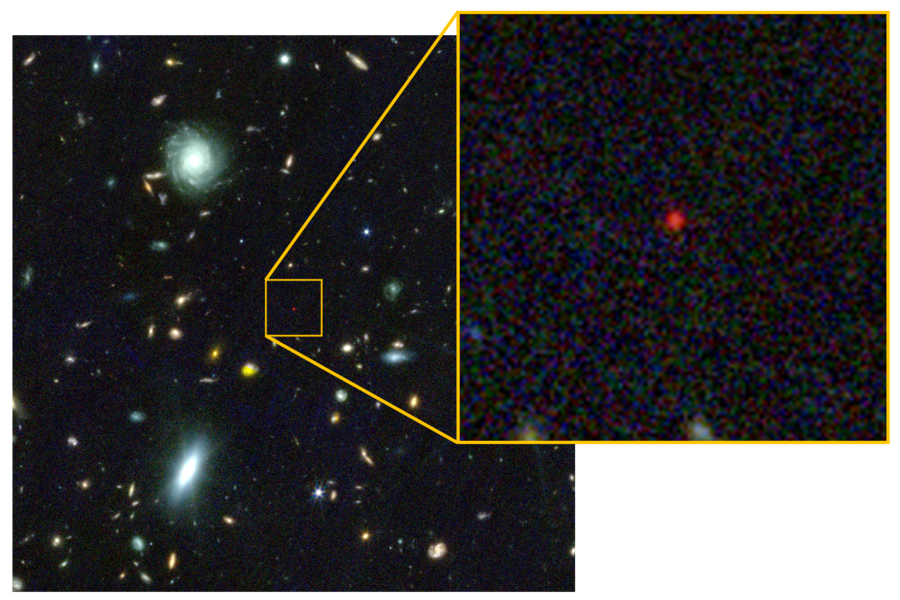
Astronomers from Massachusetts Institute of Technology (MIT) and other institutions have detected an extremely bright red spot in the early universe. This object resembles a gigantic star, the size of our Solar System. However, it emits 100 billion times more energy than any known star can physically produce. In fact, this energy is closer to what a black hole could generate.
This curious combination suggests that the red spot is a completely new type of astrophysical source. Astronomers have named it a "black hole star".
In a paper published today in the journal Nature, the team presents its analysis of the new object, discovered using NASA's James Webb Space Telescope (JWST). The telescope detected the bright red spot in the early universe, just a few hundred million years after the Big Bang.
The scientists conclude that the most likely explanation for the strange red spot is that it is a merger between a black hole and a star, a combination never observed before. The object is likely to be an extremely dense cloud of gas, powered not by conventional nuclear fusion, but by a central black hole.
"Our picture of this object is evolving very rapidly," says lead author Rohan Naidu, a NASA Hubble Fellow and Pappalardo Fellow at MIT's Kavli Institute for Astrophysics and Space Research (MKI).
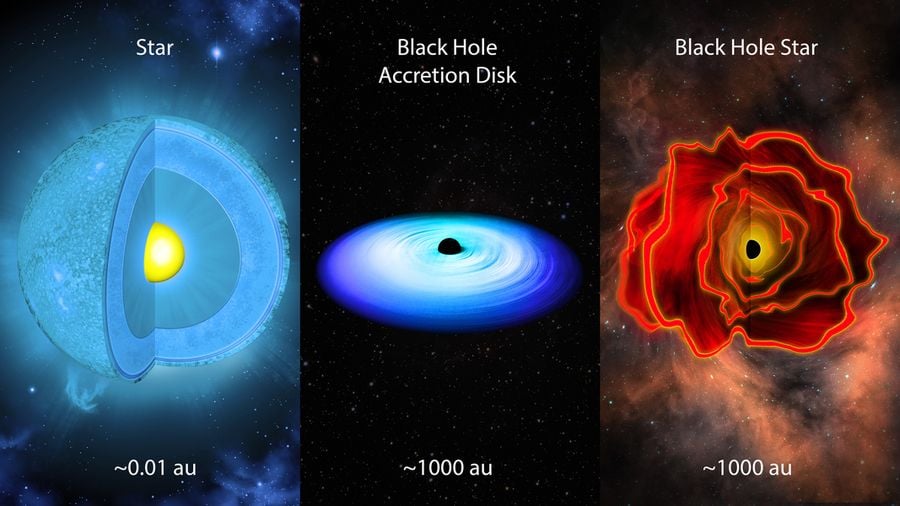
"We think there is a central black hole 100,000 times more massive than the Sun. And around this black hole, there would be a very extended envelope of gas that looks like a star the size of the Solar System. It's enormous."
If the bright red spot really is a black hole star, it would help solve the mystery of the identity of other "little red dots" that have appeared in almost every deep-space image taken by the James Webb Space Telescope to date.
"These little red dots seem to be everywhere in the early universe, but they practically disappear today," says Naidu. "Exactly what these objects are has been one of the most debated topics of the JWST era."
The study's co-authors at MIT are Robert Simcoe, director of the MKI and the Bruno B. Rossi Professor of Experimental Physics; and Wendy Sun '26, along with collaborators from other institutions.
A unique source
Naidu and his colleagues were not intending to find a black hole star. They were searching for the most distant and earliest galaxies, as part of a study they called "Mirage or Miracle" (MoM). The team used the James Webb Space Telescope (JWST) to observe deep space, when the universe was only a few hundred million years old. Their aim was to find galaxies that had formed during those earliest times.
"There has been a puzzle: the appearance of many bright galaxies at extremely early times," explains Naidu. "What we discovered was that what looks like an extremely bright early galaxy, a 'miracle', could in some cases actually be a 'mirage'."
"When we see something very red in the universe, we usually assume that it is surrounded by dust, like soot or ash," explains Simcoe. "In the same way that smoke from the Canadian wildfires recently turned the sky over Boston bright red, astronomical objects can also appear redder than their intrinsic colour when viewed through a layer of dust."
But the light displayed other characteristics that did not quite match what physicists expect from dust. The team also observed another strange pattern: the light from the spot was extremely bright, except below certain wavelengths, where it disappeared completely.
This spectral drop is known as a "Balmer break", a feature traditionally associated with dense gas that absorbs photons in the atmospheres of stars hundreds of millions of years old. Vega, one of the brightest stars in the night sky, displays precisely this pattern.
"The break we observed in this object is the deepest we have ever seen in any object, which rules out 'ordinary' stars as the source," says Naidu. "But it made us wonder whether we were seeing a new type of 'stellar atmosphere', but on a spectacular scale."
What's more, the red spot's light contained virtually no traces of metals or any other elements apart from hydrogen and helium. "It was truly unique in many ways," says Naidu.
Pure light
To determine what the origin of the red spot might be, the team ran simulations of different scenarios to see what combination of astrophysical characteristics could produce the red spot's distinctive colour.
"We started asking ourselves: Could you create something this red using only hydrogen, without dust?" says Simcoe. "To our surprise, it turns out you can, if you have an extremely dense layer of hydrogen, so dense that it looks more like the surface of a huge star than a faint interstellar nebula."
Their simulations suggested that the red spot could be a powerful hidden energy source, surrounded by a dense hydrogen envelope. If so, this would explain the Balmer break that blocks the light and the absence of any elements other than hydrogen and helium, as observed by the astronomers. However, this would not explain the object's extreme brightness.
"You have something that looks a little bit like a star, but it's 100 billion times brighter," says Naidu. "That means you can't power it with nuclear fusion, which is the energy source found in the cores of all the stars we know."
However, black holes routinely produce energy on the scales observed by the team. Naidu and his colleagues incorporated an actively accreting black hole into their simulations of the hydrogen-wrapped star and varied the black hole's mass, along with other parameters. They then compared the resulting brightness of the simulated "black hole star" with the brightness that JWST observed from the red spot.
Specifically, the object probably contains a central black hole with a mass approximately 100,000 times greater than that of the Sun. This powerful core is surrounded by a dense, star-like hydrogen envelope, whose size is similar to that of the Solar System.
The team has named the object MoM-BH-1*, after the study that detected it, and has also given it the nickname "black hole star - one", implying that it is the first of other similar objects. The researchers suspect that black hole stars could explain many of the other little red dots appearing in JWST images. These objects are not as bright as MoM-BH*-1.
"Every little red dot is consistent with being a black hole star, embedded in a generic early galaxy," says Naidu. "But what is special about MoM-BH-1 is that the black hole star is completely outshining its surrounding host galaxy, in such a way that we are seeing pure black hole star light."
Source: MIT Massachusetts Institute of Technology
News reference
Naidu, R.P., Matthee, J., Katz, H. et al. A gas-enshrouded and gas-reddened black hole at cosmic dawn. Nature.