
Could Mars generate lightning like Earth?
A group of researchers has detected the signal of a “whistler” in a one second snapshot captured by the MAVEN probe orbiting Mars, which could be linked to the presence of lightning.
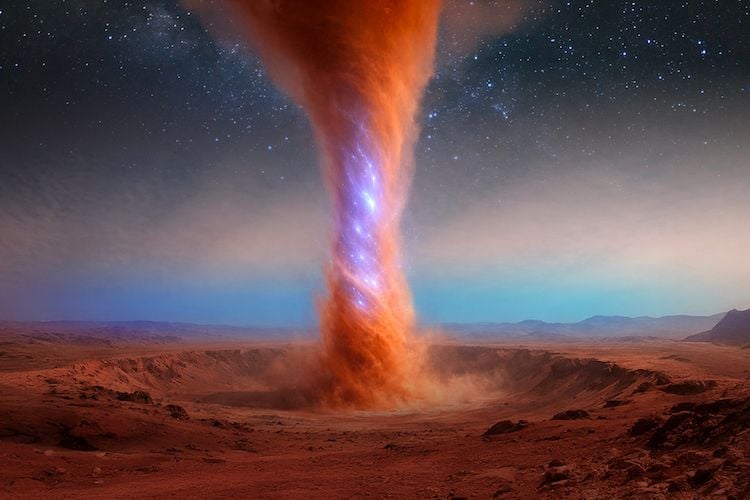
Researchers from the Czech Republic report having identified the signal of a “whistler” in a one second snapshot captured by the MAVEN spacecraft as it orbited Mars. This phenomenon, observed in the planet’s ionosphere, would represent the first lightning like electrical discharge ever recorded there, and the finding is considered important for understanding atmospheric processes in the Martian atmosphere.
“Whistlers are well known on Earth and are associated with lightning,” explains space physicist František Němec from Charles University, who led the research. “Our result implies that this phenomenon also occurs on our neighbouring planet.”
Unlike Earth, Mars does not have a global magnetic field but instead possesses localised magnetic fields created by magnetised materials in its crust. In addition, due to its thin atmosphere, lightning on Mars does not originate in water clouds but rather in dust storms, similar to those observed in terrestrial volcanic eruptions and dust devils.
During dust storms, dust grains become electrically charged as they collide with each other, generating an electric field. On Mars, previous studies have predicted that this field can discharge when it exceeds the breakdown threshold in the low pressure Martian atmosphere, which is around 15 kilovolts per metre.
Dust devils, for their part, can produce ultra low frequency radiation on Earth thanks to fluctuating electrical charges as dust spins. Since both dust devils and storms are far more intense on Mars, theory suggests they could generate broadband radiation detectable from Earth. Despite recent measurements from the Allen Telescope Array, the Mars Global Surveyor mission, the Mars Atmosphere and Volatile Evolution mission, and the Mars Express probe, no conclusive evidence of Martian lightning had been found until now.
Analysis of electromagnetic radiation
According to Němec, another way to detect these electrical discharges is by analysing the electromagnetic radiation that accompanies them. This radiation falls within the extremely low and very low frequency range and, under certain conditions, can reach a planet’s ionosphere. The phenomenon was first identified on Earth shortly before the space age and has since been successfully used to provide evidence of lightning on Jupiter, Saturn and Neptune.
These waves are known as whistlers, he explains, because of their characteristic spectral pattern in the plasma environment of the ionosphere. In this medium, higher frequency waves travel faster and reach the observation point before lower frequency ones, producing a distinctive “whistling” spectral signature.
The challenge for observation lies in the fact that these waves can only penetrate the Martian ionosphere on the night side of the planet and when the magnetic field is oriented vertically. This greatly limits the regions of Mars where spacecraft can detect magnetic whistlers, specifically to relatively small areas of crustal magnetic field in the planet’s southern hemisphere.
Němec reports having identified the electromagnetic signal of a whistler on Mars in a snapshot captured by the MAVEN probe on 21st June 2015. “I first identified it at night in a region with a strong and nearly vertical magnetic field, which is crucial for the wave to propagate to the altitude where the spacecraft orbits without excessive signal attenuation.”
Out of the many wave snapshots analysed, 108418 in total, only this single event contained a whistler signal, as he explains to Physics World. “This likely reflects both the rarity of the phenomenon itself and the specific ionospheric and magnetic field conditions required for the wave to propagate to the spacecraft.”
The MAVEN probe has been orbiting Mars since 2014 and transmitted data back to Earth until communication was lost last year. Although no large scale dust storms were recorded on the planet at the time the whistler was detected, Němec and his colleagues suggest that the signal may have originated from a localised dust event.
Different propagation speeds
“Whistlers form because, in the ionised plasma of the ionosphere, different signal frequencies propagate at different speeds,” explains Němec. “As a result, although all frequencies are generated simultaneously during an electrical discharge, the higher frequencies, which travel faster, reach the spacecraft first, followed later by the lower frequencies.”
The researchers, who describe their work in Science Advances, calculated the corresponding time delays and report that their observations match theoretical predictions very well. They also calculated how the waves attenuate by adapting methods used for Earth to the assumed composition of the Martian ionosphere. The results showed that higher frequencies are attenuated more strongly, which explains why only the low frequency portion of the whistler is observed.
Source: Physics World
Reference
František Němec et al.,Lightning-generated waves detected at Mars.Sci. Adv.12,eaeb4898(2026).DOI:10.1126/sciadv.aeb4898