
There is a 'ghost' island in Australia that only exists on maps
For over a hundred years, an island called Sandy appeared on nautical charts and official maps off the coast of Australia. In 2012, a scientific expedition sailed to its coordinates and discovered something unexpected

On the maps, the island was there. Black, compact, with a defined outline. Between Australia and New Caledonia, in the middle of the Coral Sea, there was a piece of land called Sandy Island . It wasn't a marginal rumor or a footnote: it appeared on nautical charts, atlases, and even on digital platforms.
The problem is that when they went to look for her, there was nothing there.
A mistake that persisted for decades
The first known record dates back to 1876. A French whaler reported the presence of a sandy island in that area of the Pacific. From then on, the information was copied onto nautical charts and cartographic documents. And when something appears on an official map, it acquires an aura of truth that is difficult to dispute.
This is how many historical cartographic errors work: they are inherited. A map is based on a previous one, which in turn was based on an even older report. The chain can last for decades.
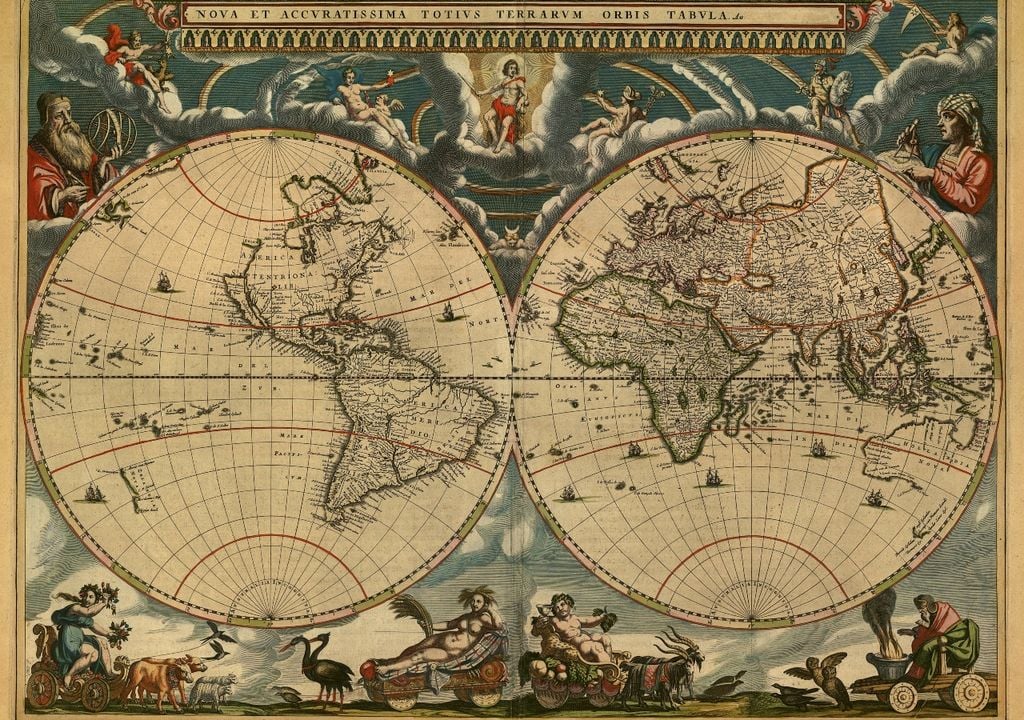
In cartography, there's a term for the unknown: terra incognita. For centuries, it designated unexplored or poorly documented regions. In Sandy's case, the paradox is different: it wasn't unknown land. It was nonexistent land.
The journey to an empty point
In 2012, a team from the University of Sydney decided to investigate what lay at those coordinates. The expedition set sail aboard the research vessel RV Southern Surveyor, equipped with oceanographic instruments capable of measuring depth and mapping the seabed.
The charts indicated that an island should emerge there. The sonar showed something else: an ocean floor 1,400 meters deep. Not a submerged sandbar. Not a barely visible reef. Deep water.
The contrast is stark. Where the map depicted land, the bathymetry showed a continuous dark blue. The island that had appeared for over a century did not exist.
How can an imaginary island survive?
The question is unavoidable. In an age of satellites, GPS, and remote sensors, how does a phantom island survive?
First, because its origin predates that technology . In the 19th century, reports relied on visual observations and coordinates estimated with instruments far less precise than those used today. A positional error, a misinterpretation of low clouds, or floating pumice deposits could be mistaken for "land."
Second, because the ocean covers more than 70% of the planet's surface, and many areas remain poorly sampled . Unlike a mistake on land, which is immediately obvious, a remote island in the open sea can go undetected for generations if no one sails directly over it with modern instruments.
Until 2012, Sandy even appeared on Google Maps. Digital mapping also inherits historical databases. When the Australian team published their results, the island was removed from several official records.
What a black dot erases teaches us
The episode offers several lessons. The first is methodological: even in the 21st century, maps are not infallible. They are constructions based on data available at any given time.
So-called "phantom islands" are part of the history of cartography. In past centuries, several appeared and disappeared from maps as explorations progressed. Some turned out to be location errors; others, duplicates of the same territory with different names. The second is broader. The deep ocean remains one of the planet's great unexplored territories. Although we now have satellites capable of estimating underwater topography through gravitational variations, detailed mapping of the seabed still depends on sonar surveys, which are progressing slowly and at great expense.
Where for over a hundred years there was an island in black ink, now there is a 1,400-meter-wide blue void. Sandy Island didn't sink or evaporate. It simply was never there. In this case, technology didn't confirm a myth: it debunked it.