
A new type of astronomical object? Hubble discovers an object made of dark matter and gas.
In new data obtained by the Hubble Space Telescope, an object that appears to be a relic of an ancient galaxy has been discovered.
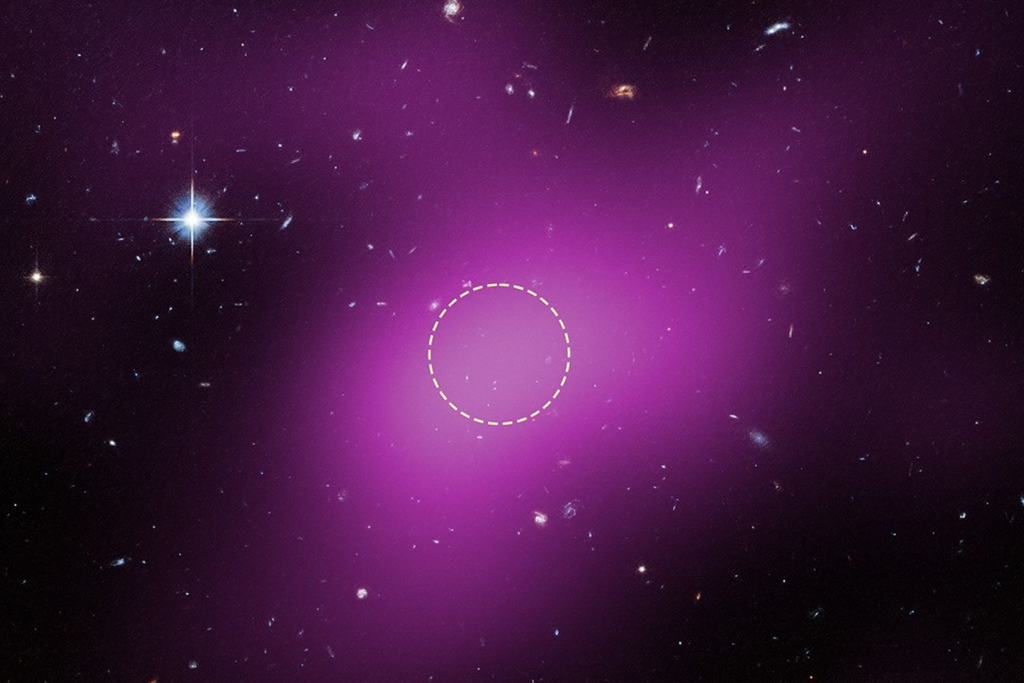
Using newly acquired Hubble data, astronomers have found an object that has never been observed before. The object appears to be a relic of a galaxy that never fully formed. It was identified through observations of nearby extragalactic regions and does not fit into any known class of astronomical objects. Its properties suggest that it may be a remnant of galaxy formation processes that took place in the early Universe.
What drew the most attention from astronomers is that the object appears to be composed exclusively of gas and dark matter, with no evidence of stars. Spectral analyses indicate the presence of hydrogen, while the dynamics of the system point to a gravitational field dominated by dark matter. The absence of detectable stellar emission suggests that the object either never initiated star formation or that this process was suppressed at a very early stage.
NASA officially released this observation together with new Hubble data and, in its press release, highlighted that this is the first time an object of this kind has been identified. The discovery provides direct evidence that structures dominated by dark matter and gas can exist in isolation. This opens a new window for studying galaxy formation and the interaction between baryonic matter and dark matter.
RELHIC
The object composed purely of dark matter and gas identified in the telescope data was classified as a reionization limited HI cloud, or RELHIC. This type of object corresponds to a primordial cloud of neutral hydrogen that never formed stars and originated in the early stages of the Universe. Its growth may have been halted during the epoch of reionisation, when radiation from the first stars heated the interstellar medium and prevented further star formation.
Cosmological models indicate that RELHICs are dark matter dominated haloes that failed to undergo star formation. Because of their origin in the early Universe, RELHICs act as cosmological relics, preserving conditions from the primordial cosmos. The object discovered by the Hubble telescope was named Cloud 9, and it suggests that many so called failed galaxies may be scattered throughout the Universe.
Cloud-9
Cloud 9 was identified as a gas rich, starless cloud dominated by dark matter. As such, it represents the first confirmed detection of a system of this type, allowing researchers to validate theoretical predictions about the existence of dark matter haloes that never formed stars. This object can help scientists study conditions in the young Universe and how baryonic matter interacted with dark matter during galaxy formation.
The core of Cloud 9 is composed of neutral hydrogen with an approximate diameter of 4,900 light years. The amount of gas was estimated at around one million solar masses and was calculated using radio emissions. From the gas mass, researchers inferred a dark matter mass of approximately five billion solar masses. Despite the dominant non luminous component, the brightness of the gas was sufficient to obtain detailed information about the object.
Objects near the Milky Way
The search for objects similar to Cloud 9 is not new, and many astronomical surveys seek starless hydrogen clouds in the vicinity of the Milky Way. Although numerous neutral hydrogen clouds have been catalogued around our galaxy, most do not display characteristics consistent with a failed galaxy. These clouds often show larger spatial extensions, irregular morphologies and signs of dynamic interaction.
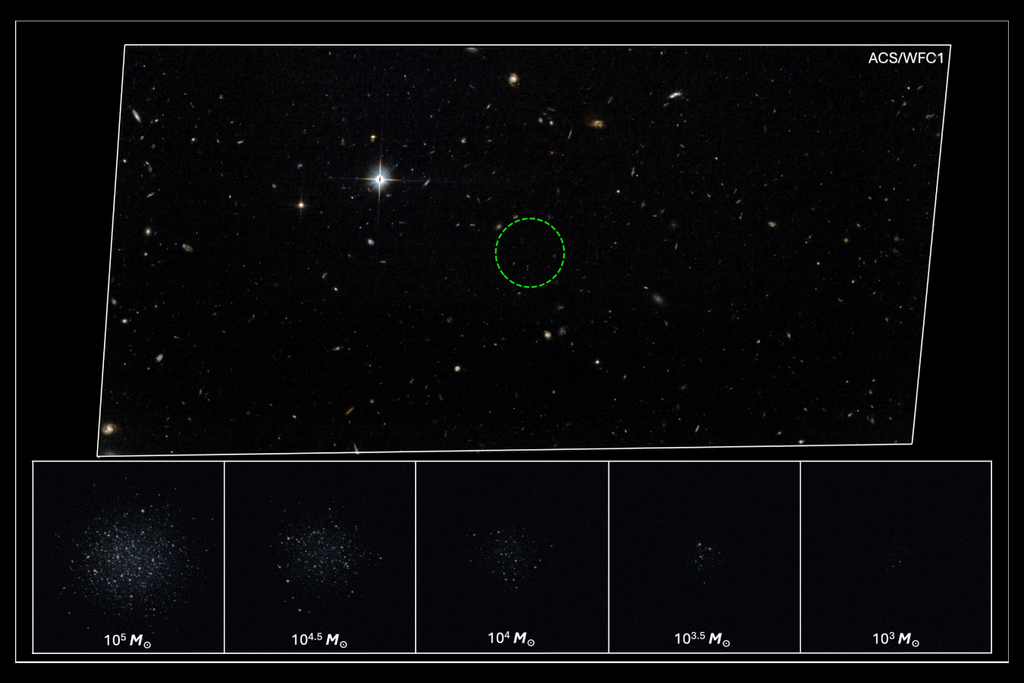
Cloud 9 received its designation sequentially, as it was the ninth gas cloud identified in the outer regions of the spiral galaxy Messier 94, also known as M94. High resolution radio observations revealed distortions in the gas, possibly resulting from interactions with M94 itself. This further supports the idea that the object is not a random structure and suggests that similar systems may exist around large galaxies, including those close to the Milky Way.
Could it become a galaxy?
If Cloud 9 formed in the early Universe and never managed to form stars, the question arises as to whether it could ever become a galaxy. From the perspective of galaxy formation, Cloud 9 is a potential candidate for star formation if its total mass were to increase. Theoretical models indicate that if the dark matter halo and its associated gas reached higher masses, the cloud would become gravitationally unstable, leading to the collapse of neutral gas and the onset of star formation.
If this were to occur, Cloud 9 would evolve into a low mass galaxy, similar to other dwarf galaxies. Conversely, if the system had a lower total mass, external processes such as environmental interactions could disperse the hydrogen, preventing any galactic formation. The fact that Cloud 9 occupies an intermediate mass range explains its survival as a RELHIC that retains its gas within the dark matter gravitational field, yet remains incapable of forming stars.