
According to Carl Sagan, Astronomer, the Entire History of Humanity Occupies Only 21 Seconds on the Cosmic Calendar
Do you feel like the center of the world? Carl Sagan showed that humanity is a simple 21-second breath in a galactic year, a fact that shakes our current reality.
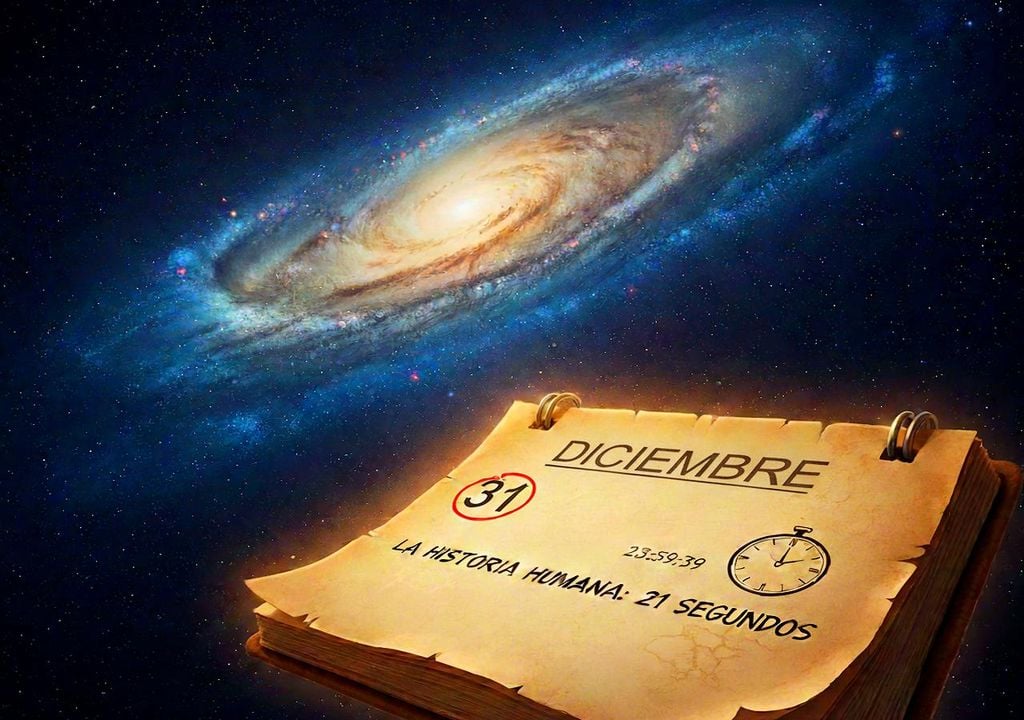
The universe has an age so vast that it is almost impossible for our minds to fully grasp. For this reason, the charismatic astronomer Carl Sagan devised a masterful tool in his works The Dragons of Eden and Cosmos: condensing the 13.7 billion years of existence of everything into a single Earth year—the Cosmic Calendar. On this scale, each month represents more than a billion years, turning eternity into something tangible.
Through this lens, humanity loses the throne it assigned itself for millennia. We are not the center of creation, but rather late arrivals who barely peek in when the party is about to end. This perspective—both poetic and scientific—aims to place us in our true position before the immensity of the stars and the void.
The Origin of Life and the Beginning of the Cosmic Calendar
Imagining that the Big Bang occurs at the first second of January on the Cosmic Calendar, space remained silent for months. The Milky Way did not fully form until May, and our own Sun waited until September to be born. It is striking to realize that Earth spent much of its existence as an uninhabited place or populated only by microscopic organisms invisible to the human eye.
Carl Sagan was the first person to explain the history of the universe in a single year, as the “Cosmic Calendar,” in his television series Cosmos.
— Ciudad Artes Ciencia (@CACiencies) February 2, 2026
Come discover it in the audiovisual exhibit #TerraExtraordinària #MuseudelesCiències pic.twitter.com/XVayBSsD0n
The appearance of the most basic forms of life is placed on September 25. During October and November, evolution progressed slowly, allowing sexual reproduction and nucleated cells to emerge. This process transformed a mineral world into a vibrant stage, preparing the ground for an explosion of diversity that would only arrive when the imaginary year was already nearing its end.
With the arrival of December, the atmosphere filled with oxygen, enabling the development of more complex creatures. By mid-month, the seas teemed with marine life and vegetation began to conquer dry land. Everything we know as wild nature is a late phenomenon on this scale, a reminder that the stability of our ecosystem is a recent gift.
The Brief History of Humanity on the Cosmic Calendar
In this framework, dinosaurs ruled for barely five days, disappearing on December 28. Mammals and primates took over just before the year ended. However, the most staggering fact is that our species does not appear until the final day, December 31, confirming that we are the last guests to arrive at the vast party of existence.
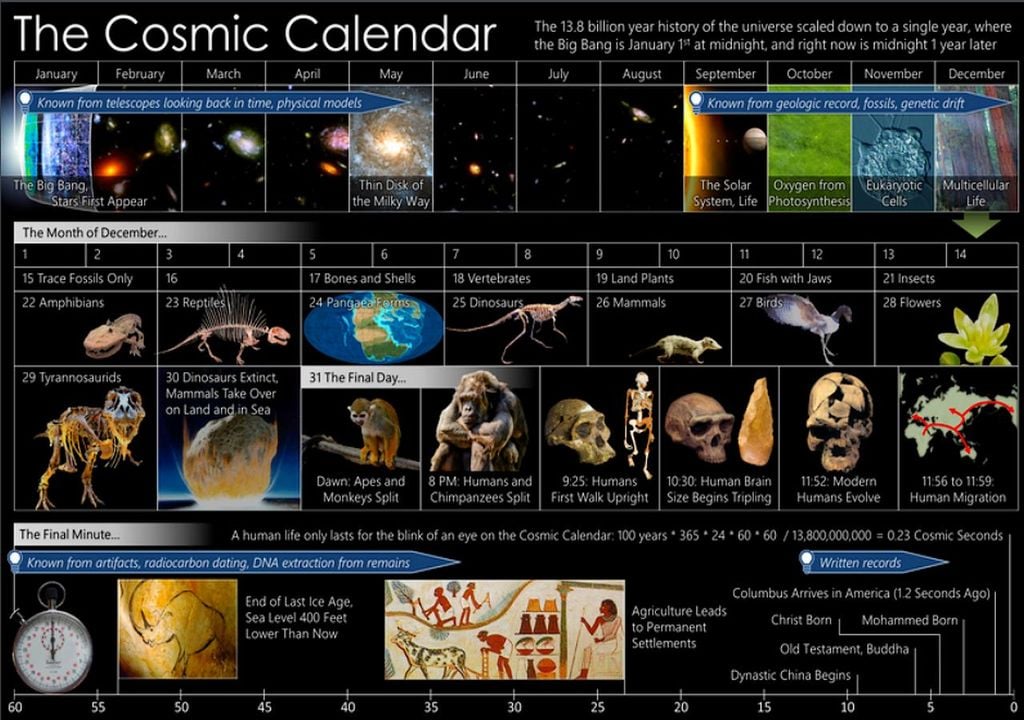
Records suggest that hominins emerged around 10:30 p.m. on the final day. According to the author, “the entire history of humanity occupies only 21 seconds” on this immense galactic clock. From mastering fire to creating the first tools, everything has unfolded within that final hour, making it clear that our presence on the planet is barely a blink.
Agriculture and the great cities of Egypt or Sumer appear only in the final minute of the year. In those last sixty seconds are concentrated every war, every poem, and every technological advance we have achieved. The birth of religions and empires are brief flashes that occur as the New Year’s grapes are about to drop, underscoring our brevity.
A Second of Science and the Future of Our Species
With the Cosmic Calendar, Carl Sagan did not seek to give us cold facts, but rather to awaken a deep curiosity for knowledge. His ability to unite science with elegant storytelling allowed millions of people to look at the sky with new eyes. This temporal exercise is a necessary lesson in humility for a civilization that often forgets how delicate the biological balance sustaining us truly is.
Placed in the present, we inhabit the first second of the new cosmic year—a stage of great expansion but also of great risk. We have the ability to explore other worlds and search for signs of extraterrestrial life, but we also carry the danger of abruptly ending our own path. We are that late arrival who must decide how to manage the next moments on this vast stage.
The universalization of knowledge places us before a mirror that reflects our smallness. Caring for the planet is a vital task, because within the immensity of time, we are a beautiful coincidence. Making the most of every moment to seek answers and better understand ourselves is the best way to honor this brief yet intense passage through the universe we inhabit.