
Will Earth survive the dying Sun? Science rewrites the final day of our planet
New models suggest that Earth may avoid being swallowed by the Sun as it expands into a red giant. Life, however, will disappear long before then, leaving the planet as a barren world orbiting a white dwarf.
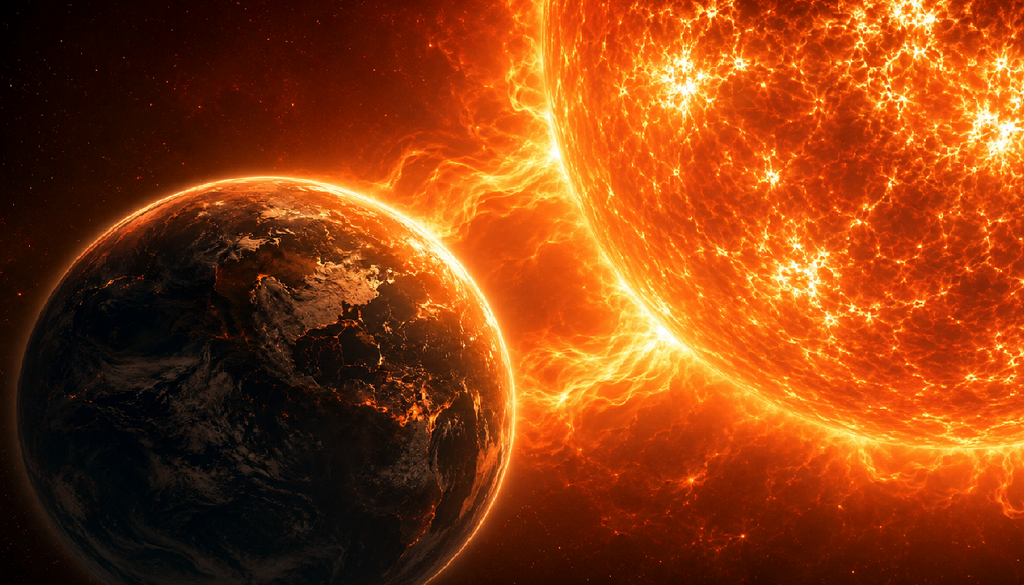
Science is clear on one thing: Earth's end will not happen in a single dramatic moment. Instead, it will unfold as part of an extraordinarily slow transformation spanning millions—or even tens of millions—of years. :contentReference[oaicite:0]{index=0}
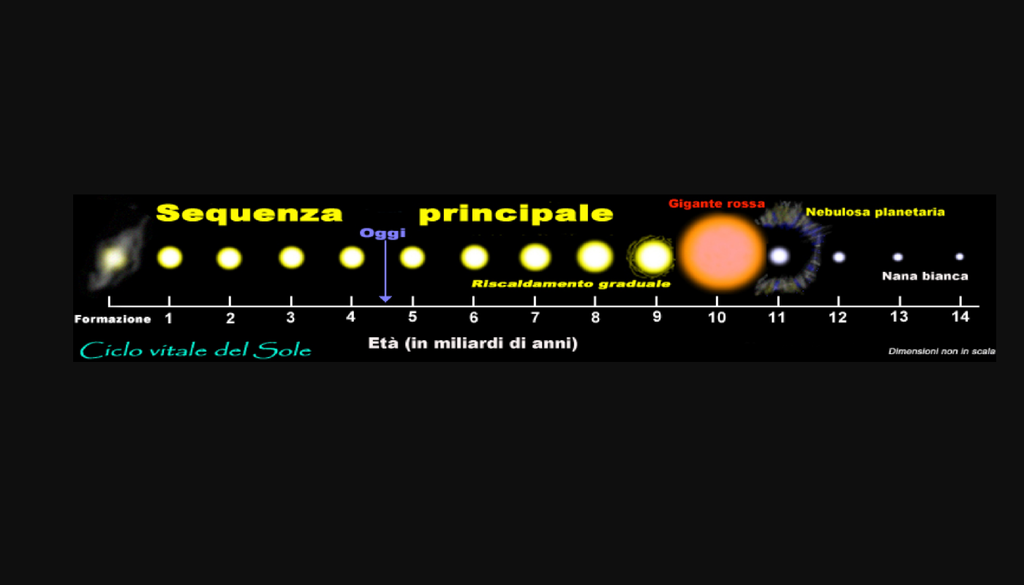
Over that time, the Sun will gradually become brighter, then expand into a massive red giant before eventually shrinking into a small white dwarf.
That does not mean it will retain its oceans, atmosphere, or life. Earth's biosphere will disappear long before the Sun reaches the end of its life.
Life will end long before the Sun becomes a red giant
Today, the Sun is in the most stable phase of its evolution. At roughly 4.5 billion years old, it is steadily fusing hydrogen into helium in its core, producing the consistent energy that has allowed life to flourish on Earth. But that balance will not last forever.
As the Sun gradually exhausts the hydrogen in its core, temperatures inside the star will rise, pushing nuclear fusion into outer layers. The result will be a steady increase in the Sun's brightness. Over hundreds of millions of years, the growing energy output will dramatically alter Earth's climate.
According to a study published in Nature, Earth's atmosphere is expected to remain oxygen-rich for about 1.08 ± 0.14 billion years. After that, increasing solar radiation will lock more and more carbon dioxide into rocks, gradually removing it from the atmosphere. While that might initially sound beneficial given today's concerns about greenhouse gases, it comes with a major consequence.
Plants will eventually be deprived of the carbon dioxide they need for photosynthesis. Biological productivity will collapse, and oxygen levels will eventually fall to less than 1% of today's concentration.
Rising temperatures will gradually evaporate the oceans, releasing enormous amounts of water vapor into the atmosphere. As that vapor reaches higher altitudes, it will intensify the greenhouse effect—since water vapor is itself a powerful greenhouse gas—and allow hydrogen to escape into space.
The oceans will not disappear overnight. Instead, they will slowly fade away over time. By the time the Sun begins transforming into a red giant, Earth will already be a barren world.
Will the red giant Sun really swallow Earth?
About five billion years from now, as the Sun's core contracts and its outer layers expand dramatically, the Sun will become a red giant, far larger and brighter than it is today. Mercury and Venus are almost certainly doomed—they will be engulfed.
Previous studies suggested that Earth's fate would depend on a competition between two opposing effects. On one hand, tidal forces would drain orbital energy, pulling Earth inward. On the other, the Sun would lose mass through powerful stellar winds, weakening its gravitational pull and causing Earth's orbit to expand.
A 2008 model concluded that the outward movement would not be enough. Tidal interactions would eventually pull Earth into the Sun's expanding outer envelope.
A new study by Mats Esseldeurs, Stéphane Mathis, and Leen Decin, published in 2026 in Astronomy & Astrophysics, uses updated tidal dissipation models and finds a greater probability that Earth could survive the Sun's red giant phase, remaining in orbit rather than being engulfed.
The researchers note that if the Sun loses mass quickly enough, Earth's orbit would expand sufficiently to ensure its likely survival—though not with absolute certainty.
A dead Earth orbiting a white dwarf
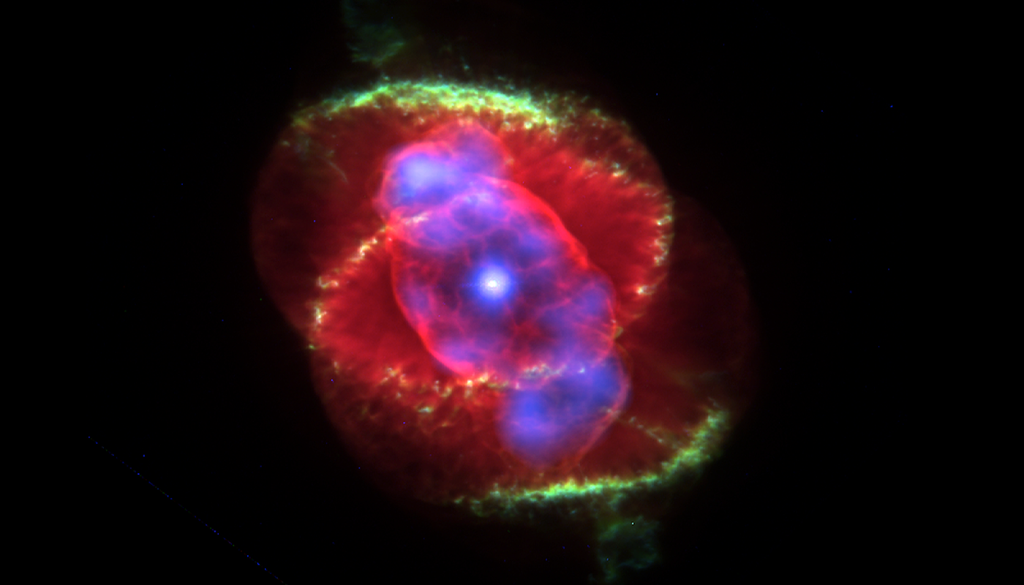
At the end of its red giant phase, the Sun will shed its outer layers to create a planetary nebula, leaving behind a white dwarf surrounded by gas and dust.
If Earth survives the Sun's red giant phase, it will continue orbiting that white dwarf—but without oceans and probably without any significant atmosphere.
Observations of other planetary systems suggest that both outcomes are possible.
Astronomers have already observed cases of stellar "cannibalism," where aging stars consume their own planets. One such event, detected in 2023, showed tidal forces and stellar expansion destroying a nearby planet.
On the other hand, in 2024 astronomers discovered a planet about 1.9 times Earth's mass orbiting a white dwarf at a distance of just over two astronomical units. By reconstructing the system's history, researchers proposed that the planet may once have orbited at roughly one astronomical unit—similar to Earth's current distance from the Sun. This suggests that the planet survived its star's red giant phase.
There is little doubt that Earth will become a sterile, uninhabitable planet within about one billion years. Even so, it may ultimately survive the Sun's death, continuing to orbit the white dwarf as a barren relic for unimaginable spans of time.
References
Esseldeurs, M., Mathis, S., & Decin, L. (2026). The fate of Earth during the Sun's giant phases: New constraints from ab initio tidal modelling and AGB mass loss.
De, K. et al. (2023). An infrared transient from a star engulfing a planet.
Zhang, K. et al. (2024). An Earth-mass planet and a brown dwarf in orbit around a white dwarf.