

The 2026 Global Risks Report indicates that the climate crisis will move from fourth to first place between 2028 and 2036. The report analyses the greatest dangers and vulnerabilities facing the world.

Ana Maria is a meteorologist with a degree from the Federal University of Pelotas (UFPel) and holds both a master’s and a PhD in Atmospheric Sciences from the Institute of Astronomy, Geophysics, and Atmospheric Sciences at the University of São Paulo (IAG-USP). She is currently engaged in postdoctoral research focused on climate change and urban adaptation strategies.
With 16 years of experience in meteorology and a profound dedication to understanding the atmosphere, Ana Maria adopts an interdisciplinary approach to her work. During her postgraduate studies, she specialized in storm dynamics in the Amazon. Later, at Embrapa, she contributed to enhancing Brazil's Agricultural Climate Risk Zoning. Since 2021, her research has centered on the impacts of climate change on urban areas, advocating for adaptive solutions and emphasizing scientific communication as a vital tool against misinformation.
Her passion for communication led her to merge her expertise in science and writing. Today, she is part of MeteoRed’s editorial team, contributing to meteored.com.br.
The 2026 Global Risks Report indicates that the climate crisis will move from fourth to first place between 2028 and 2036. The report analyses the greatest dangers and vulnerabilities facing the world.
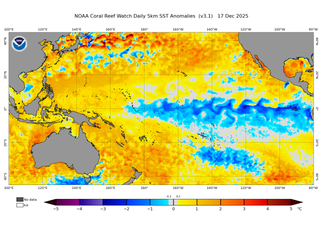
Despite recent cooling, the tropical Pacific is already showing signs of warming. This scenario reduces the chances of a La Niña event being recorded and increases the possibility of an El Niño in 2026.
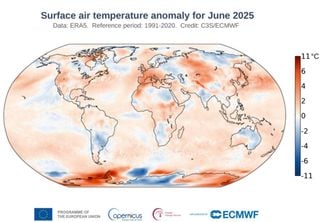
The global average temperature in June 2025 was 1.3°C above the pre-industrial average, thus below the threshold established by the Paris Agreement. However, this cooling is far from enough to curb the climate crisis.
With extreme weather events on the rise due to climate change, early warning systems are becoming increasingly essential to protect lives and minimise economic impact.
The planet has repeatedly surpassed the 1.5°C limit above the pre-industrial era, setting a record warming sequence, but do you know where this figure comes from and why scientists keep talking about it?

Discover the “Climate Dictionary”, launched by the United Nations Development Programme, a document that aims to facilitate the understanding of terms frequently used to talk about the climate crisis.
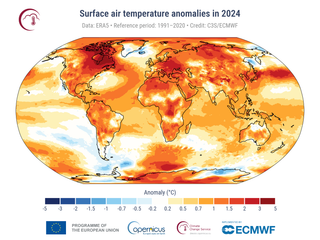
The Copernicus Observatory, the European program for climate change, has announced that 2024 has been the hottest year on record and the first to exceed the 1.5 °C barrier: here we analyze the most worrying data.