
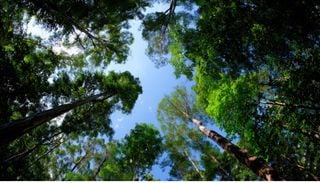
Fossils found in Wyoming reveal that, following global warming 56 million years ago, forests needed more than 100,000 years to recover. A geological warning that dispels the supposed benefits of excess carbon dioxide.

Francisca Jofré, a graduate in Geophysics from the University of Concepción, is currently finalizing her thesis project for the Master's degree in Meteorology and Climatology at the University of Chile. Her academic focus is on numerical atmospheric modeling, with particular expertise in the study of local circulation in regions with complex topography.
Throughout her academic journey, Francisca has assisted in various physics courses, with notable involvement in Agricultural Meteorology. She has presented her research at prominent meteorology and climate conferences, including the seventh edition of the Congress of Physical Oceanography, Meteorology, and Climate of the Eastern South Pacific, as well as the International Symposium on Climate Change and Resilience.
Her professional experience includes participating in meteorological campaigns such as wind measurements in Raco (2019) and urban boundary layer studies (2023 and 2024). Additionally, she has served as a teaching assistant for the Climate System course.
In 2023 and 2024, Francisca conducted outreach activities in San Antonio, focusing on extreme precipitation events and climate phenomena, engaging both local schools and the community through a local television channel.
Fossils found in Wyoming reveal that, following global warming 56 million years ago, forests needed more than 100,000 years to recover. A geological warning that dispels the supposed benefits of excess carbon dioxide.

Science continues to reveal new chapters of our evolutionary history. What emerges is a portrait of resilience, adaptability, and creativity: the qualities that allowed an African species to become a global force that would transform the entire planet.

For centuries, the Star of Bethlehem has captivated the imagination of believers and scientists alike. What celestial phenomenon could have shone that night? Astronomy offers surprising answers.
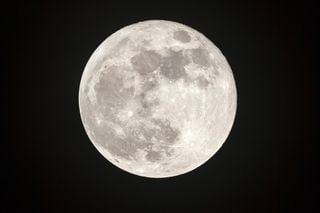
The Moon doesn't shine on its own: what we see are reflections of the Sun on its surface. In this article, we explain, in a clear and simple way, how the eight lunar phases are formed and why they repeat in a cycle.

The SWOT mission seeks to revolutionize our understanding of the oceans and surface waters by accurately measuring water depths across nearly the entire Earth. Its data will improve navigation, study ocean currents, and better understand ocean geology.
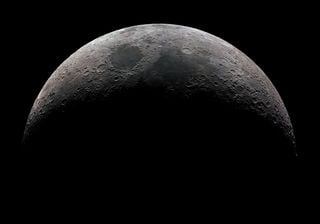
The Athena probe landed near the lunar south pole in March 2025, marking a milestone in space exploration. However, technical problems prevented its proper functioning, compromising the mission and leaving important lessons for future explorations.
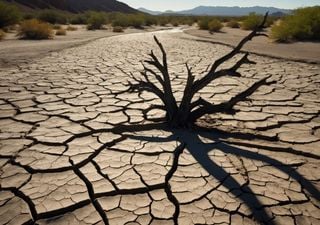
A recent global study reveals that megadroughts are not only becoming more frequent and severe, but are also drastically transforming our planet's ecosystems.