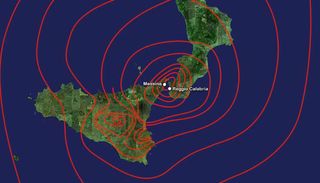
The tremor faded from collective memory because of the very limited damage in the two cities. Here is what we know today about that earthquake, the strongest to hit the area since the disastrous event of 1908.

“Meteorologist technician”, according to WMO standards, Dekra certified. In 2011, Daniele Ingemi started studying meteorology, attending a specialization course in synoptic meteorology and medium and short-term forecasts, studying conceptual models for the Euro-Mediterranean area, at the Italian Air Force. Since 2010 he has started collaborating with many local newspapers, radios and television media, as a forecaster and populariser. From 2013 to today he has held the position of meteorologist at the online newspaper Tempostretto.
Since 2015 he has held the private activity of meteorological consultant, making local forecasts for some small municipalities in Sicily and private companies, operating in the sector of energy production, transport and agricultural activities, which require detailed and accurate forecasts for the single territorial area.
Since 2016 he has been registered with the Order of Journalists of Sicily, as a journalist. Between 2016 and 2018 he collaborated, as forecaster and meteorological analyst, for a Hungarian newspaper and a Russian scientific journal, writing articles that dealt with synoptic and study of extreme weather phenomena, such as floods, wind storms, heat waves and droughts.
In April 2019 he took the Dekra certification, as a "meteorologist technician" according to WMO standards. Then he has enrolled in the AMPRO, the Professional Weather Association, where he holds the position of "meteorologist technician".
He mainly deals with dynamic meteorology, synoptic and study of extreme meteorological phenomena, and marine weather forecasts for the lower Tyrrhenian, the Strait of Sicily and the Ionian Sea.
The tremor faded from collective memory because of the very limited damage in the two cities. Here is what we know today about that earthquake, the strongest to hit the area since the disastrous event of 1908.
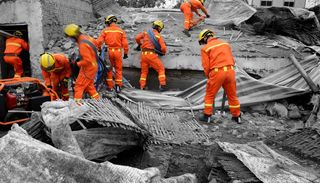
Seismologists’ analysis provides a very clear answer to the question that arose following the series of strong earthquakes that have shaken several parts of the world in recent weeks.
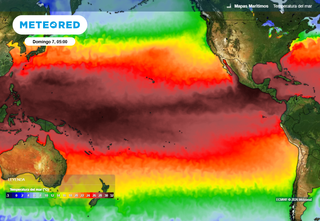
We examine the relationship between Kelvin waves, the marine heatwave in the equatorial Pacific, and the approaching arrival of El Niño. The 2026 event could become a particularly intense one.
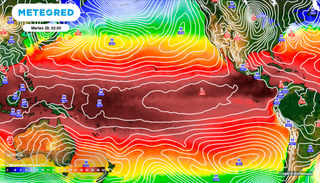
Equatorial waves are one of the most fascinating and decisive mechanisms in tropical climate dynamics. They play a fundamental role in the development phase of the El Niño phenomenon.
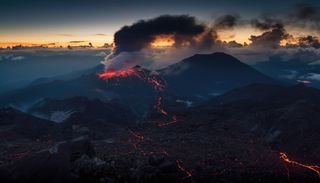
The scientific community now largely recognises this phenomenon, observed at various volcanoes around the world. But what exactly is it? Here are the explanations provided by science.
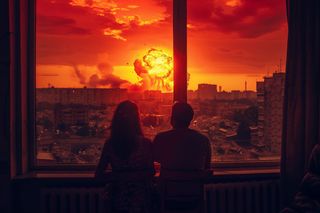
In the event of a global conflict, there are places on Earth considered among the safest and most war-proof. Let’s discover together which countries we are talking about.
According to satellite observations and climate models, the average rate of sea level rise in the Mediterranean has shown a significant acceleration. From 1993 to 2022, the global average stood at approximately 3.3 millimetres per year, but in recent years it has approached 4.5 millimetres annually, a level that is causing considerable concern.
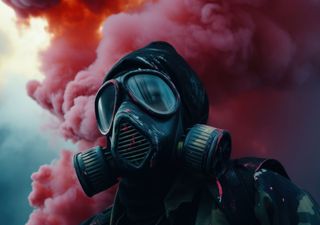
One of the most disturbing aspects of a nuclear war is not only the initial explosion, but the radioactive fallout that can contaminate distant territories, rendering them radioactive.
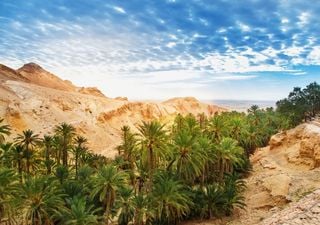
Within the largest and most inhospitable desert on our planet lie surprising ecosystems, known only to local nomadic populations, comparable to those of tropical forests.
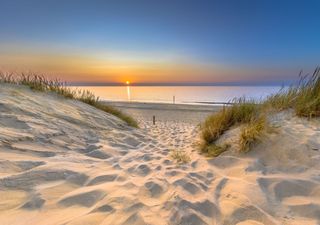
Dunes act as a physical barrier, absorbing the energy of the waves and reducing the impact of storm tides on inland areas.
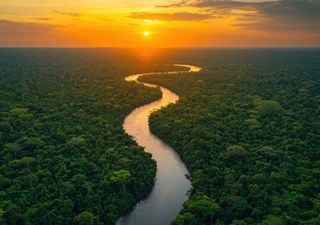
According to several scientific studies, biodiversity loss and ecosystem collapse represent one of the main environmental risks we will face in the coming years.
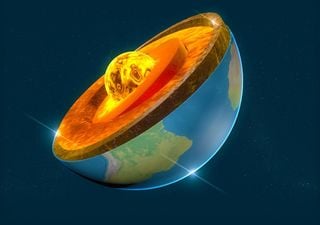
This discovery, published in the journal Nature, could revolutionize our understanding of the heart of our planet and everything related to the field of geophysics.
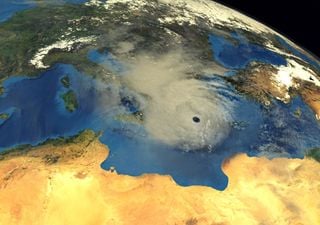
The Mediterranean is a semi-enclosed basin surrounded by significant mountain ranges (Alps, Apennines, Atlas, Pyrenees), which play a crucial role in the development of these cyclones.
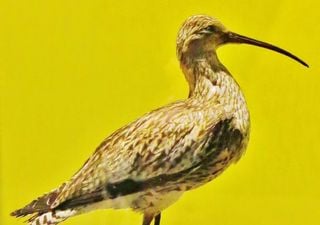
The extinction of the slender-billed curlew is not an isolated event, but a symptom of a wider crisis that threatens European biodiversity, ready to have repercussions on human activities as well.
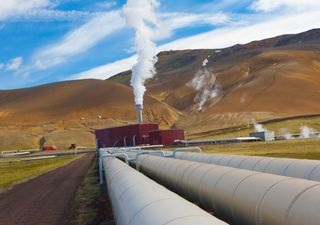
Geothermal heat integrated into Finland's heating networks will not only reduce fossil fuel consumption, but also enable the country to achieve carbon neutrality by 2030.
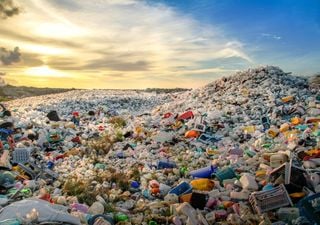
Last week, a large part of the Arctic recorded positive temperatures, above the 0°C threshold, in the middle of winter. This is a disconcerting event, which is leaving many experts speechless.
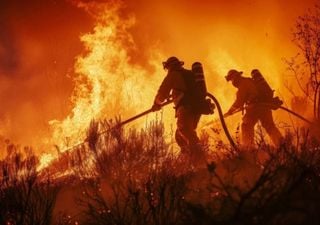
Los Angeles County is currently facing a series of devastating wildfires that are destroying entire settlements and causing fatalities, forcing local authorities to evacuate more than 100,000 people.

The problem during this long journey is the hurricanes. But these birds manage to avoid them. The thrushes finish the mating phase and the incubation of the eggs during the summer. The newborns must be ready to fly in good time to face the migration without danger.
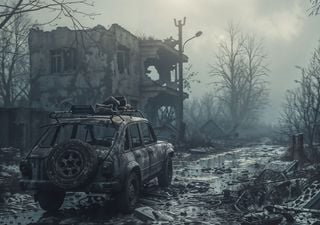
Many people wonder where one could flee in the event of a nuclear conflict, and whether there are nations or places on our Earth that could remain immune to such a dire event.

The possibility of exploiting thermal energy from existing sources makes this solution sustainable and innovative, with a significant reduction in environmental impact. In short, it will be a truly revolutionary discovery.