We've provided a complete guide with observation instructions from experts, so you can decide if what you saw in the sky and marveled at was a shooting star, space debris, a comet, or something else...

We've provided a complete guide with observation instructions from experts, so you can decide if what you saw in the sky and marveled at was a shooting star, space debris, a comet, or something else...
A free-floating planet has been observed by astronomers to be gathering dust at an unprecedented rate - what does this tell us?
New simulations reveal how rotating black holes convert their energy into cosmic particle jets, combining magnetism, relativity, and turbulence in a dance that redefines the boundaries of modern astrophysics.
Co-Venusian asteroids, still poorly studied and poorly understood, are believed to be lurking in the orbit of Venus and could pose a significant danger to our planet.

The U.S. space agency will take four astronauts outside Earth orbit on a trip around the Moon that will test the Orion spacecraft's systems and mark a new advance in lunar exploration.
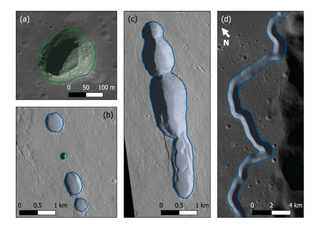
What could be within the potential cave openings that an AI model has identified through publicly available NASA images?
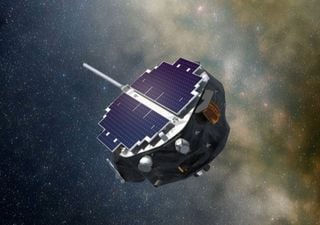
NASA’s new mission features a British-built instrument that will map the heliosphere and observe space weather; we find out more.
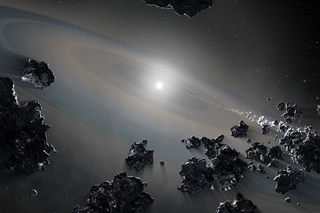
A rogue exoplanet is feeding on gas and dust at an astonishing rate and has been observed by ESO's Very Large Telescope (VLT).
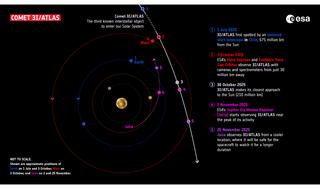
Researchers have the unique opportunity to study the rare and mysterious comet 3I/ATLAS in detail as it approaches Mars in early October 2025, with several spacecraft and telescopes studying it as this happens.
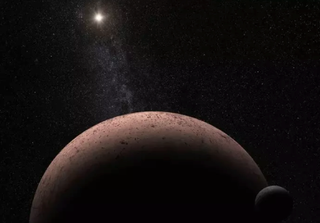
The planet with the curious name Makemake could have its own atmosphere, much thinner than that of Earth. Thanks to the James Webb Telescope, we are also discovering new important information about this family of dwarf planets.
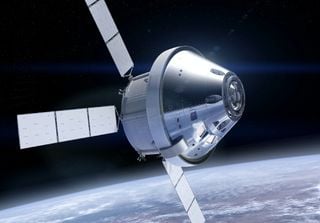
The Artemis II lunar mission will launch an Orion capsule into lunar orbit in a few months. Once its proper functioning has been verified, it will carry four astronauts to the Moon on the next mission, Artemis III, scheduled for 2027.
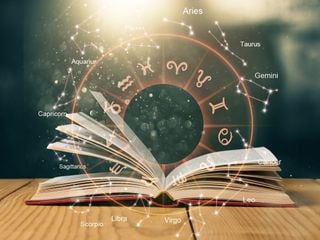
Astronomy and astrology are often confused, but one is based on science and the other on tradition. Today on Meteored, we’ll explain their essential differences and why it’s important to distinguish between them.