
Minerals analysed by Curiosity reveal that Mars preserved warm groundwater for millions of years, expanding the debate over the planet's climate, habitability and the possible existence of life beneath its surface.

Minerals analysed by Curiosity reveal that Mars preserved warm groundwater for millions of years, expanding the debate over the planet's climate, habitability and the possible existence of life beneath its surface.
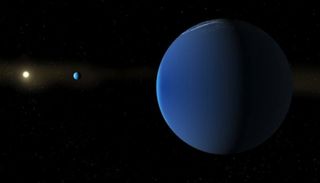
Super-puff planets lighter than candy floss have been discovered over 1,100 light years from Earth, but how did these extremely light worlds form?

Hidden inside the 4.4-billion-year-old Martian meteorite Northwest Africa (NWA) 8171, an international team of scientists discovered a gemstone, the first extraterrestrial "garnet" gem ever identified.

The mysterious dark matter and the reason particles are distributed so uniformly throughout the universe could be explained by a hypothetical particle known as the axion.
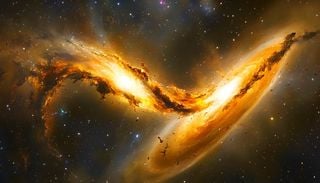
The Milky Way bears the scars of ancient collisions and is once again experiencing gravitational disturbances that point to a new encounter with another massive galaxy in its immediate neighborhood.
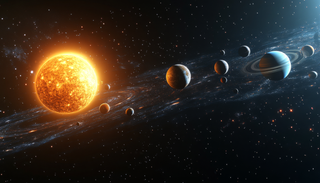
According to astronomers in the United States, the existence of a giant planet could help explain the characteristics observed in the current orbits of the planets in our solar system.
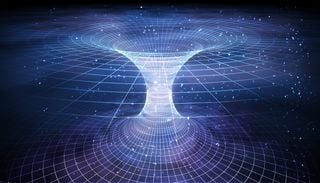
A region surrounding rotating black holes where space and time twist in such a way that we could extract almost infinite energy. Details in this report.
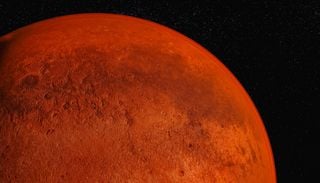
Scientists have found garnet in a Martian rock for the first time. The discovery provides new clues about the geological evolution of Mars and the processes that shaped its surface billions of years ago.
This technique combines artificial intelligence and nuclear physics to better understand the cosmic origin of elements such as gold, platinum, and uranium.

One of the most spectacular events in the Universe, Type Ia supernovae have helped us determine that the Universe is expanding at an accelerating rate and have also led to the definition of another concept: dark energy.
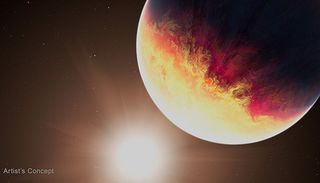
Observations from the James Webb Telescope show that HD 80606 b, a gas giant with an extreme orbit, undergoes surprising temperature spikes and chemical changes that may help us better understand other exoplanets.

NASA has responded to the controversy surrounding the absence of women on Artemis III, the mission intended to return humans to the Moon. The agency defended the experience of the selected crew and stated that the decision was based on technical criteria.