
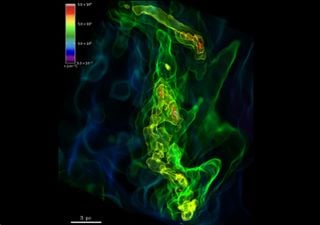
A recent scientific study has successfully revealed the origin of the first stars in the universe through simulation. It also opens up promising new avenues for understanding other crucial phenomena in the early universe.

A recent scientific study has successfully revealed the origin of the first stars in the universe through simulation. It also opens up promising new avenues for understanding other crucial phenomena in the early universe.
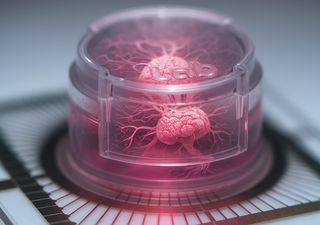
The dawn of a new era of biocomputing. We tell you all about CL1, the first computer with real, lab-grown human neurons, now on the market.
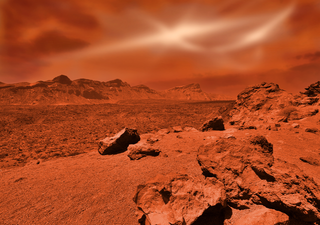
Arsia Mons, an ancient Martian volcano, was captured surrounded by ice clouds before dawn on May 2, 2025, by NASA's 2001 Mars Odyssey probe as the spacecraft studied the Red Planet's atmosphere.
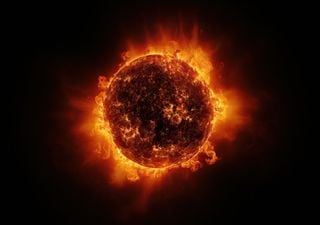
The Sun won't be like this forever. We tell you what a NASA scientist has to say about how and when our star will change and/or go dark, as well as its effects on the solar system.
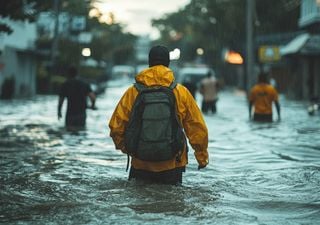
A recent study concludes that people's mental health deteriorates after the unpleasant experience of enduring repeated climate disasters
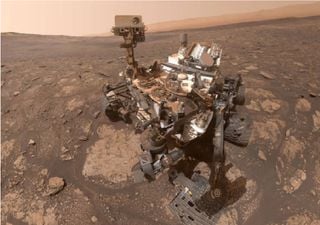
Designed for a mission of just two years, the Curiosity rover has already exceeded all expectations with more than a decade on Mars. We review the small robot's five most impressive discoveries on Martian soil.
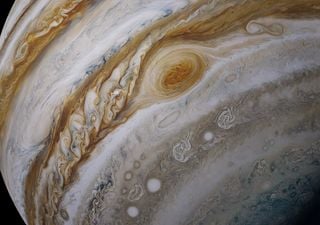
For the first time, they detected a huge wave of solar wind that crushed Jupiter's protective bubble, raising its temperature by 350 to 500°C.

Believe it or not, the history of science is full of unexpected discoveries. From penicillin to the microwave, to the pacemaker. We'll tell you about eight discoveries that have emerged from accidents or errors in the laboratory.
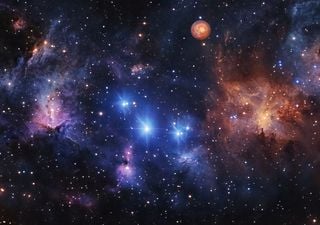
NASA's Roman mission will use Type Ia supernovae to measure cosmic distances, helping us understand and answer questions about how the universe has expanded over time.
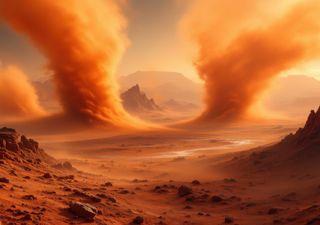
In the NASA video, featuring images taken by the Perseverance rover, one Martian dust devil can be seen swallowing another.

Machines are going to redefine the roles of society. “In a decade, artificial intelligence will make humans unnecessary for most things,” Bill Gates predicted.

A new NASA experiment involves launching three rockets to reveal how auroral substorms affect the behavior and composition of Earth's upper atmosphere.
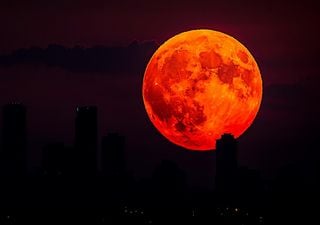
This is what happens between the light of the Sun and our atmosphere so that during a total lunar eclipse we can see from Earth what is known as a "Blood Moon."
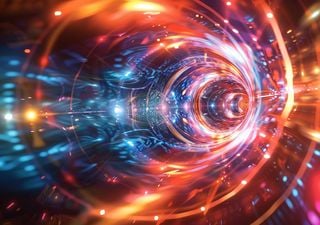
It may not be teleportation like you see in the movies, but it's real. Scientists at Northwestern University have successfully demonstrated, for the first time, quantum teleportation via fibre optic cables carrying internet traffic.

A world in the range of browns, greys and soft greens, that was the early Earth. Through evolution it became increasingly colourful, but how and why did this explosion of colours occur?
The new generation of optical clocks is going to redefine the way we measure time in the future.
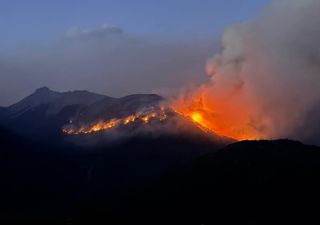
Multiple fires are spreading due to the wind in Cajón del Azul. Thousands of people are inside the mountain at risk, tourists are evacuated and tension is growing due to the proximity of the fire to a gas distributor in El Bolsón.

Pollution is one of the greatest environmental risks to human health. We explore its different forms, and for each group of pollutants how they end up affecting air, soil and water.

“A dog is man’s best friend” – this is not just a saying, it is a fact that can be proven. A new scientific discovery shows how old this friendship is – the data will surprise you.

Green awnings are a novel solution to mitigate climate change and purify the air. They can be installed in cities where it is impossible to have tree vegetation on their streets due to their particular characteristics.