
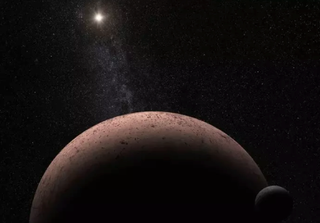
The planet with the curious name Makemake could have its own atmosphere, much thinner than that of Earth. Thanks to the James Webb Telescope, we are also discovering new important information about this family of dwarf planets.

The planet with the curious name Makemake could have its own atmosphere, much thinner than that of Earth. Thanks to the James Webb Telescope, we are also discovering new important information about this family of dwarf planets.

The Artemis II lunar mission will launch an Orion capsule into lunar orbit in a few months. Once its proper functioning has been verified, it will carry four astronauts to the Moon on the next mission, Artemis III, scheduled for 2027.
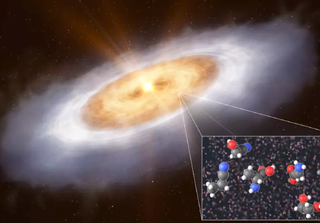
Seventeen complex organic molecules have been discovered around the star V883 Ori, two of which have never been observed before. This indicates that interplanetary space could be the place where life originated, before it migrated to planetary surfaces.
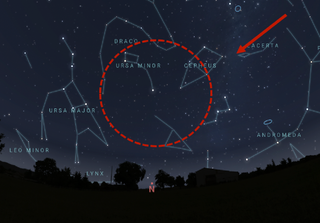
The starry sky is perhaps the first book in which, using the language of the constellations, the ancients wrote mythological tales, passing them on to subsequent generations. In this series of articles, we propose a reading of this celestial book, beginning with the constellation of Cepheus.
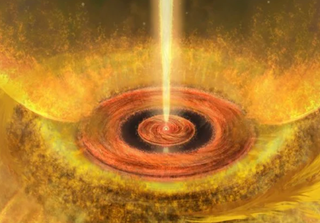
What's more sensational? The discovery itself or the technique used? Thanks to an innovative technique, a study has discovered traces of planets already present while stars were still forming.
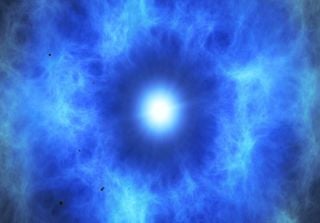
A team of astronomers made an unexpected discovery. They found the remains of a supernova that, unlike what is generally observed, occurred in a double explosion. This is the first such discovery, but likely not the only one.
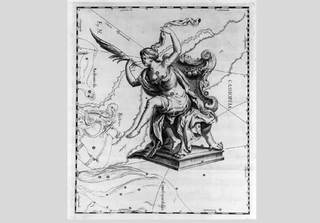
In this article, we'll talk about a constellation linked to mythology. After discussing Cepheus, King of Ethiopia, we now turn to Queen Cassiopeia, famous for her beauty but also for her vanity.
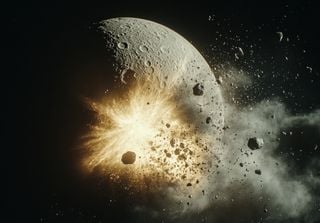
In the event of an impact with the Moon, the explosion of asteroid 2024 YR4 would hurl millions of tons of lunar rocks toward Earth, posing a serious risk to satellites but producing an unprecedented and spectacular meteor shower.
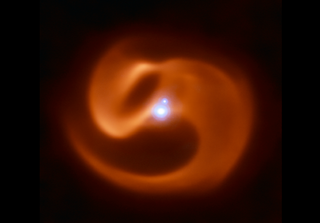
The dust nebula observed by the European Southern Observatory, with its spirals and red color, is curiously reminiscent of the giant serpent that represented the ancient Egyptian deity Apep.

The Martian canyons and valleys, so similar to those on Earth, were formed by the erosion of rivers fed by rain and snow, rather than by the melting of the polar ice caps, a recent study reveals.

The Giant Magellan Telescope will be a true giant in the telescope family. With its seven mirrors, each 8.4 m in diameter, it will be, along with the Extremely Large Telescope, the largest ever built.
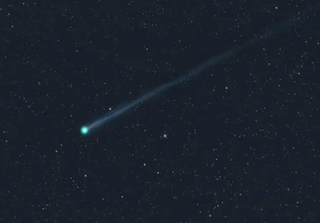
Comet SWAN25F is rapidly approaching the Sun, developing a tail that could make it bright enough to be visible to the naked eye. Already visible before dawn with binoculars, it will be more easily visible in the evening after Easter.
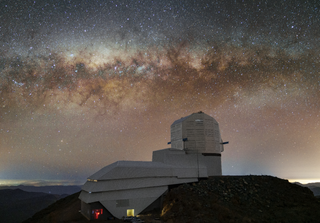
Several telescopes, which will be among the largest in the world, are currently in the design or construction phase. Among the first to come online this year is the 8.4-meter Vera Rubin telescope in northern Chile.
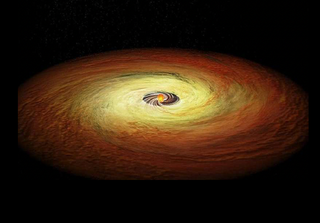
Stars much smaller than the Sun can form many more planets. In fact, their protoplanetary disks, in which planets form, last longer than those of Sun-like stars, increasing the likelihood of planet formation.
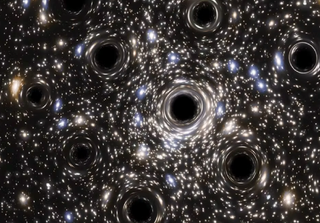
The idea of black holes passing through the human body seems strange. However, a recent study has formally calculated the minimum mass a black hole would need to have to cause serious injury or death.
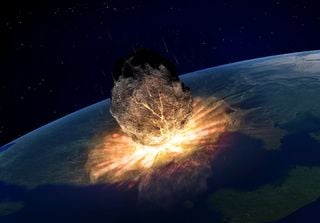
The Earth is at serious risk of being hit by an asteroid. The impact, if confirmed, will occur in 2032 and could destroy an entire city, putting the lives of tens of millions of people at risk. It is a race against time to calculate the orbit.
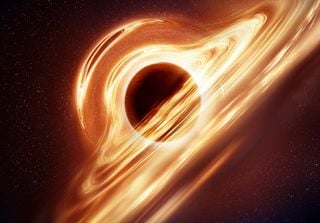
Among the mysteries of the early Universe that have not yet been solved is the recent one of the “red dots” discovered in 2022 by the James Webb telescope and whose nature is still being investigated.
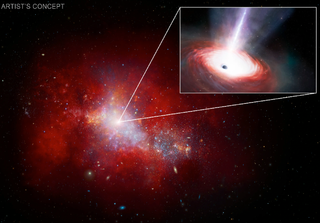
There are many known voracious black holes, but LID-568, recently observed by the James Webb telescope, seems to surpass them all. The rate at which it devours matter is a good 40 times greater than theoretically predicted limits.
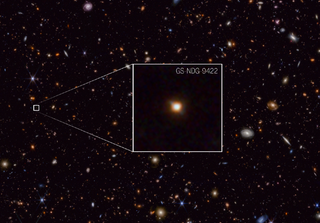
Theorists rejoice! A primordial galaxy whose gas shines brighter than its stars has been observed for the first time, in agreement with previous theoretical predictions. This is an important step in understanding the young Universe.
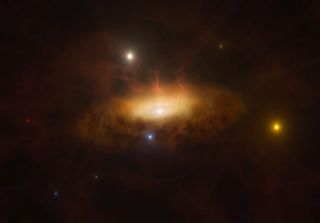
A faint dot in the sky (as the galaxy SDSS1335+0728 appears) is growing brighter and brighter. The black hole that was sleeping inside it has been awakened and is very hungry.