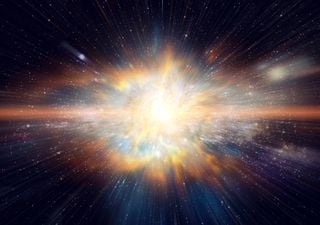
NASA's Roman mission will use Type Ia supernovae to measure cosmic distances, helping us understand and answer questions about how the universe has expanded over time.
A study suggests that the moon Titan could harbor glycine-fermenting microbial life in its subsurface ocean, albeit in extremely small quantities.
The Moon, our natural satellite, is one of the best-known celestial bodies in the solar system. Yet, since the dawn of time, we have only seen one side of it. How can this be explained?
Comet SWAN25F is rapidly approaching the Sun, developing a tail that could make it bright enough to be visible to the naked eye. Already visible before dawn with binoculars, it will be more easily visible in the evening after Easter.
Using advanced statistical tools, researchers explore how even a "failure" in the search for life could offer key answers about our position in the cosmos.
In the NASA video, featuring images taken by the Perseverance rover, one Martian dust devil can be seen swallowing another.
A recent discovery by the Curiosity rover has excited the scientific community, as it has identified the largest organic molecules ever detected on the red planet.
Several telescopes, which will be among the largest in the world, are currently in the design or construction phase. Among the first to come online this year is the 8.4-meter Vera Rubin telescope in northern Chile.
Thanks to the Chinese space mission Chang’e-6, which brought back to Earth samples of lunar soil and rocks, we were able to discover precisely when the largest crater on the Moon was formed.
Scientists are excited after finding samples of rock that suggest life may once have existed on Mars. They plan to bring them back to earth for further study.
More than 100 new moons have been discovered orbiting Saturn, bringing the total number of natural satellites around the gas giant to more than 200!
From above, the European Space Agency probe offers us a stunning view of Mars, revealing a world divided into two radically different halves.