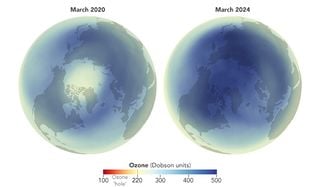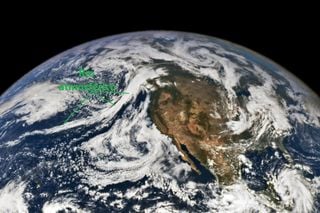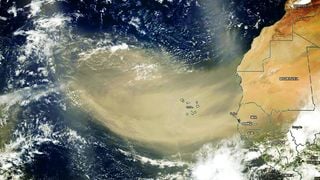
Air from the stratosphere often sinks into the troposphere due to meandering jet streams and can generate a high concentration of hydroxyl radicals with important consequences.
The slowdown of ocean currents, such as the AMOC, can generate great impacts on the redistribution of heat on Earth, which is excess in the tropics and missing at the poles, but it can also alter the CO₂ sinks in the oceans.
El Niño is a weather pattern characterised by warming of the tropical eastern Pacific Ocean caused by weakening equatorial trade winds blowing from the western coast of South America to the Philippines and Indonesia. This pattern affects winters in certain areas of the Earth
The Deep Space Network's Goldstone planetary radar had a busy few days observing asteroids 2024 MK and 2011 UL21 as they passed safely by Earth in June 2024.
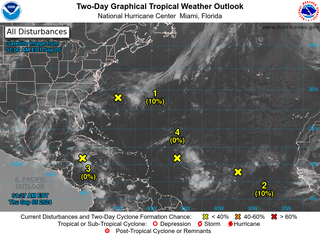
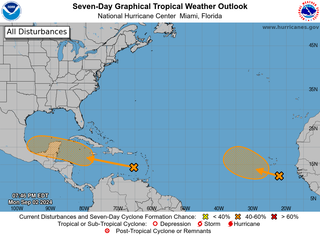
Hurricane Beryl breaks other records in the Atlantic: it became the earliest Category 5 hurricane on record on 2 July, 2024, after destructively touching and sweeping through some of the Windward Islands, and is the most intense hurricane in terms of to sustained winds for the month of July.
In certain environments, the rate at which temperature builds up over years will increase, which will likely influence the way some organisms grow and develop.
Climate scientists have discovered through modelling that geoengineering projects, such as marine cloud glow, can have unexpected and sometimes harmful consequences.
Methane is a short-lived but very powerful greenhouse gas, it is currently responsible for approximately one third of global warming due to all greenhouse gases. Its measurement and estimation in the atmosphere are fundamental.
The second annual Global Climate Change Indicators report, led by the University of Leeds, reveals that human-induced warming has increased to 1.19°C over the past decade (2014-2023), an increase from previous 1.14°C observed in 2013-2022 (established in last year's report)
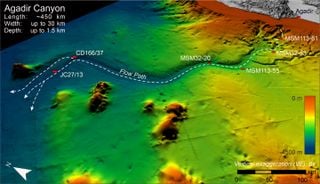
New study finds that the shape and depth of the ocean floor explain up to 50% of the changes in the depth at which carbon has been sequestered in the ocean over the past 80 million years.
A recent study reinforces the idea that anthropogenic climate change generates more intense tropical cyclones (tropical storms, hurricanes, typhoons, etc.) that support stronger maximum sustained winds.
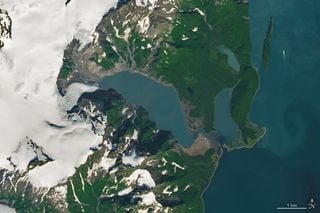
In one area of East Antarctica, the ice has remained stable and even grown slightly for almost a century, although scientists are seeing early signs of weakening.
The massive episode of coral bleaching reported by US authorities last month is expanding and deepening in reefs around the world, NOAA scientists warned
In the heart of sunny Morocco, scientists are cultivating a future where resilient crops defy an unrelenting drought, now in its sixth year.
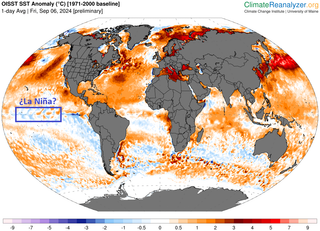
According to the Climate Prediction Center, a transition from El Niño to ENSO-neutral is expected to be possible by April-June 2024 (85% probability), with a probability of La Niña developing by June-August 2024 (60% probability).
Meteorologists estimate that there is an 85% chance that El Niño will end and the tropical Pacific will move to neutral conditions for the period April-June 2024. La Niña would then appear between June and August.
Scientists have determined that China is increasing total emissions of a powerful greenhouse gas, especially during 2011, with a warming potential that is extraordinary.
Scientists have shown that increasing greenhouse gases and anthropogenic aerosols in different parts of the world are contributing factors to the slowdown of the AMOC.
In the frozen layers of glaciers there is evidence of changes in temperature and atmospheric composition of the Earth. But as the climate warms, some of the longest records of our changing planet are melting.
ESA's Mars Express probe has captured an intriguing view near the north pole of Mars, where vast sand dunes meet the numerous layers of dusty ice that cover the planet's pole.