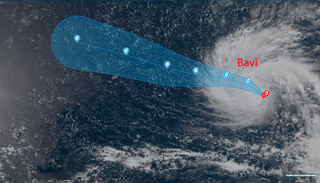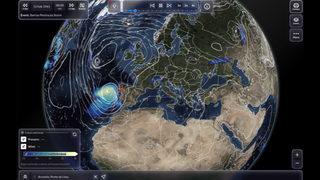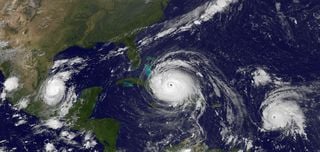
A tropical depression named Alvin could form over warm waters off the west coast of Mexico, according to the National Hurricane Center.
Amber deposits found in ancient deep-sea sediments could represent one of the oldest records of a tsunami to date, according to research published in Scientific Reports.
Biological particles, such as pollen, bacteria, spores, and plant matter floating in the air, are particularly effective at promoting the formation of ice in clouds, which in turn induces more intense precipitation and must be taken into account in numerical prediction models.
A plume of incandescent rock, which erupted from the Earth's mantle millions of years ago, helped forge a land bridge that connected Asia and Africa for the first time, allowing land-dwelling animals, like the ancestors of elephants and others, to cross between the two continents.
Scientists know that cattle are a source of greenhouse gases through their belching and flatulence, particularly methane emissions. Various studies have attempted to reduce this significant source of methane.
Storms are rare in the cold, dry Arctic, but a surprising event in August 2019 has led scientists to reconsider how these phenomena form in the polar regions.
Scientists are still analysing whether the Hunga Tonga volcano's explosion warmed or cooled the Earth's atmosphere after injecting large amounts of water vapor, a powerful greenhouse gas, into the stratosphere.
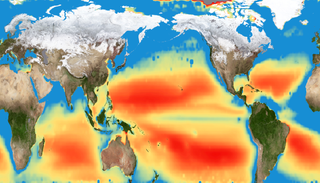
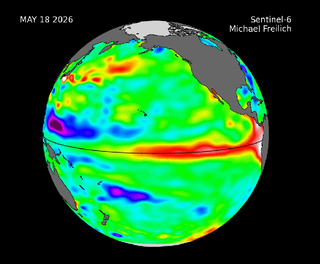
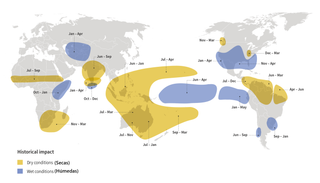
According to experts, ENSO-neutral conditions are favoured during the Northern Hemisphere summer, with a greater than 50% probability of continuation through the period from August to October 2025.
Many night sky watchers in Alaska observed strange, luminous structures resembling a giant ring above their heads. What was that?
Scientists have made a startling discovery of what they call a "shape-restoring liquid," challenging some long-held expectations derived from the laws of thermodynamics.
Researchers have attempted to show, for the first time and using a physical model, that the first-order features of the structure of the Earth's lower mantle were established four billion years ago.
The Yellowstone Caldera is a volcanic caldera and supervolcano in Yellowstone National Park, United States. It is one of the largest on planet Earth and has now undergone significant changes.
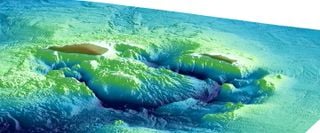
There are better maps of the lunar surface than of the Earth's ocean floor, but this is changing thanks to high-resolution data obtained from space by satellites.
A new study quantifies the effects of climate warming and intensified heatwave events on surface oxygen levels in lakes around the world.
The mantle transition zone, located more than 400 kilometres below the Earth's surface, can store water equivalent to several oceans and could be linked to continental volcanism.
The National Hurricane Center (NHC) has announced several changes to its services and products for the 2025 hurricane season, which begins 1 June..
Scientists were surprised by the larger-than-expected sea level rise observed in 2024. These rising sea level trends will continue in the coming years.
A group of scientists has studied human-generated waste in the deepest part of the Mediterranean and has found objects of all kinds: plastics, glass, metals, etc., in great numbers.
Researchers have shown that pollutants from tobacco smoke and waste can promote the growth and spread of resistant bacteria in the environment.
Researchers in Switzerland want to find out whether there are areas in the country where the powerful greenhouse gas CO₂ can be stored permanently underground and to analyse its environmental impacts.