
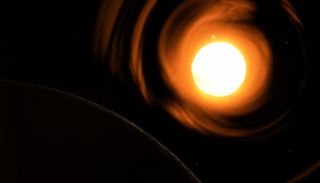
Thanks to the Voyager missions, we now understand how the solar wind slows down, changes, and ultimately gives way to the interstellar medium, marking the boundary of the Sun’s domain.

Thanks to the Voyager missions, we now understand how the solar wind slows down, changes, and ultimately gives way to the interstellar medium, marking the boundary of the Sun’s domain.
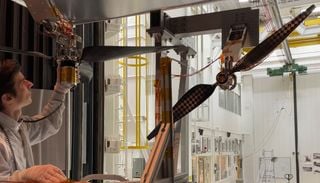
NASA successfully tested rotors capable of exceeding Mach 1 under simulated Martian conditions, a major breakthrough toward developing larger aircraft that could expand aerial exploration on Mars.
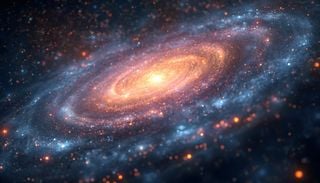
NASA’s SPHEREx space observatory has created a detailed map of interstellar ice in the Milky Way, revealing the mysterious chemical origins of water as we know it.

Anna Fisher’s story shows how motherhood and space exploration can coexist, breaking stereotypes and paving the way for generations of women who dream of going farther with freedom.
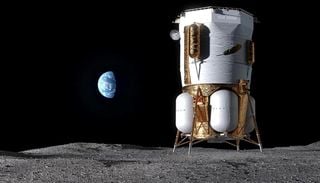
Missions to transport heavy cargo and take astronauts to the Moon are being led by billionaire Jeff Bezos, the fourth richest person in the world.
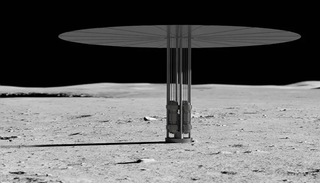
Discover how NASA plans to power the lunar South Pole through nuclear reactors, vertical solar panels, and smart electrical networks, laying the technological foundation for the future colonization of the Red Planet.
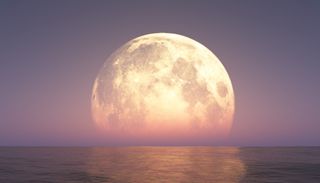
We have all noticed how the Moon looks enormous when it rises over the horizon. However, this phenomenon is a fascinating illusion created by our own mind.
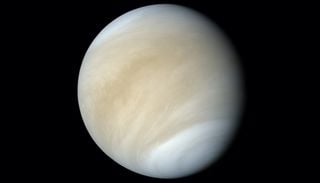
Although Venus’s surface is a toxic hellscape, its mysterious temperate clouds could hide extraterrestrial microorganisms originating from a distant past with a common origin shared with Earth.
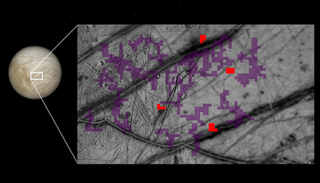
Beneath an immense shell of ice, Europa hides a global ocean. An incredible space mission is speeding through the solar system seeking to answer our greatest question: could it harbor extraterrestrial life?
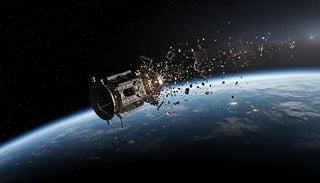
The recent Starlink satellite incident reveals new challenges in space, and its repeated fragmentations demand urgent responses to protect future missions and ensure global technological safety.
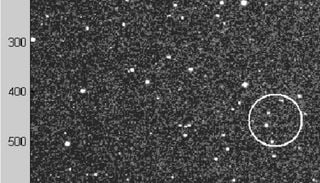
Astronomical photographs from the 1950s revealed unexplained flashes before the space age. Were they unknown objects in orbit or simply artifacts? Here we analyze the supposed mystery surrounding these objects.
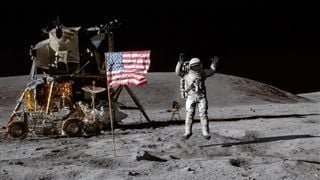
NASA is preparing its return to the Moon with a strategic shift, more infrastructure and reusable technology, as well as the goal of learning how to live beyond the planet.
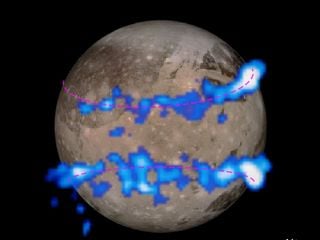
Ganymede stands out in our solar system as the largest moon, even surpassing planets like Mercury, and for harboring a saltwater ocean beneath its icy crust.
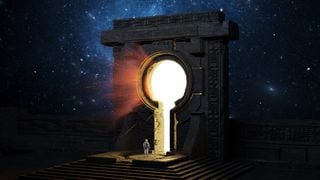
A recent study suggests that searching for unusually cold stars could reveal alien megastructures. The key lies in detecting the residual heat these civilizations would emit when harnessing vast amounts of stellar energy.
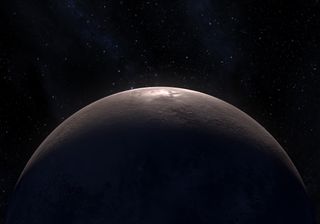
A team of astrophysicists has detected a strange distortion in the plane of the Kuiper Belt, suggesting that an invisible planet may be lurking in the cold depths of our solar system.
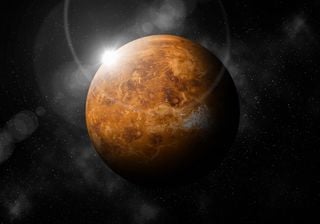
Venus, our closest neighbor, is a stark reminder of the dangers of global warming. Its extreme climate shows us how a habitable world can transform into an inferno.
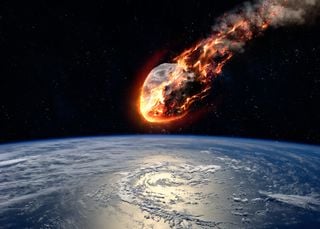
Although the DART mission to deflect an asteroid was a success, experts warn that the lack of early detection poses critical challenges for planetary defense.

The speed of light changed our way of understanding the universe: from the ether to Einstein, from just around the corner to light-years away.
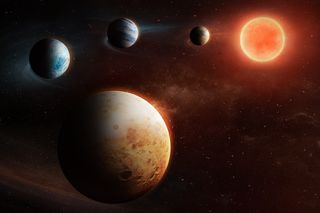
Scientists have discovered a system with four planets that defy traditional rules of stellar formation. The finding reveals rocky worlds born without gas, transforming our understanding of planetary formation.
Have you ever tuned into an empty channel on your old television and seen static? That eerie noise contains ancient photons that reveal the violent birth of our Universe.